
Corbus Pharmaceuticals Advances CRB-701 and CRB-913 in Clinical Trials Amid Pipeline Reassessment
Latest quarterly update confirms ongoing trials for oncology and obesity candidates with a deprioritized monoclonal antibody program.
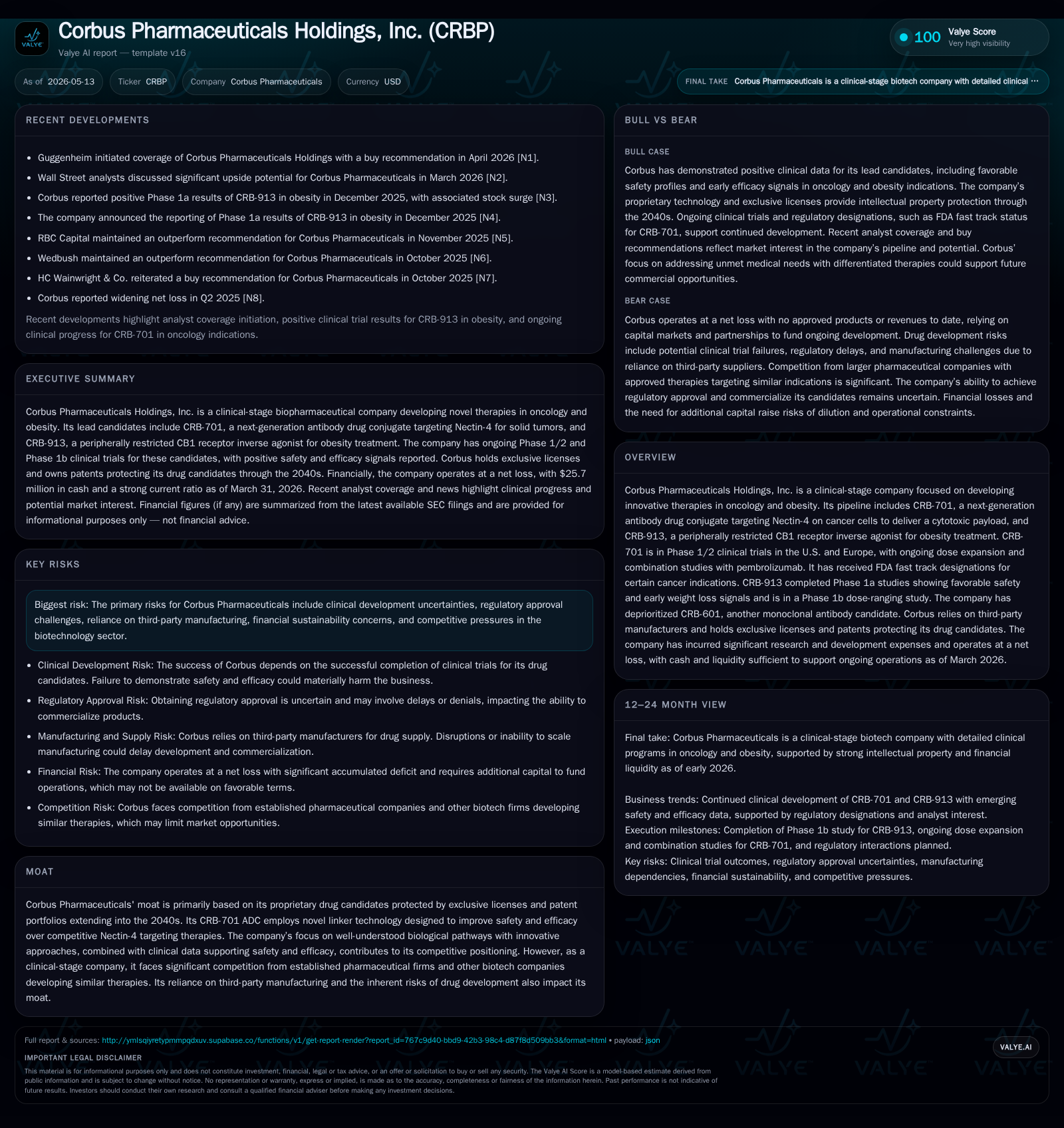
In its 2026 first-quarter disclosure, Corbus Pharmaceuticals maintains momentum in clinical development of its lead drug candidates CRB-701, an antibody drug conjugate targeting Nectin-4 in cancer, and CRB-913, a CB1 receptor inverse agonist for obesity. The company has halted further work on CRB-601, a monoclonal antibody program, signaling strategic prioritization. Corbus’ business model centers on late-stage clinical innovation complemented by partnerships and licensing arrangements, amidst a biotech landscape featuring intense competition and regulatory uncertainty. Cash resources remain sufficient to advance near-term trials, though commercialization and market success hinge on forthcoming regulatory outcomes and reimbursement dynamics.
Recent Operating Update
Corbus Pharmaceuticals Holdings’ latest quarterly report filed May 12, 2026 ([S2]) confirms continued advancement of its clinical pipeline centered on oncology asset CRB-701 and obesity candidate CRB-913. The firm disclosed progress in the Phase 1/2 Western study dose expansion for CRB-701 targeting Nectin-4 on cancer cells; notably the PD-(L)1 combination arm initiated dosing in June 2025 continues. Concurrently, Corbus is conducting a Phase 1b dose-ranging study of CRB-913 with a target completion in summer 2026 ([S4]). These updates affirm Corbus’ strategic focus on pushing forward two promising experimental treatments.
An important portfolio change is the deprioritization of CRB-601, an anti-alpha v beta 8 integrin monoclonal antibody previously assessed in early-dose escalation phases and combination immunotherapy settings. Following internal evaluation and external conference presentations in late 2025, Corbus has decided to halt enrolling patients on this program ([S4]), signaling a tactical reallocation of resources towards assets with clearer clinical trajectories.
The company’s latest event filings ([S3]) also provide qualitative insights into operational outlook and financial results supporting ongoing development activities.
Business Model
Corbus functions as a clinical-stage pharmaceutical company primarily engaged in developing next-generation therapeutics within oncology (CRB-701) and obesity (CRB-913). Its revenue generation prospects remain contingent on achieving successful regulatory approvals followed by commercialization or partnering/licensing arrangements post-launch. The firm depends heavily on out-licensing agreements such as its February 2023 license with CSPC Megalith Biopharmaceutical Co. Ltd., which grants development and commercialization rights in major western markets for CRB-701 ([S1]).
Manufacturing is outsourced entirely to third-party cGMP-compliant contract manufacturers both for active pharmaceutical ingredients (APIs) and finished drug products ([S16],[S19]). This approach controls capital expenditure but introduces risk exposure related to reliance on external suppliers’ regulatory certifications and supply chain stability. R&D costs consist mainly of payroll plus payments to contract research organizations facilitating preclinical assays and human clinical trials.
Investors should note that Corbus has not generated meaningful product revenue historically; top-line reported revenue was approximately $4.8 million as of end-2018 from non-core sources ([F1]). As expected for a clinical-stage biopharma entity, operating losses remain substantial reflecting heavy upfront investment ahead of monetization potentials.
Industry Structure and Competitive Position
Corbus sits within the highly competitive biotechnology sector marked by rapid technological innovation cycles but also extreme risks from clinical failures or regulatory rejections. Its lead oncology asset competes against established antibody drug conjugates that target Nectin-4 such as Pfizer’s PADCEV® (enfortumab vedotin). While PADCEV enjoys commercial approval for metastatic urothelial cancer with MMJE payloads similar to CRB-701’s, it is burdened by notable toxicity including skin reactions and neuropathies affecting tolerability ([S1]).
Corbus aims to differentiate via proprietary site-specific conjugation chemistry yielding a consistent drug-to-antibody ratio (DAR) of 2 and stable linker technologies intended to enhance safety profiles ([S1]). Despite this mechanistic upgrade, it remains an uphill battle given competitors like Bicycle Therapeutics plc and Mabwell also developing Nectin-4 ADCs alongside large players Johnson & Johnson and Genmab venturing alternative mechanisms for the same indications ([S19]).
For obesity treatment with CRB-913, Corbus contends against therapeutics targeting the cannabinoid type-1 receptor — an area including companies Novo Nordisk A/S and Skye Bioscience pursuing CB1-related drugs. Additionally, oral weight-loss therapies from AstraZeneca PLC, Lilly, and others exert pressure. Corbus emphasizes peripheral restriction of CB1 inverse agonism to sidestep central nervous system side effects that plagued earlier compounds ([S11]).
Overall, success hinges on the quality of clinical data demonstrating superior efficacy-safety balance alongside adept management of regulatory navigation.
Growth Drivers
Clinical Development Momentum
The current enlargement phase of CRB-701’s trial helps generate pivotal safety-efficacy data vital for advancing toward registrational studies. Initiating pembrolizumab combination arms positions the asset strategically within immuno-oncology paradigms that have reshaped cancer care.
For CRB-913, positive signals from completed Phase 1a trials coupled with ongoing Phase 1b dosing intensify prospects for early proof-of-concept confirmation in weight loss over placebo control groups.
Regulatory Milestones
Obtaining FDA Fast Track designations for relapsed/refractory metastatic cervical cancer (Dec 2024) and head & neck squamous cell carcinoma (Sept 2025) offers accelerated review pathways reducing time-to-market risk ([N2],[S14]). Harmonizing trial designs aligns with FDA expectations improving likelihood of approval success.
Partnerships & Licensing Model
Exclusive rights licensed from CSPC Megalith underpin geographical reach without direct commercialization burdens in Asia-Pacific regions where CSPC sponsors parallel trials such as Phase 3 cervical cancer studies ([S1]).
Intellectual Property Protection
Patent portfolios protecting core technologies around ADC linker chemistry through the mid-late 2040s create barriers against generic or copycat entrants if approved ([S4]).
Risks / Watchpoints / Growth Constraints
Developmental Uncertainty
As an inherently speculative endeavor, all product candidates face potential failure at any development stage due to inefficacy or unacceptable toxicities noted frequently in ADC programs or novel metabolic agents ([S7],[S9]).
Manufacturing Dependencies
Full reliance on contract manufacturers exposes Corbus to cGMP compliance risks including FDA inspection outcomes or supply interruptions impacting trial continuity or eventual commercial launch ([S16],[S21]).
Financial Sustainability & Dilution Risk
Reported cash reserves of about $25.7 million as of March-end 2026 without outstanding debt provide some runway ([F1]) but significant future fundraising will be necessary given historically rapid R&D spend (~$70 million annually) to sustain late-stage studies ([S4],[F1]). Equity dilution remains a material concern.
Competitive Dynamics & Market Access Challenges
Encroachments by established pharma brands with broad portfolios elevates competition pressure on pricing. Moreover reimbursement uncertainty prevails given complex U.S. Medicare/Medicaid coverage processes critical to commercial success ([S18]).
Regulatory Hurdles & IP Enforcement Risk
Negotiations over trial acceptability outside U.S., ongoing patent litigation risks or unforeseen regulatory changes may delay approvals or increase compliance costs significantly ([S23],[S24],[S12]).
What to Watch Next
Upcoming milestones include: completion announcement of CRB-913 Phase 1b dosing protocols expected summer 2026; interim readouts from ongoing CRB-701 expansion cohorts especially PD-(L)1 combinations; progress reports from CSPC-led China Phase 3 cervical cancer trial; FDA communications concerning registration pathway alignment in multiple oncology indications referenced in early-May dialog updates [N2]. Monitoring capital raises will clarify financial flexibility needed to extend pipelines beyond current clinical stages.
Financial Snapshot (Latest Quarter Ending March 31, 2026)
Latest financial snapshot
| Metric | Value | Period |
|---|---|---|
| Cash & equivalents | $26mm | |
| 2026-03-31 | ||
| Current assets | $144mm | |
| 2026-03-31 | ||
| Current liabilities | $18mm | |
| 2026-03-31 | ||
| Current ratio | 7.92x | |
| 2026-03-31 |
Source: SEC companyfacts cache [F1].
| Metric | Value | Period |
|---|---|---|
| Cash & Equivalents | $25.7M | Q1 2026 |
| Current Assets | $143.6M | Q1 2026 |
| Current Liabilities | $18.14M | Q1 2026 |
| Current Ratio | 7.92 | Q1 2026 |
| Total Debt | $0 | End CY2024 |
| Net Debt | -$25.7M | End CY2024 |
| Corbus is currently debt free with high liquidity ratios supporting near-term operational funding despite net losses reflecting R&D investment scale ([F1],[S2]). |
Disclaimer: This analysis is based solely on disclosed SEC filings and news releases as cited. It does not constitute investment advice nor an endorsement of any securities referenced herein.
Disclaimer: This is research-only, informational analysis and not investment advice. It may include AI-generated interpretation and general industry context. Always verify important details using primary sources.

Comments