
Hashdex Nasdaq CME Crypto Index ETF Updates Fee Structure and Index Reference in Latest Quarter
The latest quarterly filing reveals key operational changes including a January 2026 index transition and a temporary fee reduction through year-end.
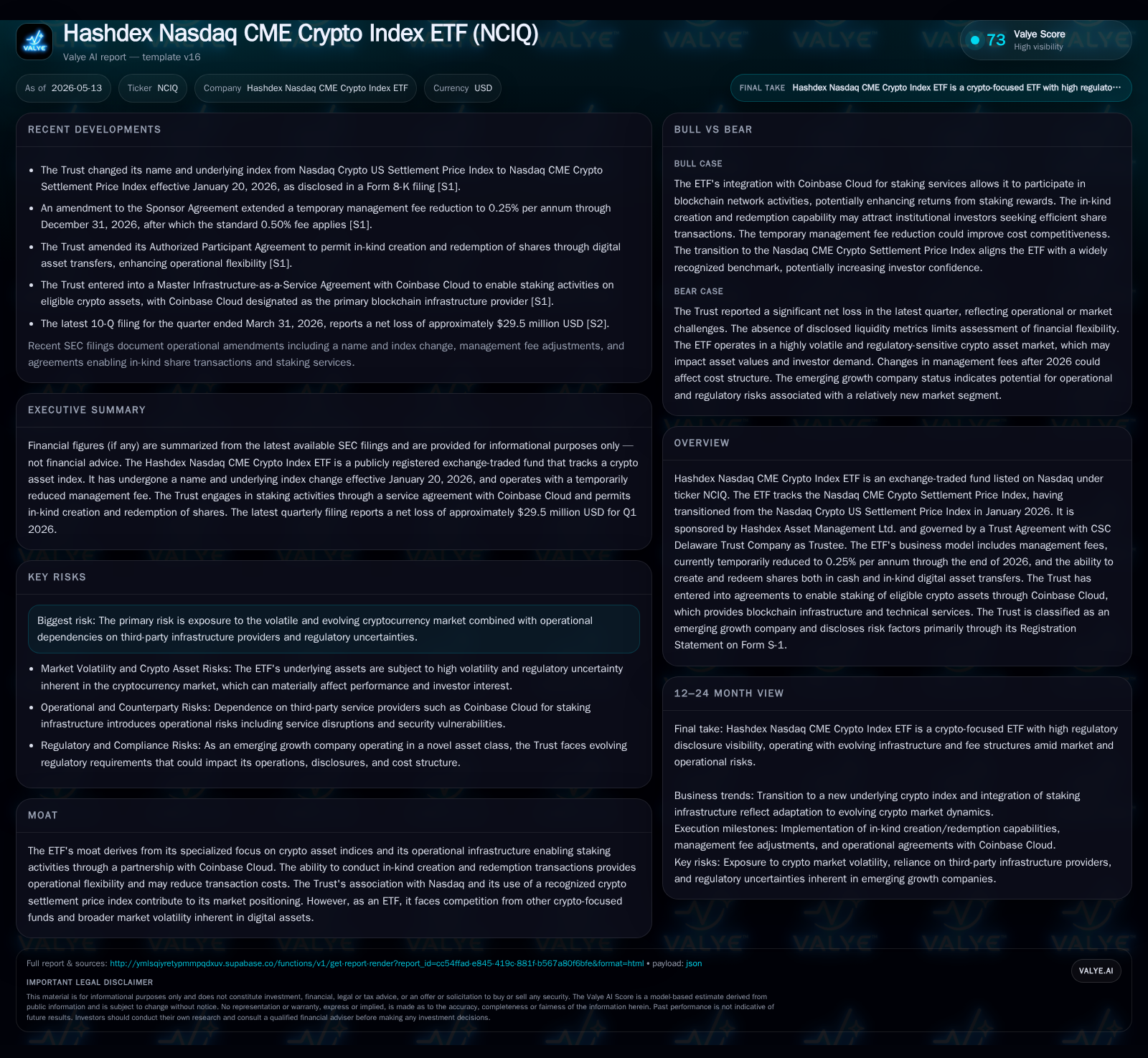
Hashdex Nasdaq CME Crypto Index ETF (NCIQ) shifted its benchmark from the Nasdaq Crypto US Settlement Price Index to the Nasdaq CME Crypto Settlement Price Index as of January 20, 2026, maintaining a consistent methodology and constituent base. In March 2026, the Sponsor announced a temporary management fee reduction to 0.25% per annum through December 31, 2026, enhancing cost competitiveness. Strategic partnerships, notably with Coinbase Cloud, enable staking activities that add an ancillary yield stream, differentiating the ETF within a crowded crypto index fund space while navigating regulatory and market volatility risks.
Latest Operating Developments: Index Transition and Fee Reduction
In its most recent quarterly filing dated May 12, 2026 [S2], Hashdex Nasdaq CME Crypto Index ETF (NCIQ) disclosed two material operational updates that shape its near-term outlook. Effective January 20, 2026, the Trust transitioned its underlying benchmark from the Nasdaq Crypto US Settlement Price Index (NCIUSS) to the Nasdaq CME Crypto Settlement Price Index (NCIS) [S1][S13]. While both indices apply substantially identical methodologies and reflect largely similar constituents—designed to measure performance across significant crypto market segments—the rebranding aligns the Trust more closely with the recognized CME brand alongside Nasdaq’s own index franchise. This subtle shift primarily updates nomenclature without materially changing the portfolio composition or risk profile.
Further enhancing competitiveness in a price-sensitive product category, on March 13, 2026, the Trust's Sponsor amended the management fee agreement to temporarily reduce fees to 0.25% per annum through December 31, 2026 [S3][S14]. This down from the standard fee of 0.50% signifies an explicit strategy to attract incremental assets under management (AUM) while market dynamics dictate pricing pressures among crypto-focused ETFs. Such a tactical fee reduction while maintaining operational expense discipline aims to position NCIQ attractively against peers who have faced criticism over high expense ratios relative to volatile digital asset returns.
Business Model Overview: Product Exposure, Creation/Redemption Mechanics, and Revenue Sources
As detailed in the annual Form 10-K [S1], NCIQ offers investors a liquid exchange-traded vehicle that provides exposure to a curated basket of crypto assets comprising its underlying index. The ETF structure circumvents complexities associated with direct crypto ownership—such as secure wallet management and exchange custody risks—by holding constituents directly via trusted custodians (Coinbase Custody Trust Company LLC, BitGo Trust Company Inc., Fidelity Digital Asset Services LLC) while offering shares tradeable on Nasdaq.
Revenue is principally derived from management fees charged on net assets. These fees were optimized recently through the aforementioned temporary cut to enhance net flows while coverage of administrative expenses remains consistent via service providers like U.S. Bancorp Fund Services acting as Administrator and Transfer Agent.
Creation and redemption mechanics are central operational facets that define liquidity and tracking precision. In February 2026 amendments [S11], NCIQ broadened Authorized Participants' ability to transact both in cash and in-kind transfers involving actual digital assets rather than solely cash settlements. This increased flexibility can reduce trading frictions, transaction costs, and tracking error relative to benchmark indices by allowing smoother arbitrage execution across market conditions—critical in volatile digital asset markets where spreads can widen significantly.
Staking Partnership with Coinbase Cloud: Enhancing Operational Infrastructure
A notable strategic differentiation for NCIQ lies in its partnership with Coinbase Cloud under an Infrastructure-as-a-Service agreement executed in October 2025 [S19][S20]. This collaboration equips the Trust with blockchain network participation capabilities including staking eligible crypto assets held by the Trust. Staking is an increasingly relevant feature whereby holders of certain Proof-of-Stake (PoS) blockchain native tokens can lock their assets to support network consensus or validation processes in return for earning additional token rewards.
By leveraging Coinbase Cloud's technical infrastructure, NCIQ can augment potential returns through these staking rewards without relinquishing custody control of underlying assets—a vital safeguard given market trust sensitivities. The service fee model whereby Coinbase Cloud receives a percentage of gross staking rewards aligns incentives towards maximizing efficient network participation. While not guaranteed income given blockchain protocol risk factors and pricing volatility, staking introduces an innovative revenue stream beyond traditional capital appreciation exposure.
Competitive Positioning Within Cryptocurrency Index ETFs
NCIQ operates in a competitive field marked by other crypto-focused ETFs seeking to capture shares of growing retail and institutional interest in digital asset investment products. Its competitive positioning benefits materially from several factors:
- Index Association: Alignment with Nasdaq and CME brands lends credibility amid evolving regulatory scrutiny compared to lesser-known alternatives.
- Fee Competitiveness: The temporary halving of fees places NCIQ at an attractive entry point relative to peers charging upwards of 0.5%-1%, potentially drawing cost-conscious investors.
- Operational Flexibility: Enabling both cash and in-kind creations/redemptions reduces liquidity constraints typical of crypto ETFs reliant exclusively on cash mechanisms which can suffer from wider bid/ask spreads.
- Staking Capability: Partnership with Coinbase Cloud introduces yield-enhancement potential uncommon among comparable products.
However, pricing power remains moderate overall given inherent cryptocurrency market volatility which limits premium valuation multiples typically afforded more stable asset classes. Regulatory pressures also temper rapid structural expansion since product approvals remain cautious across jurisdictions. NCIQ's moat is thus nuanced—operationally sophisticated but inherently exposed to macro uncertainties in digital asset adoption trajectories.
Growth Drivers: Fee Strategy, Staking Capabilities, and Market Adoption
Identifiable growth opportunities shaping NCIQ’s trajectory include:
- Management Fee Tactic: The temporary fee reduction incentivizes inflows by lowering ongoing investor cost basis; monitoring AUM trends during this window will clarify elasticity effects.
- Expansion of Staking Services: Uptake rates of staking-eligible assets held by the Trust denote direct adoption metrics impacting yield attractiveness; further addition of eligible tokens to the index could accelerate this driver.
- Broader Crypto ETF Adoption: Institutional interest remains nascent but expanding as regulatory clarity improves; similarly retail channels are evolving toward diversified indirect crypto exposure rather than spot holdings.
- Index Constituents Evolution: Periodic review allowing inclusion of emerging liquid crypto projects can enhance relevance and investable breadth.
Stakeholders should maintain vigilance particularly around evolving SEC guidelines affecting crypto funds alongside evaluating custody/distribution ecosystem resilience.
What to Watch Next: Potential Milestones and Market Demand Signals
Near-term indicators include:
- Quarterly reporting on AUM growth juxtaposed against ongoing management fee discounts will reveal sustained investor demand responses post-price adjustment [S2][S3].
- Updates on staking program ramp-up volumes through Coinbase Cloud agreements imply yield generation scalability.
- Announcements regarding index adjustments including new constituent additions or weighting changes would signal responsiveness to market innovation.
- Regulatory developments or SEC guidance affecting ETF approval frameworks for crypto products remain overarching execution risk factors.
Market participants should focus on these dimensions for signs of momentum or emerging headwinds informing operational strategy calibration ahead of the scheduled expiry of reduced fees at year end.
Financial Snapshot: Recent Profitability and Expense Trends
The latest available financial data as of September–December 2025 [F1][S2] indicate a modest operating income level detected during Q3–2025 but trailing net losses reported at fiscal year-end reflecting elevated administrative costs associated with infrastructure buildout including staking platform integration initiatives plus underlying market valuation declines across digital assets affecting fund NAVs.
No material debt or contingent liabilities are disclosed [S1], consistent with ETF structures generally exhibiting conservative balance sheets focused primarily on asset-liability matching rather than leverage-driven strategies. Expense trends bear watching especially post-fee reduction impacts wherein operational efficiency gains will be requisite to maintain profitability as margin compression looms amid competitive pressures.
This analysis synthesizes information from Hashdex Nasdaq CME Crypto Index ETF's latest SEC filings complemented by sector knowledge specific to cryptocurrency index-based ETFs. It reflects current facts without prescriptive guidance regarding investment decisions.
Disclaimer: This is research-only, informational analysis and not investment advice. It may include AI-generated interpretation and general industry context. Always verify important details using primary sources.

Comments