
Ocean Thermal Energy Corp Advances OTEC Project Amid Severe Liquidity and Development Risks
The company is progressing design work on its first commercial Ocean Thermal Energy Conversion plant under a Department of Defense contract, while grappling with fragile finances and long project timelines.
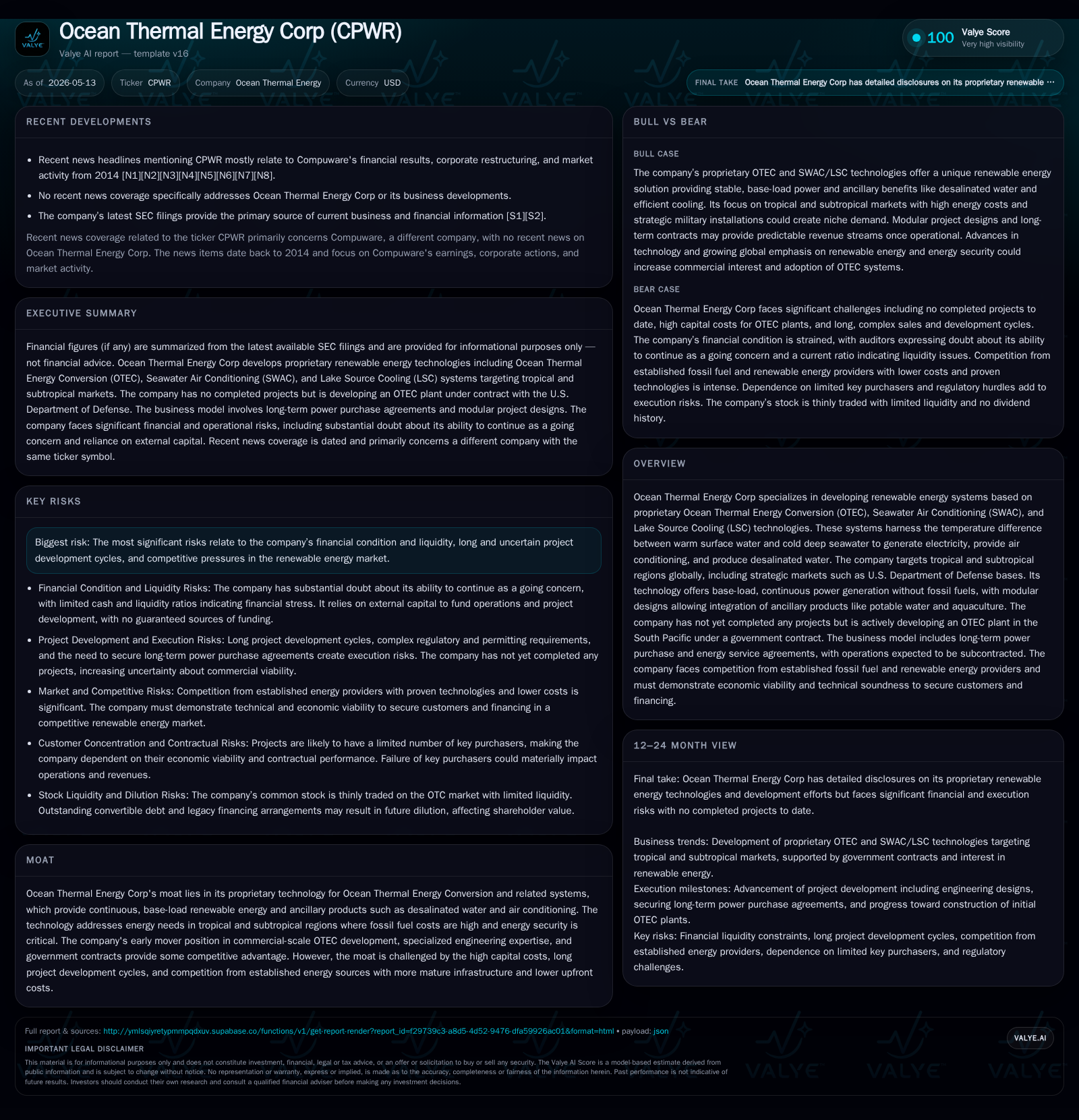
Ocean Thermal Energy Corp (CPWR) remains focused on developing its proprietary renewable energy technologies, primarily Ocean Thermal Energy Conversion (OTEC) systems that generate power from ocean temperature differentials. The latest quarterly filing reveals ongoing engineering design work for a pilot OTEC plant at a remote U.S. military base in the South Pacific, representing the company’s closest step toward commercialization. However, with no operating projects yet and limited cash resources versus significant liabilities, the company faces substantial financial and execution risks. Its business model hinges on lengthy project development cycles, government and utility contracts, and complex permitting and financing processes. While its technology offers potential advantages for tropical regions reliant on expensive fossil fuels, capital constraints and competitive pressures from more mature energy sources continue to challenge near-term growth prospects.
Recent Operating Update
Ocean Thermal Energy Corp's latest 10-Q filing dated May 12, 2026 [S2] underscores ongoing progress in their core business: designing a commercial-scale Ocean Thermal Energy Conversion (OTEC) plant under contract with the U.S. Army. This $3.6 million contract focuses on detailed engineering designs and financial analysis for a facility at a remote military installation in the South Pacific. The completion of this phase aims to enable the Army to evaluate OTEC as a sustainable source of renewable electricity and desalinated water.
Despite this advancement, the company has yet to transition any projects into construction or revenue-generating stages. Their longest project development cycle involves preliminary site evaluation, extensive permitting processes with multiple regulatory agencies across national and local levels, financing procurement from external sources, construction oversight, followed by operational commissioning—a process expected to take several years per project [S1].
Business Model
Ocean Thermal Energy Corp seeks to commercialize its proprietary technologies centered around Ocean Thermal Energy Conversion (OTEC), Seawater Air Conditioning (SWAC), and Lake Source Cooling (LSC). These systems harness the thermodynamic gradient between warm surface seawater typically at tropical latitudes and cold deep seawater drawn from depths around 3,000 feet.
Revenue Mechanics: Revenue generation is contingent upon two primary components:
Development fees approximating 3% of total project costs payable upon successful closing of project-specific financing arrangements.
Long-term equity participation targeting at least 51% ownership in completed OTEC projects to secure distributions from operating income streams.
OTEC plants are designed to provide continuous baseload electrical power at capacity factors estimated near 95%, leveraging closed-cycle Rankine processes using ammonia as working fluid alongside desalination capabilities for agricultural or potable water production [S24]. Meanwhile, SWAC/LSC implementations utilize cold oceanic or lake waters to replace traditional energy-intensive chillers in air conditioning infrastructure for large commercial facilities [S1], [S15]. These diversified outputs contribute ancillary revenues that enhance overall plant economic viability.
The company targets markets characterized by elevated fossil fuel electricity costs—including island economies in the Caribbean Pacific rim with substantial military presences—where energy security concerns provide compelling rationale for localized clean power [S21].
Industry Structure and Competitive Position
Ocean Thermal Energy operates within the broader renewable energy sector but occupies a highly specialized niche focused on marine thermal resources.
Competitive Dynamics: The space pits Ocean Thermal Energy against established conventional power sources—oil, natural gas, nuclear—and increasingly mature renewables like solar PV and wind which boast shorter lead times and lower upfront capital expenditures [S19].
Moat Analysis: The company leverages proprietary intellectual property encompassing process designs, engineering models, novel cold water piping methods, and thermal exchange innovations backed by trademarks such as TOO DEEP® [S27]. This IP coupled with deep technical expertise provides early mover advantage in commercial-scale OTEC deployment.
Challenges: High capital intensity (~$445 million estimated for a single 20-MW OTEC plant), significant regulatory hurdles spanning environmental impact assessments through multi-jurisdictional permitting processes, unproven finance structures requiring multiple layers of debt/equity commit new entrants face steep barriers to execution [S1], [S24]. ROI uncertain given lack of precedent plants operating commercially globally.
Growth Drivers
Government Contracts & Strategic Customers: Key growth driver is engagement with institutional customers such as U.S. Department of Defense installations showing interest in secure clean power sources that also produce desalinated water beneficial for remote bases [S1], [S24]. Prolonged sales cycles notwithstanding, successful PPAs would unlock recurring revenue streams.
Tropical/Subtropical Market Demand: Island states dependent on imported fossil fuels face volatile pricing pressures that enhance attractiveness of stable-cost base-load OTEC systems coupled with water productization addressing freshwater scarcity issues.
Expansion into Ancillary Markets: SWAC and LSC provide complementary offerings targeting large resort complexes, hospitals, universities seeking substantial reductions (~90%) in air conditioning electric consumption relative to standard chillers [S1].
Climate Policy Tailwinds: Global decarbonization trends favor renewable technologies promising stable output unlike intermittent solar/wind; OTEC’s unique ability to deliver continuous clean power lengthens potential operational lifespan contributing positively to total cost of ownership over decades.
Technology Innovation & IP Management: Continued R&D efforts may yield patents enhancing competitive differentiation especially regarding heat exchanger efficacy or cold-water pipe longevity under marine conditions [S21].
Risks / Watchpoints / Growth Constraints
Financial Condition & Liquidity: Company's latest reported liquidity picture is strained; current assets approximately $430K against current liabilities exceeding $51 million indicate critical solvency risks [F1]. Auditors explicitly raised going concern doubts affecting ability to sustain operations absent significant capital inflows [S23].
Lengthy Project Timelines: Multi-year development phases prolong time before any meaningful cash inflows; compounded by difficult-to-predict permitting delays in different jurisdictions must be contended with carefully.
Financing Risks: Capital requirements (~$445 million for initial OTEC plants) necessitate layered funding from debt/equity investors who may seek dilution-protected returns conflicting with existing shareholder interests emphasizing risk of resource constraint impairing growth pace [S20].
Competitive Pressure: Despite technical uniqueness OTEC competes indirectly against better-established renewables offering lower capex per MW; market acceptance may lag if pricing does not match or exceed incumbent sources immediate cost offerings.
Regulatory Complexity: Compliance obligations cover environment protection including marine ecosystem impacts during construction & operation phases creating potential unforeseen liabilities or costly design adaptations [S6].
Customer Concentration: Limited number of off-takers per plant poses concentration risk—default by key purchasers (governmental or private) could jeopardize entire project economics without insurance coverage available on acceptable terms [S22].
Execution Risk: Dependence on key personnel alongside third-party engineering procurement & contractor partners necessitates robust management; loss or disruption could materially delay projects given specialized knowledge requirements [S20].
What To Watch Next
- Completion milestones for the U.S. Army comprehensive Basis of Design report under current contract.
- Announcement or negotiation updates regarding Power Purchase Agreements or similar long-term off-take contracts critical for financing closure.
- Progress toward securing construction financing or equity investment commitments sufficient to initiate physical build phases.
- Regulatory permit approvals or environmental assessments clearing paths forward at planned site locations.
- Financial reporting updates clarifying liquidity status including any restructuring initiatives addressing high liabilities relative to cash reserves.
- News regarding potential partnerships or technology licensing deals expanding market reach beyond current military/government focus areas.
Financial Profile Briefly Supporting Context
Latest financial snapshot
| Metric | Value | Period |
|---|---|---|
| Current assets | $430,416 | |
| Current liabilities | $51,817,621 | |
| Current ratio | 0.01x |
Source: SEC companyfacts cache [F1].
According to recent data from companyfacts as of March 31, 2026:
- Current assets stand at approximately $430K versus $51.8 million current liabilities reflecting an extremely weak current ratio near 0.01 [F1].
- Cash balance is minimal ($957 as last recorded December 2021), suggesting no material liquidity buffer exists even short term [F1].
- Total debt approximates $8.7 million net of cash which remains significant though below aggregate liabilities stressing capital structure [F1].
- Latest annual revenues are negligible ($3 million last full year) while net losses exceed $69 million indicating historical heavy operating burn without offsetting income generation capabilities yet achieved [F1].
These metrics corroborate disclosures related to going concern uncertainties raised by auditors evidencing urgent need for capital infusion to sustain operations and advance commercialization efforts [S23], [S11].
Disclaimer: This analysis is based solely on publicly available SEC filings as of May 2026 along with company facts data; it does not constitute investment advice but aims to provide an analytical overview grounded in disclosed operational facts and financial data.
Disclaimer: This is research-only, informational analysis and not investment advice. It may include AI-generated interpretation and general industry context. Always verify important details using primary sources.

Comments