
Teads Strengthens Omnichannel Ad Platform with Operational Efficiencies and Debt Management
Teads Holding Co. reports first full quarter post-acquisition, focusing on AI-driven omnichannel growth and cost synergies while managing leverage.
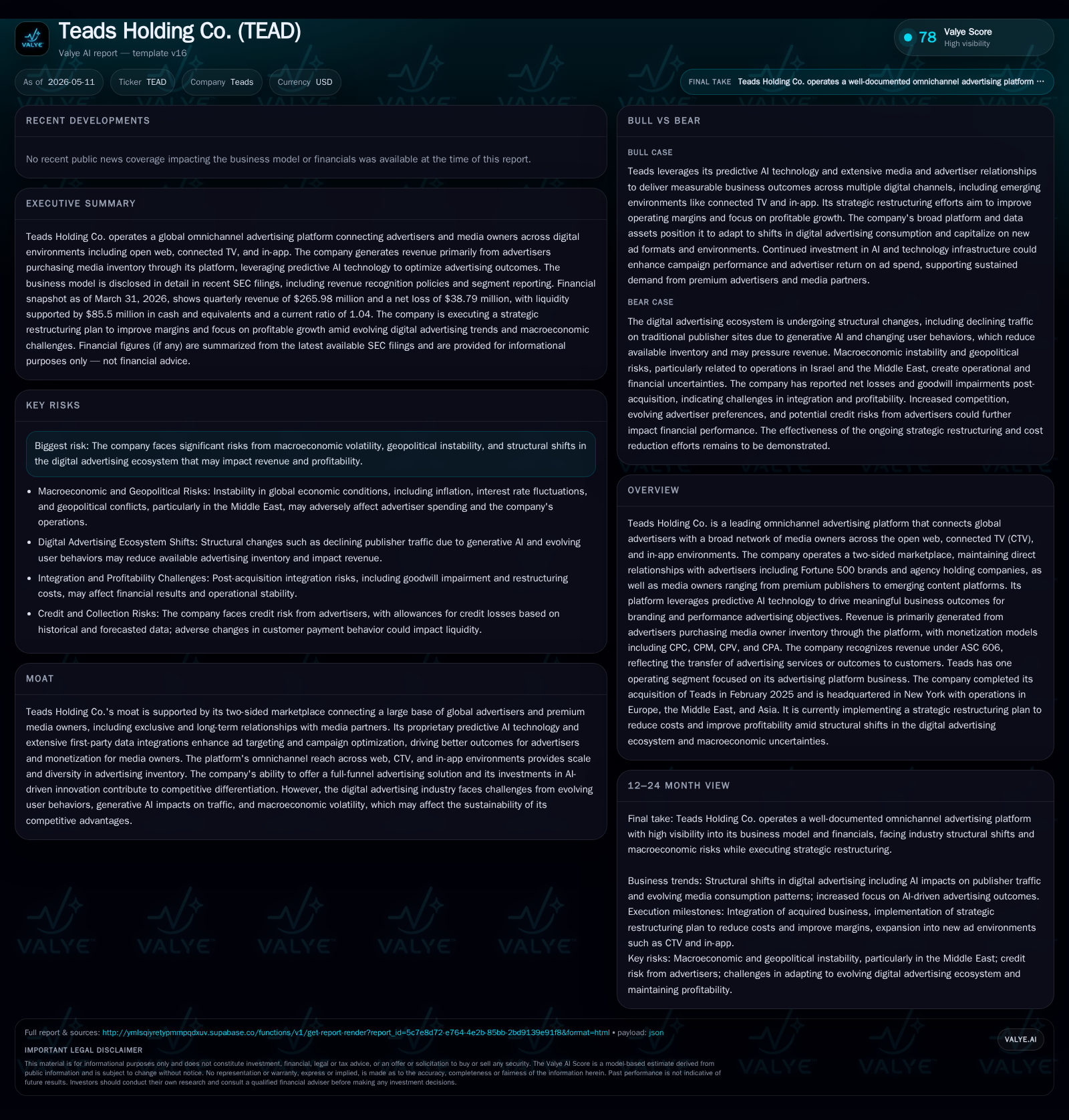
In its latest quarterly filing, Teads Holding Co. disclosed the first full quarter results following its acquisition, highlighting improvements in operating efficiencies and reduced interest expenses that support margin expansion. The company operates a two-sided omnichannel advertising platform connecting global advertisers with media owners across web, CTV, and app environments, leveraging AI to optimize outcomes. Despite macroeconomic volatility and digital ad ecosystem shifts, Teads's strong relationships and platform capabilities offer competitive advantages. Growth is underpinned by expanding content consumption in CTV and in-app spaces, new ad formats, and advanced audience targeting technologies. The company's liquidity position remains solid amid a sizable debt load incurred from acquisition financing.
Recent Operating Update
Teads Holding Co.’s latest quarterly filing (10-Q dated May 8, 2026) presents the first full-quarter results following its February 2025 acquisition of the legacy Teads business [S2]. This consolidation underscores the transition to an integrated omnichannel advertising platform that connects global advertisers with a vast network of media owners spanning web, Connected TV (CTV), and mobile in-app environments. Management notes ongoing content consumption growth in these channels — including emerging interfaces involving Large Language Models (LLMs) — which expands inventory available for monetization.
The quarter also reflected tangible margin improvements attributed to operational efficiency gains achieved through streamlining duplicative roles post-acquisition. Interest expense declined by $5.7 million year-over-year to $17.4 million for the quarter ended March 31, 2026 [S2]. This reduction follows targeted refinancing actions including repurchase of senior secured notes at discounts [S21], signaling active debt management within a substantial long-term debt position.
Liquidity remains bolstered by $85.5 million in cash holdings complemented by $13.2 million in short-term investments and an unused borrowing capacity of up to $40 million under the 2025 Revolving Facility [S2][F1]. The company maintains compliance with financial covenants while acknowledging potential discretionary opportunities to retire some outstanding debt depending on market conditions.
Business Model Overview
Teads operates a sophisticated two-sided marketplace platform that facilitates transactions between advertisers—ranging from Fortune 500 companies to agencies—and media owners comprising premium publishers alongside emerging content providers such as app developers and CTV platforms [S1][S2]. Revenue is primarily driven by selling advertising inventory owned or controlled by media partners through various pricing models: cost-per-click (CPC), cost-per-thousand impressions (CPM), cost-per-view (CPV), and cost-per-action (CPA) structures.
The platform’s value proposition centers on delivering measurable outcomes at every stage of the marketing funnel — from brand awareness via completed video views to direct response outcomes such as sign-ups or sales—leveraging proprietary predictive AI technology to optimize campaign effectiveness [S1]. This technology integrates first-party data from both sides of the marketplace to enhance precise audience targeting and dynamic campaign adjustments.
Revenue recognition aligns with ASC 606 standards based on transferred advertising services or achieved performance outcomes under contract terms [S1]. The company acts predominantly as principal in transactions controlling inventory before transfer though certain agent relationships generate net revenue recognition.
On the supply side, contracts with media owners can include programmatic bidding arrangements, revenue share agreements, or guaranteed minimum payments contingent on provider performance metrics [S1]. Traffic Acquisition Costs (TAC) correlated with revenue mix are managed carefully to preserve margin integrity.
Industry Structure and Competitive Position
Positioned within the fragmented digital advertising ecosystem, Teads differentiates itself via an omnichannel reach that spans premium open-web sites, fast-growing connected TV environments, and diverse in-app inventories [S1][S2]. The integration across device types allows advertisers seamless access to consumers as they transition between viewing contexts—a critical advantage amidst consumer behavior shifts toward mobile video and streaming platforms.
Its moat derives from scale enabled by exclusive or long-term licenses with premium publishers paired with advanced AI capabilities that improve campaign yield beyond commoditized programmatic exchanges. The ability to provide a holistic solution encompassing branding through performance marketing makes Teads attractive to large clients seeking consolidations of their ad buys for greater efficiency.
However, structural headwinds include traffic declines for certain publisher segments as users increasingly consume summarized or AI-generated content outside traditional websites—a trend analysts attribute partly to generative AI disintermediation [S1]. Macroeconomic factors affecting digital ad budgets also create cyclicality risks typical across ad tech firms.
Growth Drivers
- Omnichannel Expansion: Continued rollout of advertising formats suited for burgeoning CTV inventories coupled with deeper penetration into mobile app environments offers volume growth potential as audiences migrate from traditional web usage.
- AI-Driven Outcomes: Investments in predictive analytics that correlate spending with multi-dimensional outcomes—from completed views to conversion metrics—enable premium pricing power versus basic impression-based offerings.
- Market Consolidation: Leveraging sizable advertiser relationships alongside a unified platform creates switching costs that can anchor client retention amid ongoing industry consolidation among agencies and media buyers.
- Geographic Footprint: Operations stretching across North America, Europe, Asia, Middle East allow tapping regional budget expansions while diversifying economic exposure.
- Product Innovation: Developing new ad units tailored for Large Language Model interfaces or interactive video engagement addresses emergent consumption behaviors before competitors catch up.
Risks and Watchpoints
- Macroeconomic Volatility: Discretionary advertising spend fluctuates during economic downturns; given dependence on brand marketing budgets heavily concentrated in Q4 holiday season [S1], shifts may cause revenue variability.
- Generative AI Impact: Increasing user reliance on AI-generated answers reduces click-through rates to publisher sites creating inventory scarcity challenges; this structural trend could pressure revenues unless offset by adaptation strategies.
- High Leverage: Approximately $628 million outstanding senior secured notes at a fixed 10% coupon impose significant interest obligations despite recent reductions [F1][S2]; maintaining covenant compliance while investing in growth requires careful capital allocation.
- Competitive Pressure: Dominance of major walled gardens like Google and Meta restricts addressable market share; Teads must continually enhance differentiation via exclusive media deals and technology prowess.
- Regulatory Environment: Changes impacting data privacy rules could hamper targeting effectiveness thus diluting advertiser ROI derived from personalized ads.
What To Watch Next
Key milestones include monitoring:
- Quarterly advertiser spend trends especially across CTV and app channels indicating adoption velocity of expanded inventory formats.
- Integration success post-acquisition reflected in further operational cost reductions or synergies driving profit margins upwards.
- Progress on debt retirement initiatives or refinancings reducing financial leverage burden amidst interest rate environment fluctuations.
- Launches of new AI-enabled targeting tools or contextual ad products responding dynamically to evolving consumption patterns like LLM interface usage.
- Publisher traffic metrics signaling recovery or further erosion attributable to generative AI influences impacting available impressions.
Financial Profile Summary
Latest financial snapshot
| Metric | Value | Period |
|---|---|---|
| Cash & equivalents | $85mm | |
| 2026-03-31 | ||
| Total debt | $628mm | |
| 2026-03-31 | ||
| Net debt | $543mm | |
| 2026-03-31 | ||
| Current assets | $426mm | |
| 2026-03-31 | ||
| Current liabilities | $409mm | |
| 2026-03-31 | ||
| Current ratio | 1.04x | |
| 2026-03-31 |
Source: SEC companyfacts cache [F1].
As of March 31, 2026, Teads reported cash and cash equivalents totaling $85.5 million complemented by $13.2 million in short-term investments, supporting liquidity needs along with an available $40 million revolver under its credit facility [F1][S2]. Total debt stood at approximately $628 million primarily representing senior secured notes issued for acquisition financing, carrying a fixed coupon near 10% [F1][S2]. Net leverage remains elevated at just over $540 million net debt after accounting for cash balances [F1].
This analysis synthesizes publicly filed SEC documents as of mid-2026 without offering investment advice. It aims to provide an informed perspective on Teads Holding Co.'s operational progress, strategic positioning within digital advertising markets, key growth vectors, risk considerations, and current financial posture based on official disclosures.
Disclaimer: This is research-only, informational analysis and not investment advice. It may include AI-generated interpretation and general industry context. Always verify important details using primary sources.

Comments