
Caris Life Sciences Advances AI-Driven Oncology Diagnostics Despite Regulatory and Reimbursement Challenges
Q1 2026 results highlight operational scaling and AI innovation amid ongoing regulatory scrutiny and reimbursement variability.
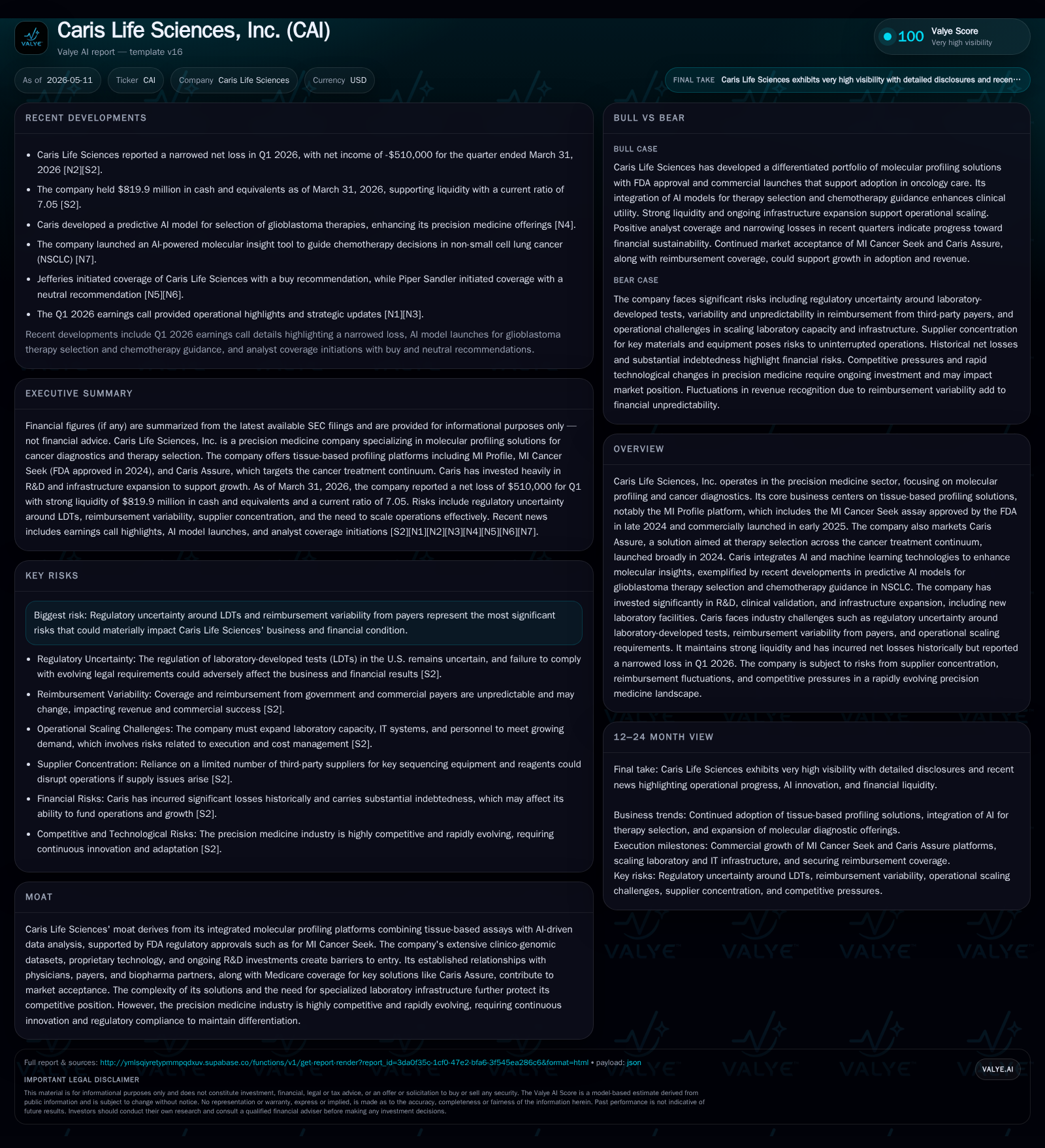
Caris Life Sciences, Inc. reported Q1 2026 operational progress maintaining its leadership in precision oncology diagnostics driven by its MI Profile and Caris Assure platforms, integrating AI/ML at scale. The company is expanding capacity with new laboratory infrastructure and advancing predictive AI models for therapy selection in cancers such as glioblastoma and NSCLC. However, the complex regulatory landscape around LDTs and payer reimbursement uncertainties remain key risks to near-term growth. Caris’ extensive clinico-genomic data assets, proprietary technology, and FDA approvals support durable competitive advantages in a rapidly evolving precision medicine industry.
Recent Operating Update
Caris Life Sciences' Q1 2026 Form 10-Q filing dated May 8, 2026, alongside a subsequent May 7 event filing, presents an operating picture marked by steady progress in scaling its molecular profiling business. The company continues broad commercialization of its MI Profile tissue-based solutions and Caris Assure liquid biopsy platform — both foundations of revenue generation. Recent earnings commentary emphasizes increased test volumes coinciding with lab capacity expansion initiatives, including a near-complete build-out of a new Irving, Texas laboratory facility designed to handle growing sample throughput seamlessly [S2][S3][S25].
Additionally, Caris is advancing multiple AI/ML-enhanced diagnostic insights that bolster its competitive edge. April news reports cite the development of predictive models targeting glioblastoma therapy selection and chemotherapy guidance for non-small cell lung cancer (NSCLC), showcased through their GPSai and other molecular signature solutions [N3][N4]. These innovations exemplify how the company leverages its extensive clinico-genomic datasets to generate actionable insights along the cancer care continuum.
Financially, Caris maintains a strong balance sheet with cash and equivalents of approximately $820 million and total debt near $381 million as of March 31, 2026, resulting in a net cash position and a current ratio above 7, indicating solid short-term financial health that supports ongoing R&D and infrastructure investments [F1].
Business Model Overview
Caris Life Sciences operates at the intersection of molecular diagnostics and AI-enabled precision oncology. Revenue is primarily derived from molecular profiling services that analyze tumor tissue or blood samples using comprehensive genomic sequencing technologies—principally whole exome sequencing (WES), whole transcriptome sequencing (WTS), and whole genome sequencing (WGS) across its three main platforms: MI Profile (tissue-based), Caris Assure (blood-based liquid biopsy), and Precision Whole Genome.
The company’s test pricing depends on reimbursement arrangements which vary by payer type; Medicare coverage notably underpins adoption of therapeutic decision-support products like Caris Assure. Volume growth arises from increasing clinical adoption across oncologists who pay for tests often facilitated through insurance reimbursement pathways. Strategic partnerships with biopharma enhance commercial sustainability by enabling use of Caris data in drug development pipelines.
Margins are influenced by test mix shifts toward higher-value assays integrating AI interpretations, operational efficiencies from scaled lab infrastructure, and variable reimbursement rates. Cash conversion hinges on payer collections which remain subject to timing uncertainties imposed by evolving coverage policies.
Industry Structure and Competitive Position
The precision medicine industry is characterized by rapid innovation cycles powered by advances in NGS technology cost declines, cloud computing scalability, and artificial intelligence integration. Firms compete on data quality depth, breadth of biomarker coverage, analytical accuracy, regulatory clearance status, payer acceptance, and ability to partner with pharmaceutical companies.
Caris distinguishes itself by combining extensive multi-modal molecular profiling with proprietary AI/ML algorithms backed by one of the largest oncology clinico-genomic datasets globally—surpassing one million profiled patient cases as of end-2025 [S1]. FDA approval of the MI Cancer Seek assay marks a notable regulatory moat hard to replicate quickly. Medicare coverage for key assays solidifies commercial footing versus competitors reliant solely on private payers.
Yet industry competition remains intense from established diagnostic labs expanding into precision oncology and emerging tech-enabled entrants challenging traditional workflows. Legal challenges around LDT regulations could reshape market contours impacting Caris’ product suite compliance costs.
Growth Drivers
Growth is structurally driven by broader adoption of precision oncology diagnostics across an expanding range of cancer types and therapy stages—from early detection through treatment monitoring. Specific catalysts include:
- AI/ML Innovation: Development of refined predictive molecular signatures driving higher clinical utility improves physician engagement and payer willingness to reimburse.
- Product Pipeline Expansion: Launches like Caris Detect multi-cancer early detection test following encouraging clinical readouts target large addressable populations beyond late-stage therapy selection.
- Capacity Scaling: Infrastructure investments such as the Irving lab enable exponential volume scaling without compromising turnaround times or quality.
- Biopharma Collaborations: Data-sharing partnerships accelerate co-development opportunities benefiting pipeline monetization.
- Regulatory Approvals: Continued FDA clearances provide validated differentiators enhancing market access.
Risks & Constraints
Several factors could materially constrain growth or impact financial performance:
- Regulatory Uncertainty: Ongoing investigations related to Medicare billing compliance (e.g., date-of-service rule) create potential liabilities; unfavourable rulemaking on LDT oversight could increase operational risk/costs [S15][S16].
- Reimbursement Variability: Payer policies remain heterogeneous with limited coverage for newer molecular signature tests complicating revenue predictability [S21][S22].
- Competitive Dynamics: Rapid innovation by competitors places continuous pressure on Carnegie’s technological edge requiring sustained R&D investment.
- Operational Complexity: Sophistication of biochemical/bioinformatics workflows entails risks around consistency affecting test sensitivity/specificity that may necessitate FDA supplemental filings [S28].
- Financial Losses: Historical net losses driven by heavy upfront investments underscore ongoing need for capital efficiency improvements despite large cash balances [F1][S27].
What to Watch Next
Key milestones that could signal trajectory include:
- Quarterly sequential volume trends across MI Profile and Caris Assure testing reflecting clinical adoption rates.
- Regulatory updates regarding CMS reimbursement policies or FDA clearances impacting product breadth.
- Progress on commercial launches such as Caris Detect early detection assay supported by upcoming clinical study readouts.
- Expansion or renewal of strategic pharma partnerships leveraging proprietary data assets.
- Updates on DOJ investigations relating to Medicare compliance potentially affecting financial provisions or operational changes.
Financial Profile Snapshot (As of Q1 2026)
Latest financial snapshot
| Metric | Value | Period |
|---|---|---|
| Cash & equivalents | $820mm | |
| 2026-03-31 | ||
| Total debt | $381mm | |
| 2026-03-31 | ||
| Net debt | $-439mm | |
| 2026-03-31 | ||
| Current assets | $1014mm | |
| 2026-03-31 | ||
| Current liabilities | $144mm | |
| 2026-03-31 | ||
| Current ratio | 7.05x | |
| 2026-03-31 |
Source: SEC companyfacts cache [F1].
| Metric | Value (USD) | Period End |
|---|---|---|
| Cash & Equivalents | 819.9M | |
| 2026-03-31 | ||
| Total Debt | 381.1M | |
| 2026-03-31 | ||
| Current Assets | 1014.2M | |
| 2026-03-31 | ||
| Current Liabilities | 143.9M | |
| 2026-03-31 | ||
| Current Ratio | 7.05x | |
| 2026-03-31 | ||
| Net Income (Annual) | -68.1M | |
| 2025-12-31 |
Liquidity remains ample allowing sustained investment in innovation-led growth while managing leverage at moderate levels relative to cash holdings [F1]. Net losses reflect continued scale-up phase rather than operational weakness.
This analysis synthesizes SEC filings through May 8, 2026 [S1,S2,S3] alongside recent news developments up to May 11, 2026 without extrapolating beyond disclosed facts or projecting future performance beyond documented milestones. It provides an operationally grounded assessment tailored for internal strategic insight without constituting investment advice.
Disclaimer: This is research-only, informational analysis and not investment advice. It may include AI-generated interpretation and general industry context. Always verify important details using primary sources.

Comments