
SmartStop Expands Managed Platform and Navigates Market Scale in Q1 2026
SmartStop’s latest quarter highlights strategic portfolio growth and the scaling of its managed self storage platform as critical advantages in a fragmented industry.
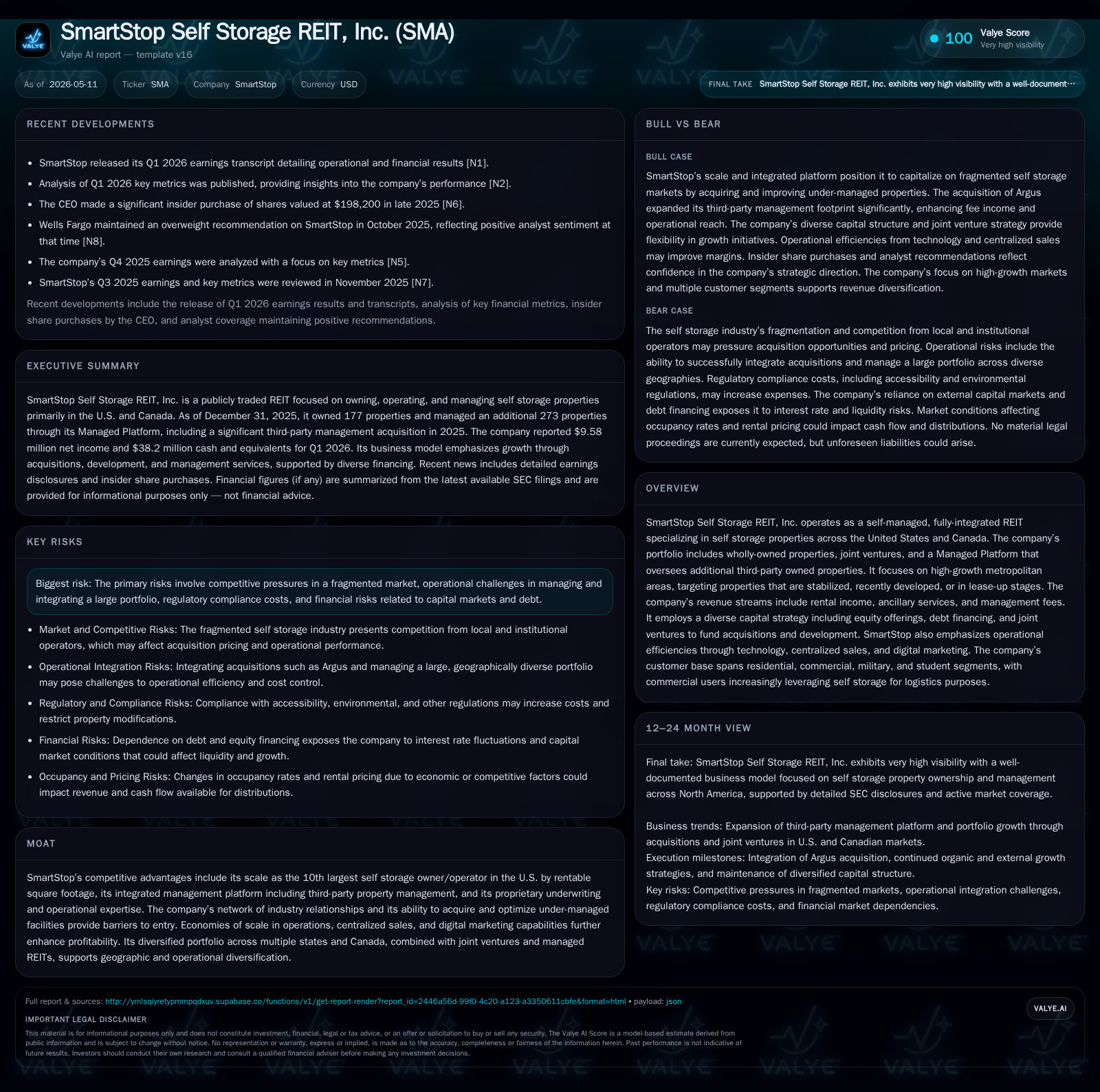
In Q1 2026, SmartStop Self Storage REIT solidified its position as a leading self storage operator by expanding its owned portfolio and significantly growing its managed platform through acquisitions. Its vertically integrated business model leverages proprietary technology, operational expertise, and a diversified customer base to drive occupancy and ancillary revenue growth. Amid intense competition in a highly fragmented market, SmartStop’s economies of scale and centralized digital sales efforts provide durable competitive advantages. Growth catalysts include ongoing acquisitions, joint ventures, and optimization of lease-up properties, tempered by operational integration challenges and regulatory compliance costs. The company’s capital strategy supports continued expansion while maintaining financial discipline.
Latest Quarterly Operating Update: Portfolio Expansion and Managed Platform Growth
The Q1 2026 Form 10-Q filing dated May 8 provides the most recent window into SmartStop’s operating progress [S2]. The company has enhanced its footprint both through ownership additions and managed properties expansion. A major development continues to be the integration of Argus Professional Storage Management acquired on October 1, 2025 [S1], which added over 221 third-party managed properties totaling approximately 98,000 units across 27 states [S26]. This acquisition more than doubled SmartStop’s managed platform unit count alongside existing Managed REIT portfolios.
Operationally, the firm reported sustained leasing velocity improvements driven by enhanced centralized sales efforts via its in-house call center and robust digital marketing initiatives [N1]. These investments aim at scaling occupancy efficiently across owned and third-party platforms while reducing per-unit operating expenses. Recent earnings transcripts reflect growing confidence in the organic leasing momentum post-acquisition [N2].
Business Model and Service Offering: Integrated, Technology-Driven Self Storage
SmartStop Self Storage REIT is a self-managed, fully integrated REIT focused on acquiring, owning, managing, and operating self storage properties primarily in top U.S. and Canadian MSAs [S1]. Its business is vertically integrated: it holds direct ownership stakes with about 177 wholly-owned properties totaling approximately 122,000 units (13.9 million net rentable square feet), interests in unconsolidated Canadian joint ventures managing additional assets under development or operation, plus a Managed Platform overseeing third-party owned portfolios including Managed REITs and the Third Party Platform (i.e., Argus) [S1].
Revenue stems from three principal streams: rental income from property leases; ancillary revenues such as tenant insurance and moving supplies; and management fees from third-party property management contracts under the Managed Platform umbrella. This hybrid model diversifies cash flow sources beyond traditional rental yields.
SmartStop leverages proprietary underwriting frameworks combined with sophisticated digital marketing strategies to efficiently acquire customers across diverse segments including residential renters, commercial clients (notably small businesses), military personnel, and university students [S12]. Economies of scale unlock operational efficiencies through centralized call centers handling inbound leasing inquiries via multiple channels (phone, web chat, text) that simultaneously feed digital pipeline conversion improvements.
Competitive Landscape and Industry Dynamics: Fragmentation Meets Scale Advantage
The self storage industry remains one of the most fragmented real estate sectors in North America with roughly 58,000 facilities in the U.S. alone operated predominantly by local or regional non-institutional owners [S1]. Within this context SmartStop ranks as the 10th largest operator by rentable square footage nationally [S1], establishing it as an institutional consolidator.
The fragmented supply creates ample acquisition opportunities especially for under-managed assets where professional oversight can increase income via revenue optimization plus cost containment strategies such as staff rationalization in clustered assets [S12]. Publicly traded peers like Extra Space Storage (EXR) demonstrate similar scale-driven competitive moats centered around centralized sales platforms and robust capex-led property enhancements.
SmartStop’s blend of wholly-owned holdings complemented by large-scale managed platforms bolsters geographic diversification while generating incremental fee income streams that enhance overall profitability. In addition to organic growth strategies focused on lease-up velocity and rate-mix improvement through climate-controlled and premium units availability, scale enables negotiating power with service providers reducing expenses relative to smaller operators.
Growth Catalysts: Acquisitions, Leasing Momentum, and Digital Marketing Efficiencies
Looking forward SmartStop is pivoting growth around several concrete levers:
- Acquisitions within top Tier-1 MSAs targeting stabilized or lease-up facilities that can deliver immediate cash flow or rapid absorption potential given population inflows.
- Joint Ventures Expansion, particularly unconsolidated Canadian ventures holding operating/development stage properties offering yield enhancement without full capital outlay by SmartStop [S1].
- Optimizing Lease-Up Velocity using differentiated proprietary call-center capabilities coupled with digital marketing spend increases aiming to accelerate absorption curves for recently developed or acquired properties [N1].
- Expanding Third-Party Management Fee Base through scaling Argus’s footprint either organically or via bolt-on acquisitions that bring additional third party portfolios onto the Managed Platform.
- Technology-driven operational efficiencies delivering cost savings relative to local operators benefiting from fragmentation-induced duplication of effort.
These catalysts are measurable by KPIs such as occupancy rate uplift on newly acquired properties/quadrants served by Argus post-acquisition; fee income growth from third-party managed units; same-store rental rate increases; along with pipeline milestones from joint ventures progressing into stabilization phase.
Risks and Challenges: Market Competition, Operational Integration, and Regulatory Factors
Despite these strengths SmartStop explicitly acknowledges risks analogous to the sector at large:
- Pricing Pressure & Competitive Fragmentation: Sustained competition among thousands of independent operators can cap rent escalation potential especially in softer submarkets; a risk reiterated unchanged since last annual report [S2].
- Integration Complexities: Incorporating Argus’s large workforce (~400 employees) across multiple states presents operational risks including cultural fit issues affecting efficiency gains realization timelines [S1],[S2].
- Regulatory Compliance Burdens: Operating cross-border (U.S. & Canada) necessitates adherence to varying accessibility laws (ADA/AODA), tenant protections impacts on ancillary service offerings plus environmental remediation liabilities all carrying potential cost escalations [S14].
- Financial Leverage Considerations: With net debt exceeding $1 trillion per recent balance sheet data [F1], SmartStop depends heavily on capital markets access for refinancing/acquisition funding. Any credit tightening or rising interest rates could pressure margins or growth pace.
These risks require ongoing monitoring particularly through occupancy trends that reflect pricing power resilience plus margin dynamics reflecting integration success.
Milestones to Monitor: Leasing Velocity, JV Developments, and Capital Deployment
Key execution points for observers include:
- Quarterly updates on occupancy gains at newly acquired or redeveloped assets primarily within high-growth MSAs.
- Performance results from Canadian unconsolidated joint ventures where management presence ensures operational alignment but entails minority ownership complexities [S1].
- Progress on share issuance programs using forward sale agreements facilitating equity funding for acquisitions or developments announced beginning early 2026 [S9].
- Realization of cost synergy targets post-Argus acquisition measurable via overhead reduction ratios per unit basis over subsequent quarters.
- Timely vesting of long-term incentive plan shares enhancing executive alignment with shareholder outcomes starting April 2026 after IPO grant cliff vesting dates passed [S5].
Tracking these milestones provides tangible insight into execution quality supporting long-term cash flow sustainability.
Financial Overview: Recent Balance-Sheet Strength and Capital Strategy
Latest financial snapshot
| Metric | Value | Period |
|---|---|---|
| Cash & equivalents | $38mm | |
| 2026-03-31 | ||
| Total debt | $1098.7bn | |
| 2026-03-31 | ||
| Net debt | $1098.6bn | |
| 2026-03-31 |
Source: SEC companyfacts cache [F1].
SmartStop’s latest quarter ended March 31 shows $38.2 million cash & equivalents against a staggering total debt level near $1.099 trillion resulting in net debt approximating $1.0986 trillion [F1]. While absolute figures appear outsized — likely indicative of consolidated accounting structures involving controlled entities — they highlight reliance on diverse capital sources including revolving credit lines (secured/unsecured), private placements (Canadian notes), equity issuance proceeds totaling nearly $931 million gross raised in April ’25 IPO follow-on offering [S6],[S8],[F1].
The credit facility includes customary covenants such as leverage caps and coverage ratios designed to mitigate refinancing risks under normal market conditions [S6]. Sustained access to capital markets will be critical for funding SmartStop’s aggressive external growth ambitions while preserving distribution capacity within defined risk limits.
| Metric | Value | Period End |
|---|---|---|
| Cash & Equivalents | $38.21 million | |
| 2026-03-31 | ||
| Total Debt | $1.099 trillion | |
| 2026-03-31 | ||
| Net Debt | $1.0986 trillion | |
| 2026-03-31 |
This analysis synthesizes recent SEC disclosures alongside industry context without prescriptive investment views. The evolving integration of SmartStop's managed platform amid a fragmented self storage sector will remain a key driver shaping operational outcomes through coming quarters.
Disclaimer: This is research-only, informational analysis and not investment advice. It may include AI-generated interpretation and general industry context. Always verify important details using primary sources.

Comments