
JFrog Unifies Software Supply Chain for AI-Driven Development at Scale
JFrog’s latest quarter underscores its commitment to expanding an integrated platform addressing modern software delivery and security challenges amid growing AI demands.
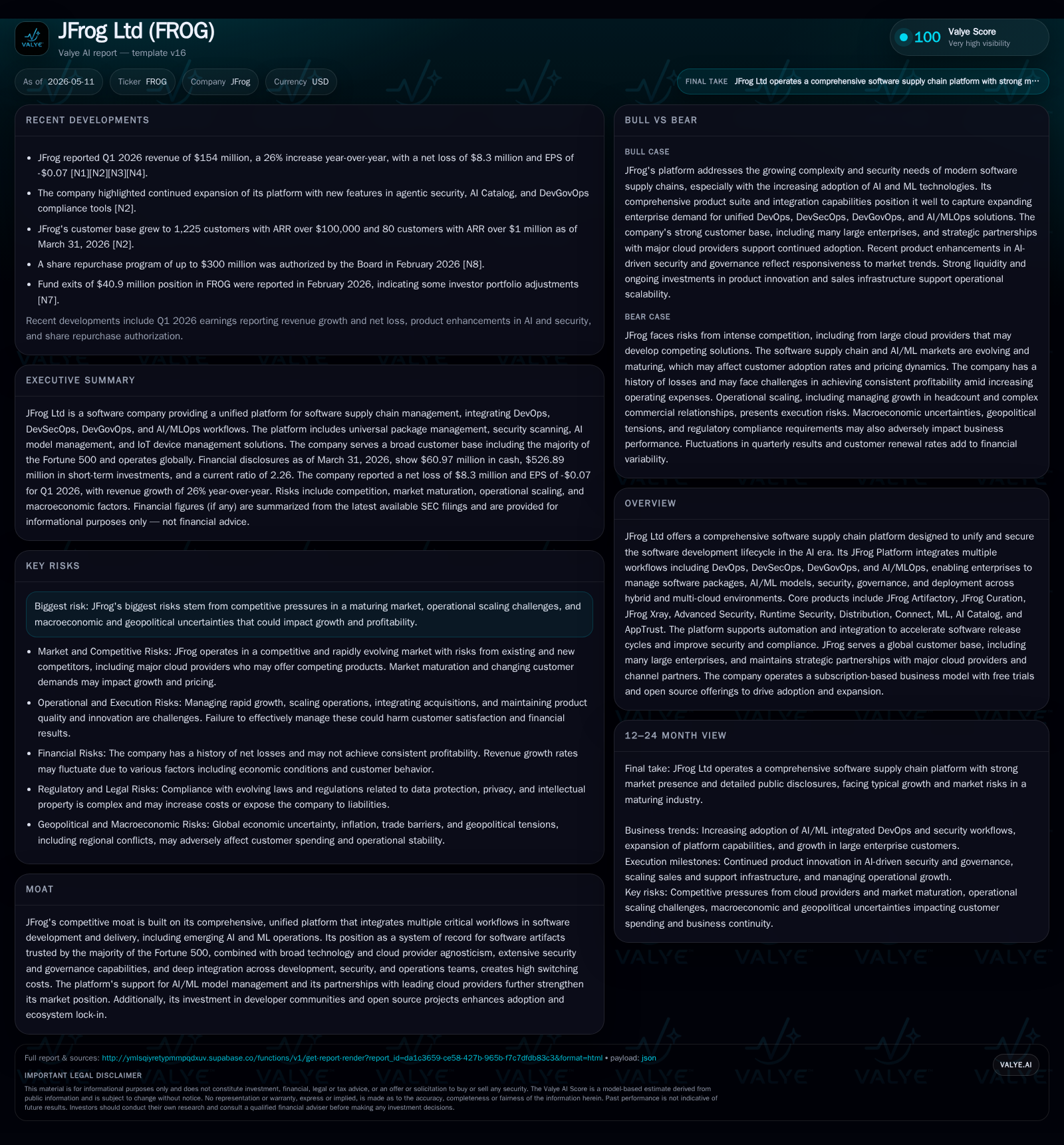
In the first quarter of 2026, JFrog demonstrated steady subscription revenue growth and an increasing shift toward SaaS offerings, reinforcing its role as a pivotal software supply chain platform provider. The company’s comprehensive product suite integrates DevOps, DevSecOps, MLOps, and AI governance, positioning it well within an evolving market increasingly reliant on secure, accelerated software release cycles. While competitive pressures and macroeconomic uncertainties persist, JFrog’s strong enterprise adoption and platform extensibility remain key growth levers. Monitoring SaaS penetration rates and innovation in AI-enabled workflows will be critical near-term indicators.
Recent Quarterly Operating Update: Key Metrics and Milestones
JFrog’s Q1 2026 filing dated May 8 affirmed ongoing operational momentum characterized by robust subscription revenue growth driven notably by SaaS expansion. Management highlighted sustained increases in monthly recurring revenue from cloud subscriptions alongside enlarged Enterprise Plus engagement from large accounts seeking comprehensive pipeline governance [S2]. The company reported steady net retention improvements reflecting cross-sell traction within existing clients across its unified platform. Additionally, recent announcements accompanying Q1 earnings emphasized new feature integrations supporting AI/ML model lifecycle management—a strategic extension addressing evolving developer demands in artificial intelligence operations (MLOps) domains [N2][N3]. Despite macroeconomic headwinds extending sales cycles for certain contracts and increasing budget scrutiny among enterprise customers, JFrog sustained its strategic focus on platform innovation paired with flexible subscription terms that accommodate diverse deployment preferences including self-managed on-premises or SaaS-based cloud solutions [S2][N3].
Business Model & Platform Ecosystem: Subscription Revenue and Product Suite
JFrog operates predominantly on a subscription-based business model selling access to its comprehensive software supply chain platform. Revenue streams bifurcate into self-managed licenses—offering customers the ability to host JFrog products within their private or hybrid cloud environments—and SaaS subscriptions delivered via JFrog-managed public cloud services. The SaaS modality gained representational prominence in FY 2025 with nearly 46% contribution to total revenues, up from 39% a year prior, evidencing secular migration toward cloud-native consumption patterns [S1]. This shift enhances margin profiles given lower operational overhead versus self-managed setups.
Core products include Artifactory for universal artifact repository management, Xray for security scanning and vulnerability analysis, Distribution for release orchestration across hybrid environments, plus advanced modules like JFrog Connect for edge device management and specialized components targeting AI cataloging functions. Through these offerings, the JFrog Platform enables converged workflows spanning DevOps (continuous integration/delivery), DevSecOps (embedded security controls), DevGovOps (policy enforcement/governance), alongside nascent AI/MLOps support catering to data scientists deploying ML models as production artifacts [S1].
The company’s strategy leverages bottom-up community adoption fueled by free open source Artifactory tiers supplemented by top-down enterprise sales engaging CIOs and CISO organizations negotiating Enterprise Plus bundled contracts. This layered approach fosters ecosystem entrenchment generating significant switching costs attributable to integrated artifact tracing capabilities essential for compliance in regulated industries [S17].
Competitive Position & Industry Context: Moat through Integration and Flexibility
JFrog occupies a defensible position as a system of record for software artifacts trusted by a majority of Fortune 500 firms. Its competitive moat derives from unparalleled platform breadth that uniquely integrates development pipelines with security governance while simultaneously accommodating emergent generative AI tooling workflows—an offering few direct competitors match comprehensively. This multi-disciplinary unification positions JFrog beyond fragmented point solutions typical in traditional DevSecOps or MLOps vendors.
Crucially, the platform maintains extensive interoperability across major package managers (npm, Maven, Docker etc.) plus cloud environments (AWS, Azure, GCP), preserving customer freedom from vendor lock-in—a prized attribute amid CIO concerns around ecosystem rigidity. While the market includes specialized start-ups targeting narrow niches such as runtime security or container scanning alone, JFrog’s holistic coverage coupled with mature enterprise-grade SLAs underpins substantial customer stickiness [S1].
Notwithstanding this strength, competition intensifies as hyperscalers integrate native artifact repositories and emerging secured software supply chain platforms vie for wallet share amid organizations’ evolving digital transformation needs.
Growth Drivers: SaaS Penetration, AI/ML Ops Expansion & Enterprise Demand
Key structural growth drivers include accelerating migration from self-managed licenses toward SaaS subscriptions which traditionally carry better unit economics due to standardized deployment efficiencies [S1][S2]. The company’s strategy to expand Enterprise Plus adoption reflects demand for bundled end-to-end solutions encompassing artifact management plus embedded security features designed specifically for complex regulatory regimes.
Further impetus stems from growing enterprise embrace of AI/ML applications necessitating governance frameworks managing ML models as first-class deliverables within software supply chains—delivery modalities JFrog increasingly integrates via its AI Catalog and ML-oriented product expansions [N2]. Demand acceleration is reinforced by broader industry dynamics where ‘Liquid Software’ — continuous incremental updates replacing monolithic releases — drives volume growth in packages managed per organization.
Ecosystem engagement through developer communities fostering open source adoption complements this expansion by creating organic user pipelines feeding conversion into paid tiers while partnering extensively with leading cloud service providers enhances go-to-market reach across hybrid cloud deployments.
Risks & Operational Challenges: Market Competition, Scaling, Macrouncertainties
JFrog faces significant risks stemming primarily from intensifying competition within both maturing DevSecOps markets and nascent AI/MLOps niches where agile start-ups may undercut pricing or innovate rapidly [S11][S15]. Market saturation among core repository offerings increases pressure on feature differentiation requiring sustained R&D investment.
Operationally scaling a platform spanning diverse technologies while managing longer enterprise sales cycles exposed during economic uncertainty complicates forecasting accuracy; heightened budget approvals may delay deal closures impacting near-term revenue visibility [S19]. Regulatory complexity around global data privacy laws poses compliance cost escalation impacting product development timelines. Intellectual property considerations surrounding open source contributions remain a nuanced balance between community goodwill and proprietary monetization protection [S13][S16].[
What to Watch Next: Guidance, Customer Adoption Signals, Platform Innovation
Going forward investors should monitor quarterly updates revealing trends in SaaS subscription percentage growth as proxy for margin enhancement potential coupled with increased uptake among Enterprise Plus tier customers signaling deeper platform penetration [N2][S2]. Pipeline health indicators such as new logo acquisitions versus upsell ratios will reveal success in broadening the customer base under challenging macro conditions.
On the innovation front, roadmap progress involving rollout of advanced ML-enabled cataloging features along with enhancements to runtime security modules aimed at trust enforcement in distributed hybrid clouds will be critical execution metrics to assess ongoing differentiation amidst competitor moves [N6][S3]. Any disclosures around acquisition activity complementing organic portfolio extensions will also bear watching given historical precedents linking inorganic moves to capability acceleration.
Current Financial Snapshot: Liquidity, Capital Structure and Profitability
Latest financial snapshot
| Metric | Value | Period |
|---|---|---|
| Cash & equivalents | $61mm | |
| 2026-03-31 | ||
| Current assets | $905mm | |
| 2026-03-31 | ||
| Current liabilities | $400mm | |
| 2026-03-31 | ||
| Current ratio | 2.26x | |
| 2026-03-31 |
Source: SEC companyfacts cache [F1].
| Metric | Value (USD millions) |
|---|---|
| Cash & Equivalents | 60.97 |
| Current Assets | 904.81 |
| Current Liabilities | 400.17 |
| Current Ratio | 2.26 |
As of March 31, 2026, JFrog reported cash and equivalents totaling approximately $61 million paired with current assets exceeding $900 million against current liabilities near $400 million yielding a healthy current ratio above 2.2 which supports its capacity to fund research and development along with operations without acute liquidity concerns [F1]. The company’s operating income remains negative historically reflecting continued investment posture aligned with market expansion objectives though improving top-line growth accompanied by subscription mix evolution lays groundwork for eventual operating leverage gains [F1].
Disclaimer: This analysis is strictly informational based on publicly available filings as of May 2026 without any investment advice or recommendation. Readers should conduct further due diligence before making any financial decisions related to JFrog Ltd.
Disclaimer: This is research-only, informational analysis and not investment advice. It may include AI-generated interpretation and general industry context. Always verify important details using primary sources.

Comments