
Ascent Solar Technologies Targets Niche Market with Advanced Flexible CIGS Panels
Latest quarterly results demonstrate stable liquidity while the company leverages its proprietary thin-film solar technology for specialized aerospace and defense markets.
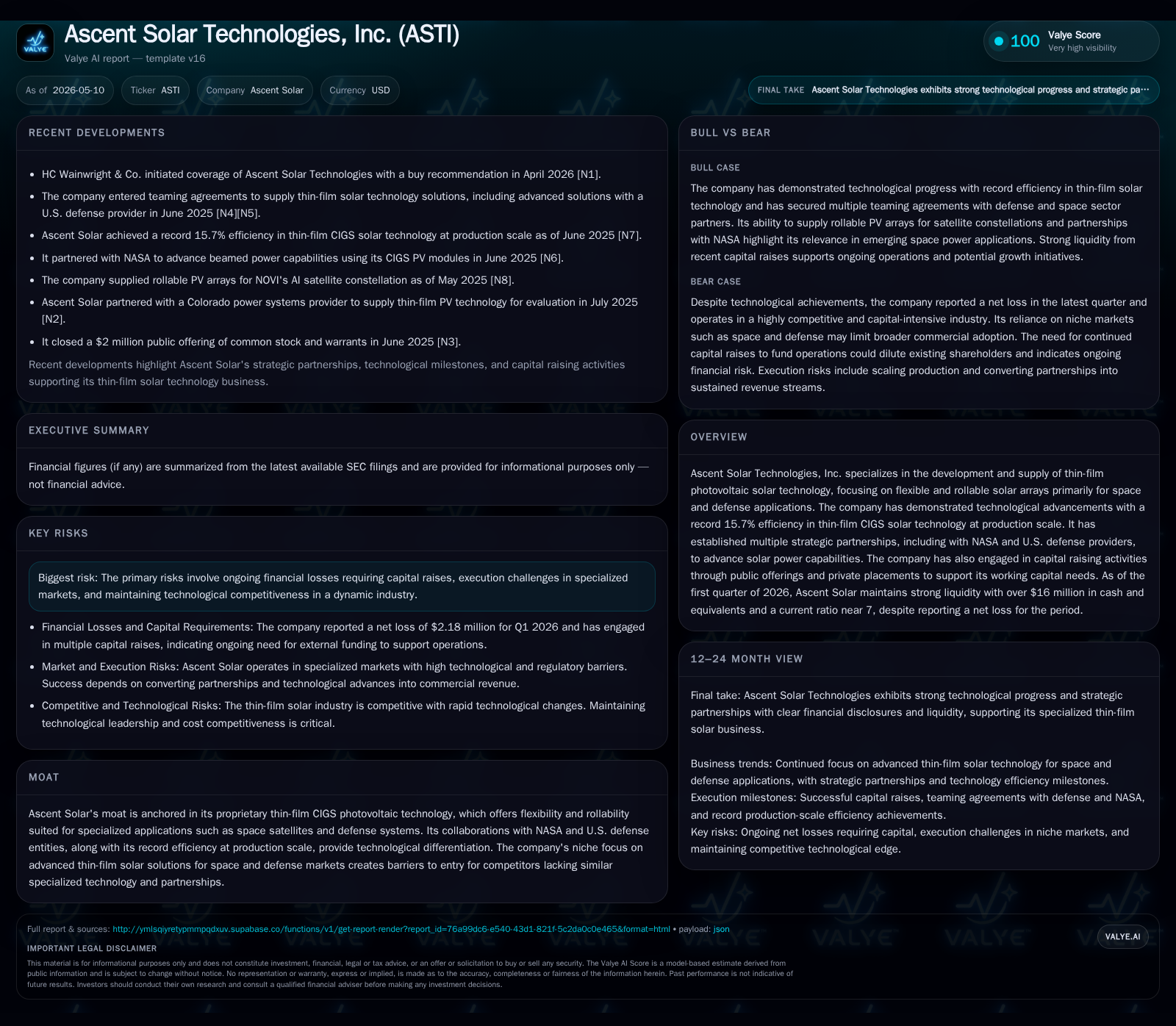
Ascent Solar Technologies continues to focus on its core strength of advanced thin-film CIGS photovoltaic technology tailored for flexible, rollable solar panels. Despite ongoing net losses, the company maintains strong liquidity, supported by recent capital raises, enabling sustained investment in production efficiency and strategic government partnerships. Its niche market presence in space and defense sectors, underpinned by record production-scale efficiencies and exclusive collaborations, creates meaningful competitive barriers. Key risks remain around financial sustainability and scaling challenges as Ascent seeks to expand its market footprint.
The company's cash and cash equivalents stood at approximately $16.07 million as of March 31, 2026, supporting a current ratio of nearly 7x [F1], which underlines its capacity to meet short-term obligations comfortably. Despite this liquidity strength, Ascent Solar reported continued net losses during the quarter consistent with its strategic phase of investing heavily in advancing production-scale efficiencies and sustaining operations within specialized markets. This financial posture reflects a common theme among companies at technology development intersections where R&D intensity remains substantial before scaled commercialization.
The latest filing confirms that the company is actively managing its capital base via public offerings and private placements conducted recently to underpin working capital needs and ensure runway continuity [S2][S16]. Although the business remains unprofitable from an income perspective, these inflows enable ongoing innovation efforts critical to maintaining technological leadership in a competitive environment dominated by rigid silicon alternatives.
Business Model Centered on Flexible Thin-Film CIGS Technology for Specialized Markets
At its core, Ascent Solar’s business model revolves around the design, manufacture, and licensing of advanced copper indium gallium selenide (CIGS) thin-film photovoltaic technology with a unique emphasis on flexibility and rollability [S1]. This product differentiation targets high-value applications that demand lightweight, conformal solar solutions—most notably spacecraft power systems and defense-related portable power devices.
The revenue generation mechanics primarily involve sales of proprietary flexible solar modules or contractual licensing arrangements tied to bespoke array designs tailored to clients’ mission profiles. Customers pay for high-efficiency solar panels designed to withstand rigorous operational environments where traditional rigid photovoltaics fall short in durability or form factor compatibility. Consequently, volume increases depend largely on contract awards from agencies valuing performance under stringent technical constraints rather than broad commodity pricing pressures typical in utility-scale solar sectors.
Cost structures are influenced by materials sourcing complexity inherent to thin-film deposition processes, manufacturing precision required for reliable flexible substrates, and ongoing R&D expenditures aimed at incremental efficiency gains—the latest milestone being a record 15.7% conversion efficiency at production scale. This metric not only enhances product competitiveness but may also gradually improve gross margins if realized systematically across manufacturing volumes.
Competitive Advantages from Proprietary Tech and Government Collaborations
Ascent Solar’s moat anchors itself strongly in its intellectual property portfolio protecting the proprietary CIGS thin-film formulation capable of producing rollable solar arrays—a capability few competitors replicate at comparable efficiency levels. The technology’s niche application scope fosters natural switching costs as system integrators align closely with Ascent’s flexible module designs when developing mission-specific products.
Strategic partnerships further reinforce this position. Engagements with NASA grant access to cutting-edge aerospace validation processes while collaboration with U.S. defense providers ensures alignment with evolving military standards and contract pipelines [S1]. These relationships do more than provide sales opportunities—they facilitate co-development ventures that embed Ascent’s technology deeply into supply chains that are challenging for new entrants to penetrate absent similar credentials.
Moreover, the sector’s regulatory environment imposes certification complexities favorable to incumbents possessing established compliance records. Combined with the scientific hurdle of achieving consistent high-efficiency thin films on flexible substrates at production scale, these factors erect formidable entry barriers preserving Ascent’s competitive landscape.
Growth Catalysts: Efficiency Gains, Defense Contracts, and Market Penetration
Looking forward, several growth drivers shape Ascent Solar’s trajectory:
Efficiency Improvements: Ongoing R&D aiming to push beyond the current 15.7% production-scale efficiency confers direct product enhancements impacting power-to-weight ratios—a critical parameter in aerospace applications where every gram impacts mission cost effectiveness.
Government Contract Expansion: The renewal or initiation of contracts with NASA and defense agencies constitutes a vital revenue source increasing product adoption visibility while reinforcing future backlog levels. The nature of these contracts typically involves multiyear awarding cycles supporting medium-term growth visibility.
Terrestrial Applications Exploration: While historically focused on space/defense niches, evolving manufacturing techniques may unlock broader terrestrial uses where flexible solar wraps can be installed on curved surfaces or portable equipment—potentially enlarging addressable markets should technical scalability & cost-effectiveness align favorably [N1].
Collectively these catalysts converge around technological execution measured by tractable KPIs such as efficiency percentage gains in pilot runs, contract win announcements from government solicitations, order intake sizes reflecting increased adoption rates, and successful demonstration projects translating to commercial traction.
Risks to Monitor: Financial Losses, Execution Complexity, and Market Scalability
Notwithstanding promising operational dimensions, several risk factors warrant close attention:
Persistent Operating Losses: The company continues enduring net losses fueled by intensive R&D spending coupled with manufacturing scale-up expenses necessitating recurrent capital raises that could dilute existing shareholders if not offset by revenue acceleration [S1][S2].
Specialized Market Dependence: Revenue concentration within space/defense niches subjects the company to cyclical funding patterns characteristic of government budgets which can fluctuate due to policy shifts or procurement delays affecting order predictability.
Scaling Manufacturing: Transitioning from pilot lines demonstrating record efficiency figures to reliable volume manufacturing carries execution risk. Cost overruns or yield volatility could erode margin assumptions challenging profitability timelines.
Technological Competition: Emergent photovoltaic technologies or alternative energy storage innovations could diminish demand for Ascent’s solution if faster-to-market competitors deliver superior value propositions without comparable integration hurdles.
Tracking these markers will provide insight into execution momentum confirming whether Ascent is closing gaps between innovation promise and commercial realization.
Financial Overview: Liquidity Position and Capital Structure Snapshot
Ascent Solar’s balance sheet presents a healthy liquidity buffer supporting near-term obligations comfortably with a current ratio approaching sevenfold coverage [F1]. While explicit current debt figures have not been updated recently in filings beyond mid-2020 data indicating modest indebtedness relative to cash reserves [F1], ongoing reliance on equity-based financing rounds signals that operating losses pressure cash burn profiles necessitating vigilant cash management strategies [S2][S16].
Disclaimer: This is research-only, informational analysis and not investment advice. It may include AI-generated interpretation and general industry context. Always verify important details using primary sources.

Comments