
Alliance Resource Partners LP Navigates Coal Market Pressures with Diversified Mineral Assets and Strategic Investments
Recent quarter highlights operational resilience amid market and regulatory headwinds, leveraging a broad coal-mineral portfolio and royalty income.
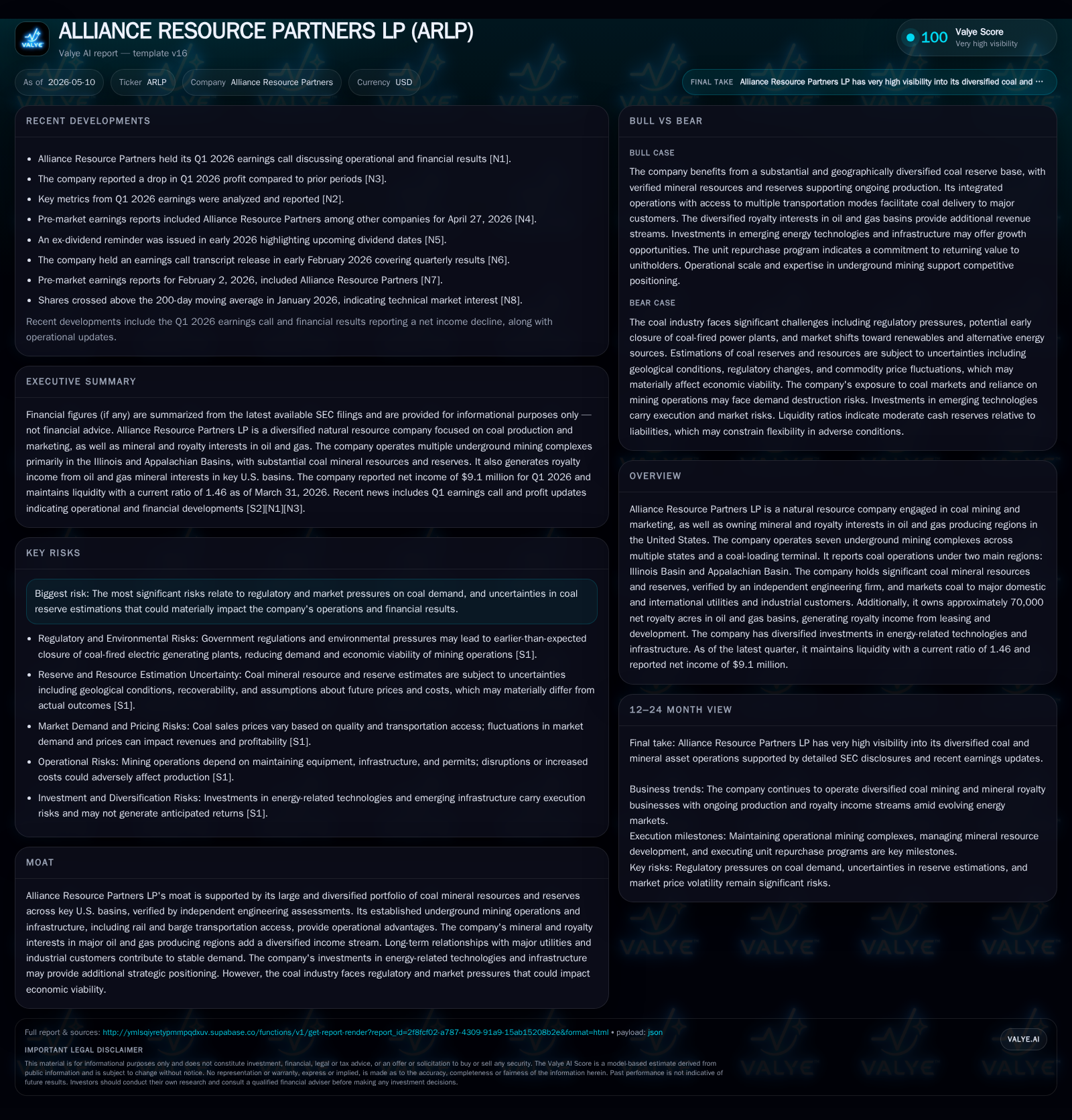
In Q1 2026, Alliance Resource Partners LP reported stable operating conditions despite ongoing coal industry challenges, underpinned by steady mineral resource development and diversified royalty interests. The company’s large-scale underground mining operations in major U.S. basins and its 70,000 net royalty acres in oil and gas play a pivotal role in sustaining revenue streams. Growth initiatives focus on expanding mineral lease development and strategic energy technology investments. Regulatory and market risks persist as key constraints on long-term coal demand, highlighting the importance of the company’s diversification strategy.
Recent Operating Update
Alliance Resource Partners LP’s latest quarterly filing dated May 8, 2026 ([S2]) confirms continuity in its core operational footprint amid a challenging macro environment for coal. The company operates seven underground mining complexes across Illinois, Indiana, Kentucky, Maryland, Pennsylvania, and West Virginia with outputs segmented into two main regions: the Illinois Basin and Appalachian Basin. Despite sector headwinds impacting coal demand globally, ARLP maintained steady production volumes in Q1 2026 and continued leveraging its coal-loading terminal assets on the Ohio River for logistics efficiency.
A recent April 27, 2026 event filing ([S3]) supplements this narrative with management commentary emphasizing the importance of mineral lease activity on their approximately 70,000 net royalty acres primarily held in the Permian, Anadarko, and Williston Basins. Royalty cash flows from oil & gas development have become an increasingly material complement to the company’s traditional coal portfolio.
Business Model Overview
Alliance Resource Partners LP operates as an integrated natural resource enterprise focused predominantly on coal mining and marketing while concurrently managing extensive mineral interest assets in oil & gas plays. The firm earns revenue through multiple channels:
- Coal Production Sales: Direct sale of mined thermal coal to domestic utilities and industrial customers as well as international buyers.
- Coal Mineral Leasing: Internal leases within its holdings supply mining complexes while external leases provide intercompany royalty income.
- Oil & Gas Royalties: Leasing mineral rights to operators across top U.S. basins that yield royalties linked to production volumes.
- Strategic Investments: Through subsidiaries like Matrix Group (technology products/services) and Bitiki (bitcoin mining), ARLP diversifies earnings beyond fossil fuels.
The company focuses on maximizing value from its substantial asset base — promoting long-term commodity cash flow stability through diversified asset exposure while controlling operating costs via underground mining efficiencies and leveraging economies of scale.
Industry Structure and Competitive Position
ARLP is recognized as the second-largest eastern U.S. coal producer with well-established underground mines possessing high-quality reserves vetted by independent engineering (RESPEC) as noted in their latest annual filing ([S1]). The dual-region approach spanning Illinois Basin (high-sulfur thermal coal) and Appalachian Basin (varied quality) allows a balanced product slate catering to diverse customer needs.
Key competitive advantages derive from:
- Extensive reserve base with over 287 million tons of proven plus probable reserves comprising thick seams (average >4.5 feet) at favorable depths (200–500 feet).
- Control over logistical infrastructure including river terminal access facilitating multimodal distribution critical for industrial-scale delivery requirements.
- Long-standing contracts with major utilities underpinning reliable baseload demand despite sector volatility.
- Integration of mineral leasing mitigates exposure solely to physical production disruptions while tapping into upstream oil & gas activity cycles.
However, the broader industry faces pronounced secular decline driven by regulatory plant retirements affecting long-term demand sustainability in thermal coal markets.
Growth Drivers
Three principal growth levers emerge:
- Expansion of Mineral Lease Development: Continued leasing activity across ARLP's mineral acres supports incremental royalty streams aligned with rising upstream exploration/development trends noted across premier basins like the Permian.
- Operational Efficiency Gains: Technological upgrades via Matrix Group's offerings aim to reduce mining costs per ton through improved equipment reliability and process innovations — essential to sustain margins amid commodity price pressures.
- Energy-Related Investment Portfolio: Diversification into bitcoin mining (Bitiki) and other infrastructure projects provides optionality outside traditional commodity cycles, potentially offsetting cyclical dips in coal pricing or volume sold.
Management targets capital deployment towards these areas while maintaining financial discipline — enabling flexible responses to fluctuating market conditions.
Risks and Constraints
While ARLP maintains a strong asset base coupled with operational scale advantages, several risk factors constrain growth visibility:
- Regulatory Environment: Accelerating U.S. environmental policies could hasten closure schedules for coal-fired generation plants reducing demand faster than modeled assumptions underlying reserve valuations ([S1]).
- Market Demand Uncertainty: Increasing competition from renewables/natural gas alongside potential structural drop in industrial coal usage presents permanent headwinds.
- Reserve Estimation Variability: Geological condition unpredictability affects recoverable volumes; revisions can materially impact future production volumes ([S1]).
- Litigation Exposure: Despite settling labor disputes amounting to $15.3 million approved late 2025 ([S7]), ongoing environmental compliance risks remain inherent with mine safety regulations continuously enforced ([S8]).
- Debt Leverage: With total debt near $507 million against cash reserves around $29 million and a current ratio of about 1.46 ([F1]), financial flexibility depends on stable cash flow generation amidst sector cyclicality.
What to Watch Next
Investors and analysts should track milestones such as:
- Quarterly production volumes segmented by basin to gauge operational momentum against external demand shocks.
- Royalty income trends reflecting upstream drilling/leasing activity within owned mineral acreage.
- Earnings releases referencing margin progression attributable to cost control initiatives or pricing shifts.
- Capital expenditures related to technology deployments or new investments signaling strategic capital allocation decisions.
- Regulatory developments impacting federally mandated plant retirements or permitting that alter demand outlooks for thermal coal products.
Management guidance updates during earnings calls or SEC filings will also signal evolving expectations amid volatile energy markets ([N1], [N2]).
Financial Profile Summary
Latest financial snapshot
| Metric | Value | Period |
|---|---|---|
| Cash & equivalents | $29mm | |
| 2026-03-31 | ||
| Total debt | $507mm | |
| 2026-03-31 | ||
| Net debt | $479mm | |
| 2026-03-31 | ||
| Current assets | $409mm | |
| 2026-03-31 | ||
| Current liabilities | $280mm | |
| 2026-03-31 | ||
| Current ratio | 1.46x | |
| 2026-03-31 |
Source: SEC companyfacts cache [F1].
From the latest quarter ended March 31, 2026 ([F1], [S2]):
| Metric | Value (USD) | Period Ended |
|---|---|---|
| Cash & Equivalents | 28.9M | |
| 2026-03-31 | ||
| Total Debt | 507.5M | |
| 2026-03-31 | ||
| Current Assets | 408.7M | |
| 2026-03-31 | ||
| Current Liabilities | 280.3M | |
| 2026-03-31 | ||
| Current Ratio | 1.46 | |
| 2026-03-31 | ||
| Net Debt | ~478.6M | |
| 2026-03-31 |
This analysis is based on publicly available filings as of May 2026 without investment recommendations.
Disclaimer: This is research-only, informational analysis and not investment advice. It may include AI-generated interpretation and general industry context. Always verify important details using primary sources.

Comments