
Yelp Expands AI-Driven Local Advertising in Face of Economic Challenges
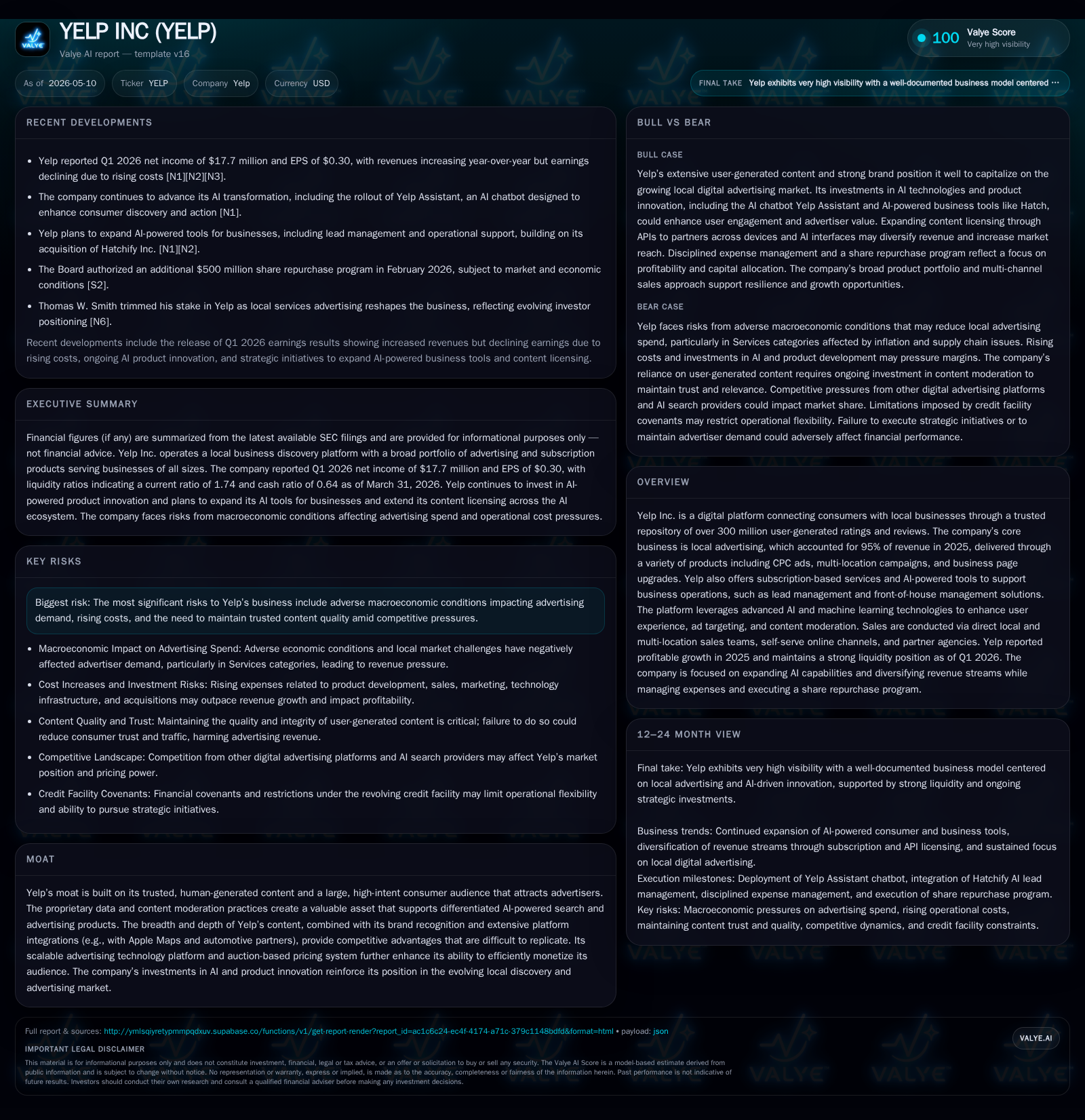
Yelp's Q1 2026 highlights resilient revenue growth and strategic AI investments despite mounting cost pressures under macroeconomic headwinds.
In its latest quarterly report, Yelp demonstrated robust year-over-year revenue gains driven by its local advertising platform, even as operating expenses from sales and marketing rose notably. The company’s longstanding moat built on trusted user-generated content continues to underpin a sizable high-intent consumer base, supporting both direct and self-serve advertising models. Yelp is increasing its focus on AI-powered tools that enhance advertiser targeting and operational services, positioning for long-term growth amid persistent challenges in local economic conditions and advertiser demand. Risks persist from macroeconomic pressures and the ongoing necessity to maintain content integrity amid regulatory scrutiny.
Q1 2026 Operating Update: Revenue Growth and Cost Dynamics
Yelp's first-quarter earnings filing dated May 8, 2026, reveals continued top-line expansion despite persistent challenges in the broader local economy. The company reported year-over-year revenue growth driven primarily by its core local advertising offerings. However, rising expenditures weight heavily on profitability: increased sales and marketing expenses were notable contributors to margin pressures during the quarter [S2][N2]. This elevated cost base reflects strategic investments aimed at sustaining customer acquisition momentum and accelerating product innovation—particularly connected to Yelp’s AI initiatives.
Importantly, Yelp maintained profitable growth in this environment as it managed the delicate balance between fueling future growth drivers and controlling near-term financial performance. Recent event filings reinforce this narrative with management commentary reaffirming their commitment to leveraging AI-enhanced products across both consumer-facing discovery tools and business operational solutions [S3][N1].
Yelp’s Business Model: Trusted Content Meets Advertising Innovation
At the heart of Yelp’s business model lies a highly curated corpus of over 300 million user-generated reviews—a resource foundational to its platform’s credibility. Yelp employs advanced content moderation systems combining machine learning algorithms alongside human moderators to ensure review reliability, helping preserve consumer trust and platform integrity. This extensive repository attracts an affluent consumer audience demonstrating significant purchase intent, a critical factor that lowers traffic acquisition costs while enhancing advertiser appeal [S1][S9].
Revenue generation primarily depends on delivering targeted advertising products to local businesses that seek exposure within this engaged audience. Yelp operates an auction-based cost-per-click (CPC) pricing mechanism for ads placed both on its own platform and across partner ecosystems. The company caters to a variety of advertisers—from small single-location businesses served predominantly through its Local sales team or self-serve digital channels to multi-location national advertisers who benefit from more complex campaigns and account management support [S9][S21]. Additionally, subscription services have grown as ancillary revenue streams providing business page upgrades and AI-powered tools designed for operational efficiency beyond pure advertising spend.
Competitive Context: Positioning Within the Local Digital Advertising Market
Yelp’s competitive position derives significantly from its dual fortress of trusted local content and consumer trust combined with sophisticated advertising technology infrastructure. Its proprietary recommendation software evaluates thousands of signals per review submission to promote only reliable content prominently, a crucial differentiation from lower-quality aggregators or algorithmically generated platforms. The ability to attract a loyal base of users with high intent translates into higher-bid competition in Yelp’s auction system for ad placements—a structural advantage enabling efficient monetization [S14].
Further reinforcing its moat are strategic integrations such as with Apple Maps and automotive infotainment systems expanding reach beyond traditional web or app channels. These integrations embed Yelp’s verified content within broader discovery contexts where consumers seek immediate local information.
However, the market remains fiercely competitive with major players like Google leveraging larger ecosystems for search dominance while also developing integrated ad offerings targeting local businesses directly. Yelp confronts industry cyclicality heavily influenced by macroeconomic conditions impacting discretionary budgets within key categories such as Restaurants, Retail & Other (RR&O). Sustained efforts in product innovation and sales channel diversification are vital defenses against these headwinds [S14][S26].
Growth Drivers: AI Integration and Enhanced Customer Offerings
Yelp is actively pivoting toward enhanced AI capabilities as central pillars of future growth. Initiatives include expanding usage of large language models (LLMs) within Yelp Assistant — an AI chatbot designed to transform traditional search into conversational experiences facilitating seamless transitions from discovery to actionable outcomes (e.g., booking appointments or requesting quotes) across numerous business categories [S19].
On the advertiser front, expansions involve offering AI-driven operational tools like lead generation/management platforms acquired via Hatchify Inc., enabling service businesses especially to manage customers beyond simple ad clicks—extending value deeper into client workflows [S19][N1]. Such products address unmet needs within verticals where advertising alone is insufficient for capturing full demand potential.
These advancements are expected to improve subscriber uptake rates among business customers as well as increase average revenue per user through add-on service sales. The integration of richer user behavior data coupled with machine learning-optimized ad targeting aims to boost advertiser ROI perception which is critical given current budget sensitivities.
Risks and Constraints: Macroeconomic Headwinds and Content Integrity
A persistent risk outlined by management focuses on adverse macroeconomic factors constraining advertising demand particularly within RR&O sectors hit hardest by tightened consumer spending patterns in recent years—a scenario exacerbated by inflationary pressures, elevated interest rates, labor shortages, and supply chain disruptions [S1]. Reduced demand poses risk for customer acquisition volumes, retention rates, and could pressure pricing power long term.
Additionally, maintaining content quality amidst increased scrutiny presents ongoing financial and reputational risks. Legal proceedings related to intellectual property rights claims or regulatory investigations into data privacy could result in costly compliance expenditures or restrictive operational mandates influencing product design decisions [S6]. Preservation of trusted review authenticity remains imperative; any dilution due to deceptive practices or compromised moderation efficacy can degrade user engagement.
Monitoring Key Milestones: Customer Adoption and Product Expansion
Looking forward, important milestones include monitoring sequential trends in paying advertisers across Local versus Multi-location segments as indicators of continued sales execution success [S2]. Uptake rates for newly launched AI-powered subscriptions will provide early validation of expanded monetizable offerings beyond traditional advertising.
User engagement metrics—traffic levels especially repeat visitation—and average revenue per user will be useful barometers reflecting marketplace relevance amid changing consumer behaviors impacted by economic cycles [N4][N5]. Margin trajectory will also merit attention given cost increases; improving operating leverage through scalable technologies represents a midterm objective.
Latest Financial Snapshot
Latest financial snapshot
| Metric | Value | Period |
|---|---|---|
| Cash & equivalents | $110mm | |
| 2026-03-31 | ||
| Current assets | $302mm | |
| 2026-03-31 | ||
| Current liabilities | $174mm | |
| 2026-03-31 | ||
| Current ratio | 1.74x | |
| 2026-03-31 |
Source: SEC companyfacts cache [F1].
| Metric | Value (USD) |
|---|---|
| Cash & Equivalents | $110.4 million |
| Total Debt | $17.6 million |
| Current Assets | $302.0 million |
| Current Liabilities | $173.7 million |
| Current Ratio | 1.74 |
As of March 31, 2026, Yelp maintains a strong liquidity position with cash reserves significantly exceeding debt obligations resulting in negative net debt—a positive signal for financial flexibility amidst investments in product innovation [F1][S2].
This analysis is based solely on publicly available SEC filings as well as verified news reporting without speculation or forward-looking statements beyond those expressly disclosed by the company.
Disclaimer: This is research-only, informational analysis and not investment advice. It may include AI-generated interpretation and general industry context. Always verify important details using primary sources.

Comments