
International Tower Hill Mines Advances Livengood Project with Fresh Capital Influx
Strong equity raises and a key board appointment in early 2026 provide financial and governance support for Livengood Gold Project advancement.
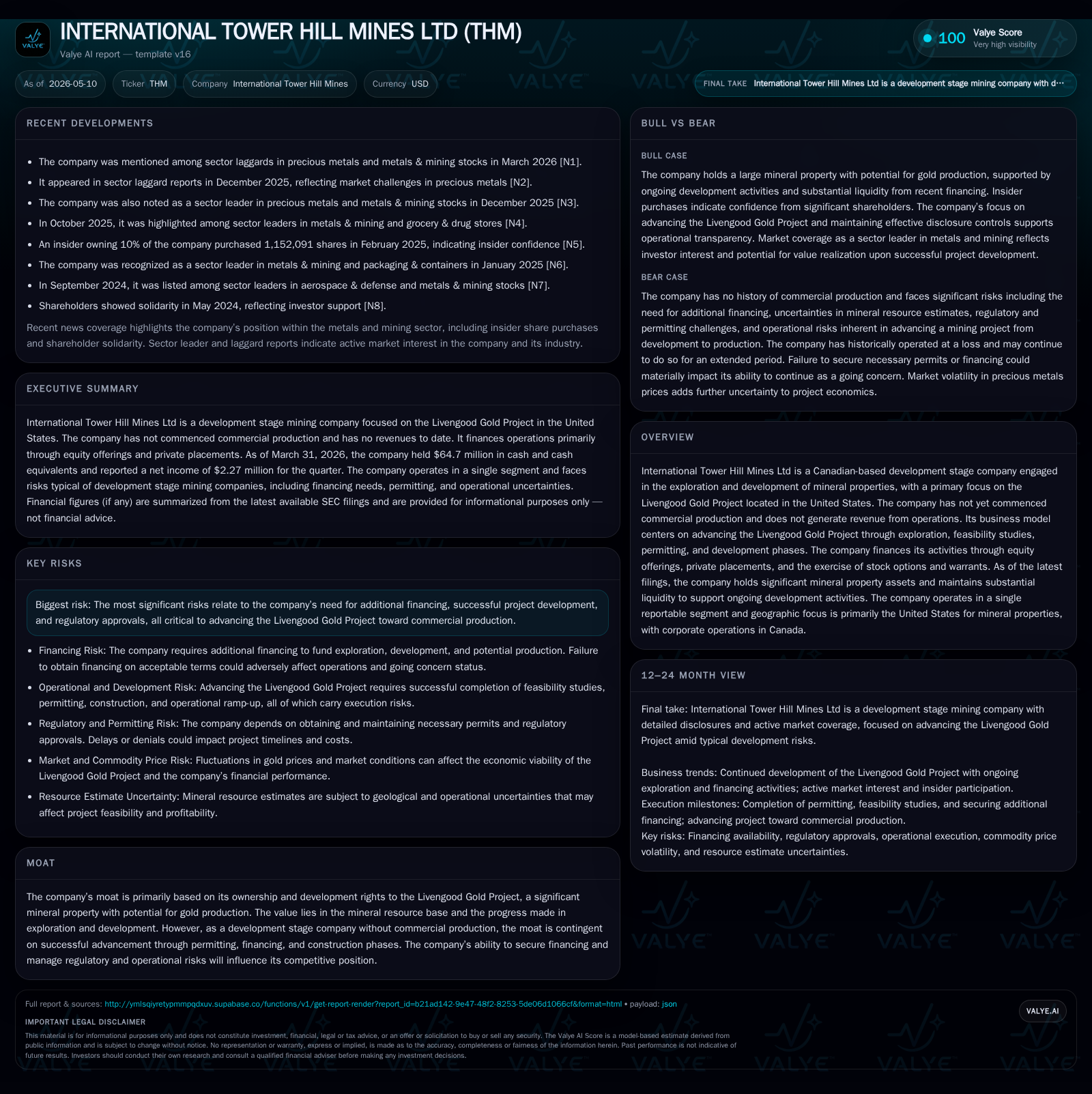
International Tower Hill Mines Ltd (THM), a development-stage company focused solely on the Livengood Gold Project in Alaska, reported substantial capital raising in Q1 2026, including a $74.75 million public offering and a concurrent $43.3 million private placement, boosting cash reserves to nearly $64.7 million. These funds underpin planned exploration, feasibility, and permitting activities essential for progressing toward commercial gold production. While still pre-revenue and reliant on capital markets, recent leadership enhancements and strong liquidity position the company to navigate typical junior mining development risks amid fluctuating gold prices and regulatory challenges.
Recent Quarterly Update: Capital Raising and Operational Snapshot
The latest quarterly filing dated May 8, 2026 outlines substantial financing activity enabling International Tower Hill Mines Ltd (THM) to markedly strengthen its liquidity position amid ongoing development-phase expenditures [S2]. Notably, the company completed a public offering of 33.67 million common shares at approximately $2.22 per share grossing about $74.75 million before costs. Concurrently, it executed a private placement yielding roughly $43.3 million from existing major shareholders including affiliates of Paulson [S2][S24]. Additionally, exercise of stock options generated minor proceeds nearing $0.3 million.
This influx brought cash and equivalents to $64.7 million as of March 31, 2026 versus only $1.35 million at year-end 2025, with working capital surging from near parity to over $114 million [F1][S2]. The investment of $50 million into short-term certificates of deposit was also recorded, reflecting a temporary deployment of capital towards preserving value while maintaining liquidity flexibility.
Operationally, THM continues to incur burn primarily from drilling programs, engineering studies, permitting activities, and administrative overheads consistent with an exploration and development stage company without commercial production or revenue generation [S2]. In concert with these financial milestones was the appointment of Andrew Cole to the board on April 1, 2026 — signaling an enhancement in governance as the company approaches critical project advancement hurdles [S3].
Collectively, this quarter represents a pivotal moment as fresh capital secures runway for executing feasibility studies and regulatory filings integral to moving Livengood towards production readiness.
Business Model Centered on Livengood Gold Development
International Tower Hill Mines operates exclusively within one reportable segment: mineral property exploration and development focused entirely on the Livengood Gold Project located in Alaska, USA [S2][S1]. The firm holds a 100% interest in this significant deposit containing proven and probable reserves totaling approximately 430.1 million tonnes at an average grade of 0.65 g/tonne (roughly 9 million ounces) evaluated using a gold price assumption near $1,680 per ounce [S24]. Measured and indicated resources beyond reserves reach over 4.6 million ounces.
Revenue generation remains nonexistent as THM has not begun ore extraction or commercial operations; thus its business model revolves around advancing geological understanding via drilling campaigns, refining economic feasibility through technical studies (including pre-feasibility and definitive feasibility), securing lengthy environmental permitting under U.S. jurisdictional frameworks, followed by construction phase planning [S1].
Funding stems predominantly from equity markets via share offerings alongside stock option/warrant exercises due to zero operational cash flow or underlying earnings ability. Operating expenses encompass exploration logistics, professional fees related to engineering consultants and legal advisors for permits, corporate overhead including wages & benefits, investor relations efforts, travel for regulatory engagements as well as rent & administration costs — all reflective of typical junior mining expenditure profiles without short-term margin considerations [S2][S12].
The monolithic focus on one mineral asset introduces concentration risk but also delineates the company’s strategic value proposition premised on successful development of a large-scale gold resource with potential multi-decade production.
Navigating The Exploration-Development Industry Structure
THM’s operating environment typifies junior mining companies pushing large-scale projects through a capital-intensive development cycle marked by high uncertainty and long lead times before any cash flow realization can occur [S1]. The sector requires ongoing access to financing amid fluctuating commodity cycles which affect investor appetite for high-risk projects.
In this space, competitive positioning depends heavily on property scale (resource size), grade quality relative to extraction cost thresholds established by feasibility studies, political/regulatory climate favorability particularly under U.S. mining regulations — which tend to be stringent with protracted permitting periods — plus demonstrated management capability steering projects across technical milestones [S1].
Livengood’s reserve size offers moat potential through scale economies once operational; however security of this advantage hinges on successful exploration proving consistent grades aligning with model assumptions as variability in resource estimates can materially alter projected economics post-extraction start-up.
Market pricing power is indirect: while gold prices set fundamental value ceilings underpinning project viability thresholds stated at ~$1680/oz in their latest reports — timing mismatches between project duration and commodity cycles may compress realized returns or extend financing horizons if commodity prices dip below economic cutoffs during ramp-up phases [S1]. Thus sustainable growth leverages both macro pricing structures and milestone execution reliability.
Growth Catalysts: Financing Pathway and Project Advancements
Primary growth drivers for THM comprise its ability to reliably secure large-scale financing evidenced by Q1’s successful equity raises totaling over $114 million net proceeds enabling continued operational activity without imposing immediate dilution panic among shareholders [S2][S24]. Furthermore:
- Advancement through key permitting stages critical for project legitimacy under U.S federal/state laws;
- Completion of updated feasibility studies confirming economically viable parameters such as cost estimates vs expected revenues;
- Expanding or upgrading measured resources or reserves through further drilling increasing project scale;
- Reducing technical risk by resolving metallurgical uncertainties that affect processing efficiency;
- Potential formation of strategic alliances or joint ventures bringing additional capital or operational expertise.
The Q1 capital injection sustains work plans forecasted throughout 2026 allowing the team to maintain drill programs alongside environmental impact assessments fundamental for licensing applications. Management commentary underscores optimism about crossing financing/regulatory milestones that unlock transition from development toward construction phases contingent upon successfully navigating bureaucratic processes within projected budget envelopes [S2][S24].
Risks and Constraints: Financing Needs, Permitting, and Execution Challenges
Despite positive recent developments THM operates under pronounced risk conditions common across early stage mineral developers:
- Persistent dependence on external equity raises due to zero operating revenue generating capacity heightens exposure to market sentiment swings inducing fundraising difficulties especially amid broader market volatility or downturns in precious metals investor interest [S1];
- Variability in ore grade distribution relative to preliminary estimates may reduce anticipated recoverable ounces impacting economic viability;
- Regulatory risks arising from potentially lengthened environmental permitting timelines or changes in legislation could delay project schedules increasing carrying costs;
- Execution risks tied to managing complex technical studies accurately forecasting capex requirements without material overruns;
- Share dilution risk inherent in successive financings required until commercial production begins possibly depressing existing shareholder value.
The company explicitly acknowledges these vulnerabilities noting its "moat" is contingent upon overcoming technical/regulatory/capital constraints successfully while adapting strategically to prevailing gold price environments that justify continued investment commitment [S1].
Upcoming Milestones and What Investors Should Monitor Next
Key upcoming factors investors should monitor include:
- Publication of updated or definitive feasibility study updates detailing shifts in projected costs or production timelines;
- Progress updates on acquiring necessary permits from U.S federal agencies required for surface disturbance approvals;
- Announcements regarding additional equity or debt financing transactions indicating ability to fund prolonged construction expenditures;
- Strategic partnership developments providing alternative financing sources or operational capabilities;
- Capital expenditure forecasts revisions clarifying revised cost structures or timing changes demonstrating management execution competency.
These developments will provide tangible markers reflecting whether THM is advancing beyond development phase hurdles toward eventual mine construction readiness.
Latest Financial Position: Balancing Liquidity and Operating Cash Flow
Latest financial snapshot
| Metric | Value | Period |
|---|---|---|
| Cash & equivalents | $65mm | |
| 2026-03-31 | ||
| Current assets | $115mm | |
| 2026-03-31 | ||
| Current ratio | 7.65x | |
| 2026-03-31 |
Source: SEC companyfacts cache [F1].
As of March 31, 2026 end-of-quarter data reveal THM holds cash & equivalents totaling approximately $64.7 million supported by current assets near $115.4 million resulting in a solid current ratio estimated around 7.65x indicative of robust short-term liquidity coverage relative to liabilities recorded previously reflective mostly of accrued obligations unrelated directly to long-term indebtedness given no disclosed debt balances currently reported [F1][S2].
Operating outflows during Q1 amounted roughly $1.8 million representing burn related mainly to high-cost exploration activities without offsetting revenues given the pre-production status consistent with zero top-line reporting historically by the firm [F1][S2].
Interest income realized rose significantly owing largely to investment placements coinciding with increased cash balance deployment into certificates of deposit yielding better short-term returns enhancing overall net income reported positively this quarter unlike losses recorded prior reflecting primarily non-operational income effects rather than business earnings base expansion [S2][F1].
This analysis synthesizes information from International Tower Hill Mines Ltd’s recent SEC filings emphasizing operational mechanics behind their Avancement strategy focused exclusively on their flagship Livengood Gold Project's progression through development milestones supported by substantial recent capital raises enhancing liquidity posture albeit tempered by inherent sector risks typical for early stage mineral developers lacking operating revenues. All statements are grounded exclusively in filed disclosures without speculative inputs or investment recommendations.
Disclaimer: This is research-only, informational analysis and not investment advice. It may include AI-generated interpretation and general industry context. Always verify important details using primary sources.

Comments