
Airship AI Strengthens Edge Data Platform Amid Client and Industry Dynamics
Recent quarterly filing highlights Airship AI's operational momentum as it advances its edge AI platform while balancing customer concentration risks.
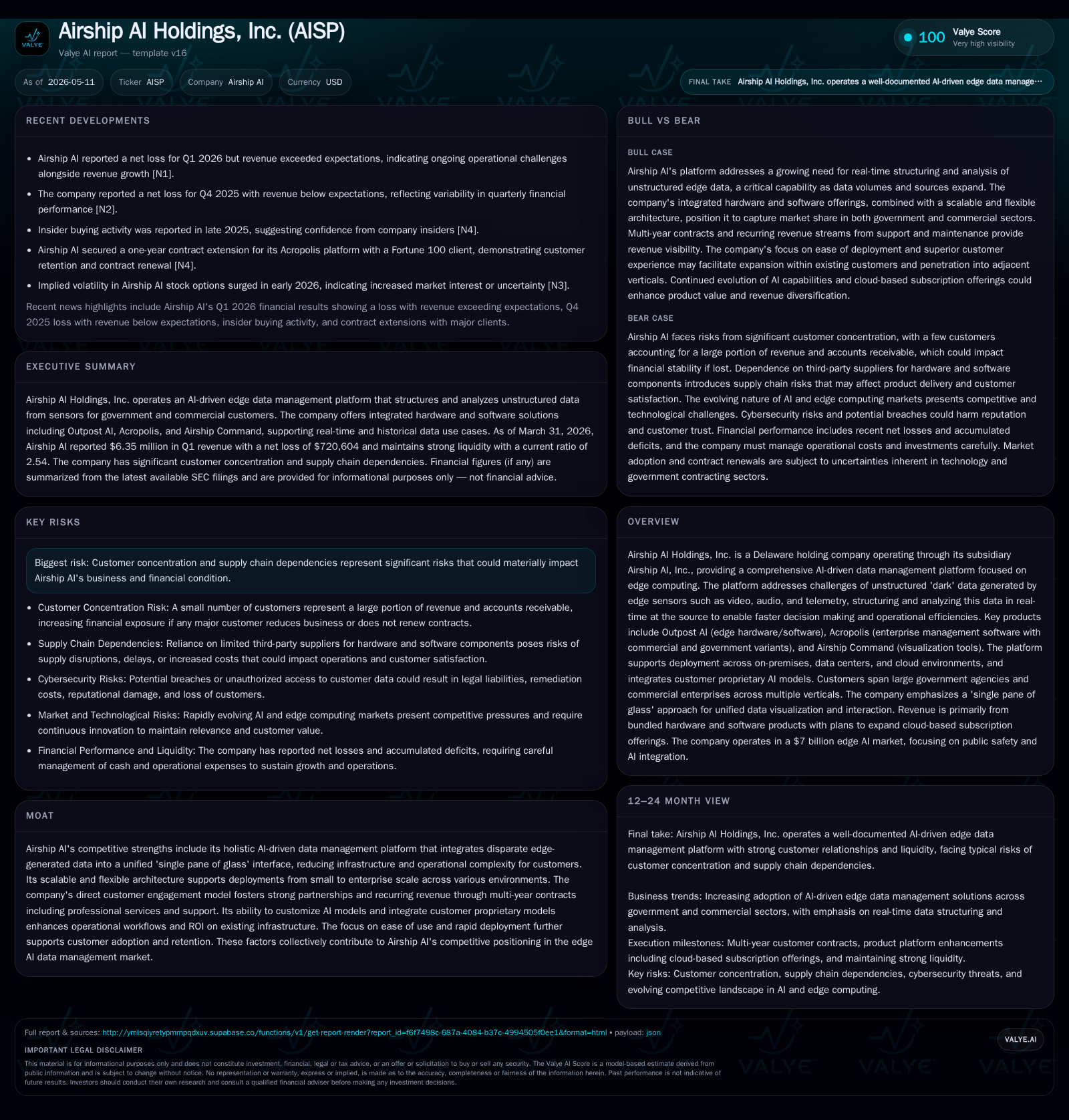
Airship AI reported a revenue beat despite ongoing operating losses in its latest quarterly filing, underscoring improving market traction for its edge AI data management offerings. The company's platform integrates hardware and software to analyze unstructured edge data in real time, targeting government and commercial clients with multi-year contracts. While customer concentration and supply chain constraints pose risks, expanding deployments and pipeline growth support a strategic push into broader public safety and enterprise sectors. Financially, Airship AI maintains robust liquidity with zero debt, positioning it to absorb R&D investments for future scale.
Latest Quarterly Operating Update
Airship AI Holdings, Inc.'s latest quarterly filing dated May 8, 2026 ([S2]) reveals continued momentum as the company beat revenue expectations despite recording an operating loss of approximately $7.2 million for the quarter ending March 31, 2026. This operating loss deepens the trend of investment in scaling operations but is offset by gains recognized from changes in fair value of earnout and warrant liabilities driving a reported net income gain per year-end filings ([S19]). This mix signals that while profitability at the operating level is not yet realized, underlying market acceptance—especially in contract awards and deploying solutions—is progressing.
The quarter continues to highlight Airship's development trajectory from annual results ([S1]) to quarterly execution cadence ([S2]), showcasing how expanded customer engagement and contract ramp-ups are unfolding amidst complexity inherent to an emerging technology with high upfront R&D intensity.
Business Model and Product Portfolio
At its core, Airship AI operates a vertically integrated edge AI data management platform tailored to address complex unstructured 'dark' data challenges generated by edge sensor deployments including video feeds, audio sensors, telemetry, acoustic input, seismic devices, and autonomous systems ([S1]). Its flagship products span:
- Outpost AI: Edge hardware coupled with proprietary software stacks enabling real-time onsite data ingestion and preprocessing.
- Acropolis: Enterprise-level management software designed with both commercial and government variants that unify data visibility and workflow control.
- Airship Command: Visualization interfaces providing operators or analysts with a 'single pane of glass' view consolidating multi-source intelligence from diverse sensor arrays.
The company’s revenue derives primarily from bundled hardware-software sales augmented by professional services and multi-year contracts structured with recurring support components ([S1],[F1]). Notably, the platform's flexible design supports deployments across on-premises infrastructure, dedicated data centers, or hybrid cloud environments; this modularity empowers customization aligned with client-specific AI model integrations—significantly enhancing switching costs and deepening client stickiness.
Typical end-customers include U.S. federal agencies such as Department of Homeland Security (DHS), law enforcement entities, military commands, alongside commercial enterprises requiring mission-critical situational awareness applications ([S20]). Expanding footprint within these tiers leverages Airship's capability to break down traditional data silos by securely sharing processed information across functional domains—a key value proposition given legacy fragmentation in these settings.
Industry Structure and Competitive Positioning
The edge AI market targeted by Airship is estimated around $7 billion comprising hardware devices for sensor capture plus software analytics systems deployed at the network perimeter where data originates ([S1]). Key verticals include public safety/government surveillance as well as industrial/enterprise monitoring contexts where rapid decision-making from large-scale streaming datasets is critical.
Competition remains fragmented ranging from pure-play hardware vendors to cloud-centric analytics providers; however, Airship’s holistic approach integrating bespoke edge processing hardware with adaptive software platforms creates a differentiated offering that reduces complexity for large institutional buyers ([S1],[S7]). The company's comprehensive solution helps mitigate multiple discrete procurement steps that traditionally plague such projects.
Pricing power appears somewhat tempered by customer concentration: four clients contributed roughly 87% of revenues in recent periods ([S7]), which could pressure negotiation leverage. Yet the embeddedness of customized AI workflows combined with recurring contract structures sustains long-term partnership dynamics less vulnerable to commoditization.
The firm faces supply chain exposure—especially related to Taiwan-based component sourcing—which introduces risks tied to geopolitical uncertainties impacting lead times or costs ([S10], analysis). Compliance mandates around data security in government contexts also enforce rigorous certification requirements shaping product development cycles and competitive hurdles.
Drivers of Growth
Airship's growth thesis rests on several quantifiable catalysts:
- Expansion within Customers: Existing large clients are broadening usage beyond initial deployments to adjacent business units or agencies to unify fragmented data domains. This internal expansion leads to larger deal sizes over multi-year timelines ([S1],[S20]).
- Edge Sensor Proliferation: Global uptick in IoT sensing devices producing massive unstructured datasets augments total addressable market for real-time edge analytics solutions.
- Pipeline Strength: As disclosed, a validated sales pipeline exceeding $173 million comprised of staged opportunities indicates visible revenue runway awaiting conversion over 18-24 months ([S22]).
- New Pilot Deployments: Recent awards including $1.9 million from DHS for National Special Security Events in 2026 plus $2.8 million commercial contracts demonstrate continuing commercial traction ([S22],[N1]).
- AI Model Integration Flexibility: Ability to incorporate client proprietary models into the platform enhances appeal among sophisticated users seeking operational ROI beyond point solutions ([S1]).
Together these drivers suggest primarily structural demand fueled by digital transformation imperatives within government and security-sensitive enterprises rather than transient budget fluctuations.
Risks and Constraints to Expansion
Several material risks warrant active consideration:
- Customer Concentration: With four clients generating nearly nine-tenths of revenues recently ([S7]), loss or downsizing by any single major client could materially disrupt top-line results or delay scaling economies.
- Supply Chain Dependencies: Reliance on critical hardware components manufactured in geopolitically sensitive regions like Taiwan introduces potential delays or cost escalation disrupting delivery schedules ([S10]).
- Market Adoption Uncertainty: Edge AI remains emergent; end users might underappreciate benefits or prefer legacy systems delaying purchase decisions necessitating extended sales cycles coupled with educational initiatives ([S1]).
- Integration Complexity: Aligning diverse proprietary models within a unified platform demands ongoing R&D enhancements which may face technical hurdles or interoperability challenges impacting time-to-market ([S1]).
- Government Budget Volatility: Federal agency funding shifts due to policy changes can unpredictably impact contract renewals or new awards given dependency on public sector spend priorities ([S25]).
These factors combine into a profile where growth is promising but execution-sensitive requiring calibrated resource allocation and close client relationship management.
Key Milestones and What to Watch Next
Critical forthcoming indicators for assessing Airship’s trajectory include:
- Progress on booking anticipated pipeline projects highlighted in recent disclosures specifically continuation or increase in multi-million-dollar DHS-related contracts alongside new commercial expansions ([S22],[N1]).
- Success metrics from pilot deployments regarding platform scalability performance and user operational impact informing broader rollout decisions.
- Updates on supply chain developments especially supplier lead times or alternative sourcing moves reflecting resilience against external disruption risks.
- Contract renewal timing with top customers including any movement toward subscription/cloud-based software licensing models enhancing recurring revenue stability ([S20]).
- Further integration capabilities supporting client proprietary AI model adoption as a moat extension through technology differentiation ([S12]).
These milestones collectively serve as tangible markers for validating whether current investments translate into sustainable commercial footing within target markets.
Financial Profile Snapshot
Latest financial snapshot
| Metric | Value | Period |
|---|---|---|
| Cash & equivalents | $13mm | |
| 2026-03-31 | ||
| Current assets | $18mm | |
| 2026-03-31 | ||
| Current liabilities | $7mm | |
| 2026-03-31 | ||
| Current ratio | 2.54x | |
| 2026-03-31 |
Source: SEC companyfacts cache [F1].
No recent update since annual last confirmed data.
The company reported strong liquidity supported by over $12.5 million in cash reserves against no outstanding debt as of the latest available figures ([F1]). Operating losses exceeding $7 million signal an ongoing cash burn phase consistent with growth-stage technology firms prioritizing platform development over immediate profitability ([F1],[S2],[S19]). The balance sheet strength aids absorption of volatility associated with expanding customer engagements while progressing toward positive cash flow outlook set for later in the year per management commentary ([S22]).
This analysis focuses strictly on publicly disclosed metrics up through the May 8th quarterly filing window without extrapolating beyond documented evidence or speculative forecasts. Observers should monitor upcoming quarterly reports and announced contract updates closely for shifts in execution pace or margin dynamics that may recalibrate Airship AI’s growth profile within the evolving edge AI landscape.
Disclaimer: This is research-only, informational analysis and not investment advice. It may include AI-generated interpretation and general industry context. Always verify important details using primary sources.

Comments