
AltEnergy Acquisition Corp Faces Critical Deadline With No Business Combination Completed
AltEnergy Acquisition Corp remains a pre-merger SPAC under pressure to consummate its initial business combination by May 1, 2026.
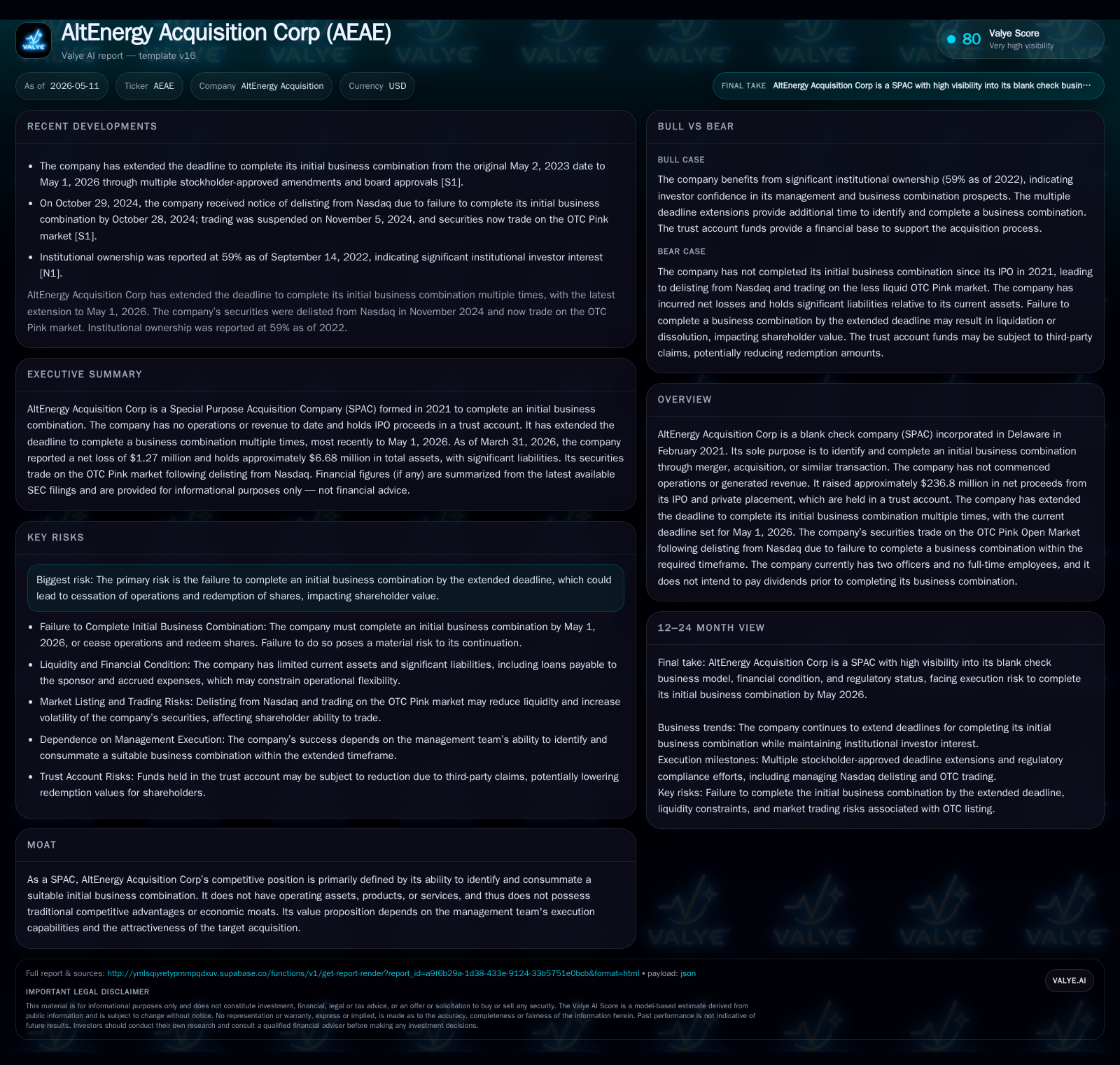
AltEnergy Acquisition Corp (AEAE) continues to operate without any revenue-generating activities or completed mergers, persisting as a blank-check company with a looming deadline for its initial business combination. The company’s latest 10-Q confirms no cash equivalents outside its trust account and founder-shareholders’ waived liquidation rights, contrasting with public shareholders’ exposure to redemption if no deal closes. This situation underscores the structural risks tied to the SPAC’s model, which entirely depends on merger execution within regulatory timelines. Market competition among SPACs and tightened liquidity in the post-deadline OTC trading environment further accentuate uncertainties around AEAE’s path forward.
Latest Operational Update Highlights Urgency on Business Combination Deadline
AltEnergy Acquisition Corp’s latest quarterly filing dated May 8, 2026 ([S2]) reaffirms its status as a blank-check company with no operational revenues or cash equivalents outside investments held in the trust account. Critically, the filing emphasizes multiple deadline extensions authorized by corporate governance actions extending the timeframe to consummate an initial business combination until May 1, 2026. Despite these extensions, AEAE has yet to identify or finalize a suitable target merger.
Notably, AEAE’s securities have been delisted from Nasdaq due to failure to complete their business combination within prior deadlines and now trade exclusively on the OTC Pink Open Market ([S3]). This transition reflects increased market risk and reduced visibility commonly associated with second-tier SPACs that fail to meet listing standards linked to deal closure timelines. The founder shareholders have formally waived their liquidation rights contingent on deal completion failure; however, holders of public shares retain redemption rights that would obligate distributions from the trust account per share if no transaction materializes ([S2]).
This evolving situation places acute pressure on management’s ability to execute amid diminishing external market support.
AltEnergy Acquisition’s Business Model: The SPAC Structure and Its Executional Challenges
By design, AltEnergy Acquisition Corp operates as a special purpose acquisition company (SPAC), capitalizing approximately $236.8 million through its November 2021 IPO unit sale combined with private placement warrants sold simultaneously ([S1]). These proceeds are held predominantly in a U.S.-based trust account earning minimal interest and constitute essentially all company assets until deployment into an initial business combination.
The blank-check entity structure means AEAE itself produces zero revenues or operating cash flows prior to acquiring an operating company. Its economic proposition rests solely on identifying an attractive private target for merger or acquisition that public equity markets will ascribe incremental value above the trust-account baseline. This reliance places disproportionate importance on management expertise in deal sourcing and negotiation coupled with investor appetite for PIPE (private investment in public equity) commitments post-announcement—a critical mechanism for financing large transactions typical in energy-sector SPACs.
Founder shares issued at nominal cost provide sponsors with incentive alignment but also introduce dilution considerations once converted. Warrants add optionality but increase complexity in capital structure valuations ([S1]).
Competitive Dynamics and Industry Context in the SPAC Market
Within the crowded SPAC ecosystem—reaching peak issuance levels several years ago—AltEnergy Acquisition Corp competes against numerous contemporaries targeting energy or renewable energy sectors presumed from its branding ([S1]). The efficacy of AEAE hinges on timely identification of viable deals amidst heavy sponsor competition and fluctuating investor sentiment influenced by regulatory scrutiny concerning disclosure requirements and sponsor economics.
PIPE investors remain cautious given overall market uncertainties affecting valuation benchmarks and sector exposure in green energy investments—traditionally susceptible to policy shifts and technological disruption dynamics.
Growth Potential Demystified: What Could Catalyze Value Post-Business Combination
Should AEAE succeed in consummating its initial business combination before May 1, shareholder value creation would pivot sharply from stagnation toward operational exposure within potentially growth-oriented energy sectors. Accessing new revenue streams post-merger could unlock multiple expansion beyond trust-account valuations depending on acquired company fundamentals such as technology innovation, market share growth potential, or favorable policy incentives for alternative energy solutions ([S1]).
Moreover, establishing a strong governance framework following combination could facilitate further acquisitions or organic growth initiatives funded through improved capital markets access. This transition from shell status could materially alter investor perceptions and enable market re-rating aligned with fundamental enterprise prospects rather than speculative structure.
Risks Spotlight: Expiry of Extension Periods and Shareholder Redemption Implications
The foremost risk confronting AltEnergy Acquisition Corp is failure to complete an initial business combination by May 1, 2026—the terminal deadline after multiple corporate-approved extensions ([S2]). In this scenario, AEAE must initiate wind-down operations immediately thereafter leading to mandatory redemption of all public shares at cash amounts derived from trust funds inclusive of accrued interest ([S1]). Given prolonged contractual inactivity and administrative expenses incurred during extensions, redemption prices may stand below original purchase levels resulting in realized shareholder losses.
Cash management outside the trust account is especially constrained evidenced by a razor-thin current ratio of approximately 0.04 as of quarter-end March 31, 2026 ([F1]), underscoring limited liquidity resources available for operational contingencies or transaction facilitation absent fresh capital infusion.
Additionally, while founder shares have waived certain liquidation preferences related to deal failure ([S2]), dilution effects upon any surviving equity raise or post-merger reorganization remain significant watchpoints.
Key Milestones Ahead: What to Monitor in the Next Quarter
Investors and observers should closely monitor announcements regarding shareholder votes if an acquisition agreement surfaces promptly given that April 27, 2026 stockholder meeting occurred without material deal disclosures ([S3]). Potential amendment proposals extending deadlines beyond May 1 would demand further governance approvals but represent a structural backstop if genuine negotiations are underway.
Watch also for signs of PIPE financing commitments which typically accompany announced target transactions as positive indicators of deal credibility within competitive underwriting syndicates.
Finally, ongoing scrutiny of listing status changes or regulatory filings evidencing progress toward merger consummation remain critical demand markers influencing valuation dynamics.
Brief Financial Snapshot: Liquidity Position and Shareholder Equity Considerations
Latest financial snapshot
(Source: [F1], [S2])
This snapshot reveals extremely tight operational liquidity when excluding the segregated trust account monies designated exclusively for business combination purposes. The disproportion between liabilities and readily convertible assets highlights limited day-to-day financial flexibility ahead of securing merger financing or completing transaction-related funding arrangements.
Net income remains negative reflecting accumulated expenses relating primarily to administrative costs without offsetting operating revenue streams ([F1]). Overall financial health carries standard cautionary flags common across aged SPACs unable to close deals within established timelines.
This report is for informational purposes only and does not constitute investment advice. It reflects analysis strictly anchored in available SEC filings and factual disclosures about AltEnergy Acquisition Corp as of May 11, 2026.
Disclaimer: This is research-only, informational analysis and not investment advice. It may include AI-generated interpretation and general industry context. Always verify important details using primary sources.

Comments