
Aspen Aerogels Maintains Strong Cash Position Despite Revenue Fluctuations from Contract Terms
Q1 2026 results show $174 million liquidity supporting operations amid revenue variability linked to customer concentration and flexible purchase agreements.
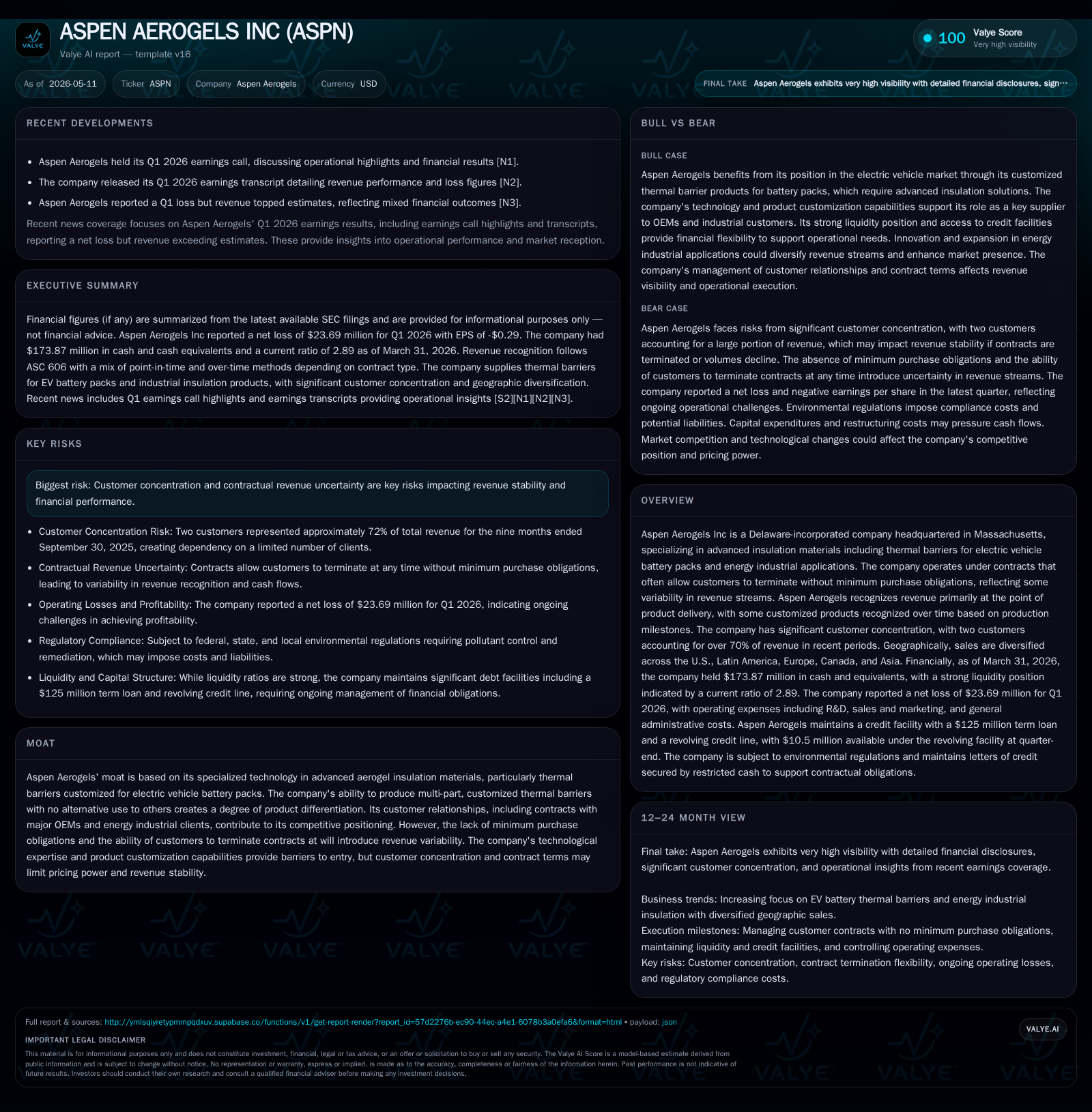
Aspen Aerogels reported a $23.7 million net loss for Q1 2026 but generated $34.1 million in cash from operations, ending the quarter with $174 million in cash and equivalents. The company maintains ample liquidity to support its business serving energy industrial and electric vehicle markets despite revenue variability due to contracts lacking minimum purchase obligations and customer concentration risks. Aspen's competitive edge lies in its proprietary aerogel thermal barriers, especially for EV battery packs, with growth hinging on continued R&D, market adoption, and capital investment.
Recent Operating Update
Aspen Aerogels' latest quarterly report for Q1 2026, filed on May 8, 2026, anchors the current operating analysis [S2]. Despite recording a net loss of $23.7 million during the quarter, the company generated positive cash flow from operations of $34.1 million. Capital expenditures were modest at $1.4 million, resulting in an unrestricted cash balance of approximately $174 million as of March 31, 2026 [F1][S2]. Management states that this cash position should sufficiently cover operating requirements and necessary capital expenditures related to Aspen’s core EV and energy industrial businesses for at least the next twelve months. However, they acknowledge the likelihood of supplementing their liquidity through operational cash flow or additional financing instruments such as equity raises, debt financings, lease transactions, or government grants to fund long-term growth ambitions.
A recent amendment to Aspen’s credit facility introduced more favorable financial covenants including adjusted minimum liquidity requirements and revised EBITDA testing thresholds [S17]. These adjustments improve near-term financial flexibility amid a backdrop of revenue volatility linked to customer contract terms.
Additionally, an 8-K filing on May 7 reiterated Q1 results alongside forward-looking commentary embedded within their Regulation FD disclosures [S3]. These filings collectively update investors on Aspen’s financial outlook and strategic positioning.
Business Model Overview
Aspen Aerogels operates as a technology-driven materials company focusing on high-performance aerogel-based insulation products. The primary revenue streams stem from sales of proprietary aerogel insulation materials used across two main application areas:
- Energy Industrial Sector: Providing thermal insulation solutions for pipelines, refineries, power plants, LNG facilities, and other industrial energy infrastructure.
- Electric Vehicle (EV) Market: Manufacturing customized PyroThin® aerogel thermal barriers designed specifically for battery pack thermal management.
Contracts with customers typically lack minimum purchase obligations and can be terminated at will by customers without penalty. This contractual design reflects the bespoke nature of Aspen's products but introduces notable variability in order volumes and timing [S2][S1]. The company recognizes revenue primarily upon product delivery; however, certain specialized products with long production cycles recognize revenue over time based on milestones achieved.
Aspen’s product quality and differentiation lie in its ability to engineer multi-part thermal barriers with unique performance characteristics tailored to client specifications. These custom solutions are difficult to substitute due to their proprietary composition and integration complexity in high-stakes applications such as EV battery packs.
Customer relationships exhibit significant concentration: two customers represent over 70% of Aspen’s recent revenues. This concentration underscores dependency risks but also suggests deep integration with major Original Equipment Manufacturers (OEMs) and key industrial players.[S1]
Industry Structure and Competitive Position
The aerogel insulation industry is characterized by high technical barriers to entry due to sophisticated material science requirements, capital-intensive manufacturing processes, and stringent performance standards demanded by end markets in energy infrastructure and electric vehicles.
Aspen Aerogels commands a niche leadership position through its advanced aerogel formulations and patented PyroThin® technology specifically optimized for EV battery thermal management—a fast-growing segment driven by global electrification trends. The uniqueness of these multi-part thermal barriers limits direct competition.
Within the broader industry value chain, Aspen acts as an upstream component supplier to insulation fabricators, contractors, or directly to end-users like automotive OEMs and energy companies. Distribution channels include specialized insulation distributors and fabrication partners who help scale product deployment across diverse geographies including the U.S., Latin America, Europe, Canada, and Asia.
Pricing power is moderated by contract terms often lacking firm purchase commitments and customers’ ability to terminate freely. High customer concentration amplifies bargaining leverage against Aspen in commercial negotiations. However, technological expertise combined with strong OEM relationships create switching costs that underpin customer retention.
Growth Drivers
Robust Demand from EV Battery Thermal Management
The accelerating global shift toward electric vehicles is a key structural growth driver opening new avenues for Aspen’s PyroThin® aerogel barriers. As OEMs prioritize battery safety and efficiency under thermal regulation standards, demand for advanced insulation components tailored to battery packs grows structurally rather than cyclically [S6].
Energy Industrial Market Penetration & Sustainability Trends
Legacy energy infrastructure continues requiring thermal solutions for enhanced efficiency amid tightening environmental regulations. Additionally, sustainable insulation materials gain traction as industries seek carbon-footprint reductions. Aspen’s longstanding presence with proven performance positions it well for incremental growth alongside sector decarbonization initiatives.
Research & Development Investment
Consistent R&D expenditure supports innovation pipelines aimed at next-generation aerogel products enhancing performance attributes or reducing production costs [S6]. Technological advances enable penetration into new applications within EVs or industrial sectors while maintaining differentiation.
Geographic Expansion & Customer Diversification
Expanding sales footprints internationally coupled with efforts to reduce extreme customer concentration by onboarding additional OEMs or fabricators can help stabilize revenues long term.[S2]
Risks / Watchpoints / Growth Constraints
- Contractual Revenue Volatility: Lack of minimum purchase obligations permits customers to delay or cancel orders abruptly impacting top-line visibility.
- Customer Concentration: Over 70% revenue exposure concentrated in two customers exposes Aspen to single-customer credit or strategic risk.
- Pricing Power Limitations: Free termination clauses potentially weaken pricing leverage limiting margin expansion opportunities despite technological advantages.
- Capital Requirements: Scaling manufacturing capacity for EV segment demands funding beyond current cash reserves which may require financing dilutive or debt-raising activity.[S2]
- Regulatory Shifts & Market Dynamics: Changes in environmental policies or EV adoption rates could accelerate or impede addressable market expansion.
What To Watch Next
- Q2/Q3 quarterly results assessing operational scalability especially order intake trends from large OEM customers in EV segment.
- Updates on new product development cycles or commercial launches reflecting R&D effectiveness.[N1][N2]
- Monitoring covenant compliance per amended MidCap Loan Facility at upcoming test dates (next test June 30, 2026).
- Investments announced in manufacturing capacity expansion or strategic partnerships enabling broader market access.[S2]
- Movements toward greater diversification of customer base reducing concentration risk.
Financial Profile (Latest Snapshot)
Latest financial snapshot
| Metric | Value | Period |
|---|---|---|
| Cash & equivalents | $174mm | |
| 2026-03-31 | ||
| Current assets | $254mm | |
| 2026-03-31 | ||
| Current liabilities | $88mm | |
| 2026-03-31 | ||
| Current ratio | 2.89x | |
| 2026-03-31 |
Source: SEC companyfacts cache [F1].
| Metric | Value (USD millions) | Period End |
|---|---|---|
| Cash & Equivalents | 173.9 | |
| 2026-03-31 | ||
| Current Assets | 254.0 | |
| 2026-03-31 | ||
| Current Liabilities | 87.8 | |
| 2026-03-31 | ||
| Current Ratio | 2.89 | |
| 2026-03-31 |
The company ended Q1 2026 with a strong liquidity buffer reflected by a current ratio near three times coverage indicating good short-term solvency [F1]. Total debt approximations suggest net cash positioning given substantial cash balances relative to reported debt facilities; though detailed debt levels reflect a term loan facility sized around $125 million with revolving credit availability reduced after repayments during first quarter[S13][F1]. Covenants recently amended ease near-term pressure but ongoing profitability challenges persist amid high fixed costs associated with innovation-driven manufacturing scale-up phases.[S17]
This analysis synthesizes publicly filed SEC disclosures combined with sector context insights relevant as of Q1 2026 — it does not constitute investment advice or endorsement but aims to provide a comprehensive understanding aligned with best industry analyst practices.
Disclaimer: This is research-only, informational analysis and not investment advice. It may include AI-generated interpretation and general industry context. Always verify important details using primary sources.

Comments