
Krispy Kreme Faces Execution and Leverage Challenges While Pursuing Franchise Expansion
Latest quarter highlights operational pressures amid strategic refranchising and international divestiture moves.
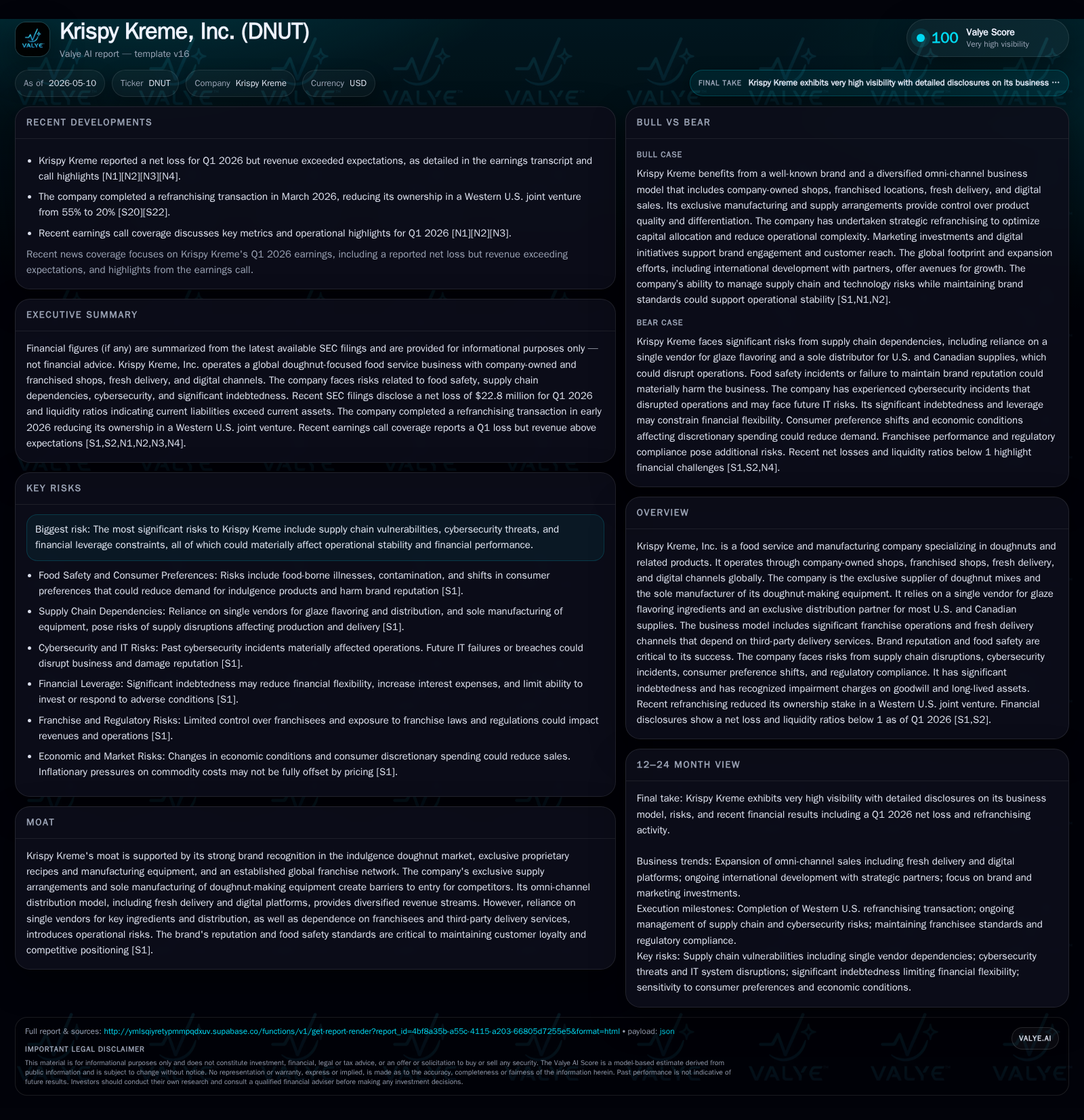
Krispy Kreme's Q1 2026 results reveal ongoing headwinds from operating losses and leverage strain despite revenue beats. A major refranchising deal increased ownership stake of JV partner WKS while reducing company exposure to Western U.S. stores. The impending sale of Japanese operations signals strategic refocus, but significant debt and reliance on key suppliers introduce risks. Growth depends on expanding franchise network, international development, and omni-channel delivery amidst competitive and regulatory challenges.
Recent Operating Update
Krispy Kreme reported first quarter results for the period ended March 29, 2026, showing continued challenges in profitability with operating losses persisting despite revenue exceeding expectations [S2][N4]. The company highlighted strategic changes including a material refranchising transaction completed in March that transferred majority control of its Western U.S. joint venture stores to WKS Restaurant Group. Under this arrangement, WKS’s indirect ownership increased from 45% to 80%, with Krispy Kreme’s share reduced to 20% [S25]. This transaction included a promissory note of approximately $40 million payable by WKS Holdco over six years secured by their JV equity interests.
In addition to the refranchising event, Krispy Kreme announced in late 2025 an agreement to sell its wholly owned Japanese subsidiary Krispy Kreme Japan Co. Ltd., expecting proceeds near $65 million when closing early in 2026 [S26]. This divestiture reduces direct operational exposure in Asia and aligns with the company’s strategic focus on profitable franchise growth.
Business Model
Krispy Kreme operates primarily within the indulgence doughnut market through three main streams: company-operated retail shops, franchised shops worldwide, and fresh delivery channels supported by extensive digital platforms. The franchising segment contributes royalty revenues based on sales volume while the direct store operations generate retail sales. Fresh delivery leverages third-party delivery services to expand reach beyond brick-and-mortar stores.
A key strength is Krispy Kreme’s proprietary position as the exclusive supplier of its hallmark doughnut mixes alongside being the sole manufacturer of its custom doughnut-making equipment [S1]. Such exclusivity constitutes substantial barriers for competitors seeking entry or replication. Yet these exclusive supplier relationships also embed operational risk due to dependence on single vendors for critical glaze flavor ingredients as well as distribution rights covering most U.S. and Canadian markets.
Marginal profitability is influenced by mix shifts toward franchise fees versus lower-margin company-operated sales, cost pressures from supply chain disruptions, and expenditures on marketing digital ordering platforms.
Industry Structure and Competitive Position
The indulgent doughnut sector sits within a highly competitive quick-service landscape where traditional bakery chains and emerging specialty confectioners vie for consumer attention. Krispy Kreme’s established global brand recognition furnishes goodwill assets that are reinforced by consistent quality controls and notable product innovations.
However, the company faces robust challenges from multi-brand aggregators offering convenient delivery solutions — many owned or integrated with local restaurants — where platform usability and extensive reach can poach traffic from Krispy Kreme’s own digital channels [S27]. Maintaining competitive parity requires ongoing investments in technology-enabled ordering systems alongside managing relationships with third-party delivery logistics.
Franchise growth is regulated under varied legal regimes internationally which limit contractual remedies against underperforming or non-compliant operators; thus consistency in operational quality is a persistent management issue [S23][S24].
Growth Drivers
Growth principally stems from expanding the footprint of Krispy Kreme branded franchises both domestically and internationally. The company’s strategy places emphasis on accelerated store openings and increasing "Points of Access" which includes non-traditional locations like grocery partners and convenience outlets.
International expansion through joint ventures or master franchises remains pivotal — though recent divestitures indicate selective pruning to prioritize markets with higher return profiles [S26]. Fresh delivery continues as a strategic lever, with the potential to capture incremental consumption occasions by leveraging suburban lifestyles and increasing online ordering habits post-pandemic.
Digital channel enhancements—such as mobile app loyalty programs—seek to boost customer retention and increase average ticket sizes. However, ultimate growth realization depends heavily on third-party deliveries maintaining service quality without eroding pricing power excessively.
Risks and Watchpoints
Supply chain fragility remains a central vulnerability due to reliance on single suppliers for essential inputs including glaze ingredient sourcing [S1]. Any disruption could negatively impact production continuity or costs.
Cybersecurity threats pose operational hazards given the growing role of digital ordering networks; breaches or outages could damage customer trust or incur regulatory penalties [S1].
The current ratio stands at 0.42, indicating liquidity constraints that require careful management [F1]. This financial profile suggests limited flexibility for large capital expenditures or navigating unforeseen crises.
Brand reputation is critically sensitive to food safety concerns or franchisee missteps—either could trigger adverse publicity damaging consumer loyalty more so than non-indulgence food segments [S1][S23]. Furthermore, regulatory developments related to nutritional labeling, ingredient disclosures or advertising practices present enduring compliance burdens.
The company also has historically recognized significant goodwill impairments demonstrating susceptibility to asset writedowns if operational pivots fail to yield expected performance improvements.
What to Watch Next
Key upcoming milestones include completion of the Japanese business sale expected shortly after March quarter-end closing [S26], along with integration effects from the expanded WKS joint venture ownership following the March purchase agreement [S25]. Monitoring the effectiveness of refranchising efforts will be critical as transfer of store operations reduces direct risk but also dilutes control over consumer experience.
Additional metrics such as quarterly same-store sales growth across franchised shops, fresh delivery penetration rates, digital active users, and new franchise agreements signed will inform execution progress.
Technological investment outcomes in online platforms paired with franchisee operational adherence will remain leading indicators for sustaining competitiveness amid evolving consumer behaviors.
Financial Profile Summary
Latest financial snapshot
| Metric | Value | Period |
|---|---|---|
| Cash & equivalents | $74mm | |
| 2026-03-29 | ||
| Total debt | $830mm | |
| 2026-03-29 | ||
| Net debt | $755mm | |
| 2026-03-29 | ||
| Current assets | $187mm | |
| 2026-03-29 | ||
| Current liabilities | $446mm | |
| 2026-03-29 | ||
| Current ratio | 0.42x | |
| 2026-03-29 |
Source: SEC companyfacts cache [F1].
| Metric | Value | Period End |
|---|---|---|
| Cash & Equivalents | $74.2 million | |
| 2026-03-29 | ||
| Total Debt | $829.7 million | |
| 2026-03-29 | ||
| Current Assets | $186.9 million | |
| 2026-03-29 | ||
| Current Liabilities | $446.0 million | |
| 2026-03-29 | ||
| Current Ratio | 0.42 | |
| 2026-03-29 | ||
| Net Debt | $755.4 million | |
| 2026-03-29 |
The financials highlight a stretched liquidity position driven by high leverage despite stable cash balances post-year-end. Operating losses at year-end underscore ongoing margin pressure requiring careful capital allocation going forward.
This analysis is based exclusively on public filings through May 8, 2026. It does not constitute investment advice or recommendations.
Disclaimer: This is research-only, informational analysis and not investment advice. It may include AI-generated interpretation and general industry context. Always verify important details using primary sources.

Comments