
Magnachip Semiconductor Consolidates Power IC and Analog Solutions Amid Gumi Fab Power Upgrade Risks
Magnachip's latest quarterly report highlights operational disruptions from power infrastructure upgrades and strategic consolidation aimed at streamlining its power semiconductor platform.
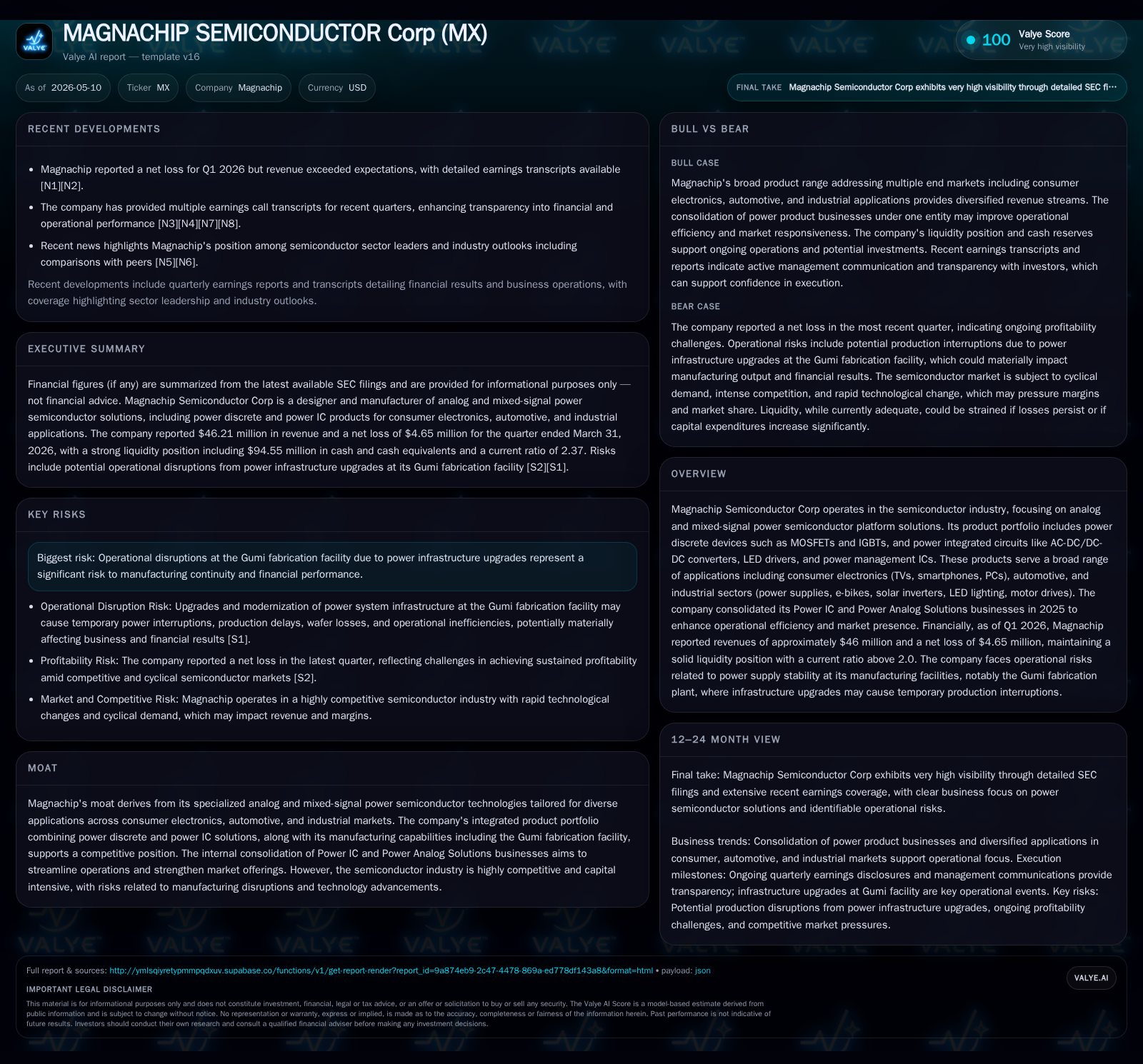
In Q1 2026, Magnachip Semiconductor reported revenues around $46 million alongside a net loss of $4.65 million, maintaining a strong liquidity position with a current ratio above 2.0. The company unified its Power IC and Power Analog Solutions businesses in 2025 to strengthen market competitiveness and operational efficiency. However, upcoming power infrastructure upgrades at its Gumi fabrication facility pose notable risks of production interruptions and manufacturing inefficiencies. Magnachip serves diverse end markets including consumer electronics, automotive, and industrial applications with a specialized analog and mixed-signal semiconductor portfolio bolstered by its in-house manufacturing capabilities.
Recent Operating Update
Magnachip Semiconductor Corp's latest 10-Q filing for Q1 2026 [S2] underscores both strategic progressions and operational challenges. The company reported revenue near $46 million with a net loss of $4.65 million, continuing a pattern of near-term losses during restructuring [N2][N1]. Notably, the company carries a strong liquidity buffer — over $94 million in cash equivalents — supporting a current ratio exceeding 2.3 as of March-end 2026 [F1]. This financial cushion is essential given announced modernization efforts at its core Gumi fabrication facility.
A critical near-term risk is the planned upgrade to the power infrastructure supporting the Gumi fab [S2]. This upgrade is poised to trigger temporary power interruptions impacting sensitive semiconductor manufacturing equipment. Potential consequences include production delays, wafer losses, yield deterioration, and operational inefficiencies which would materially affect Magnachip’s results.
Alongside these operational headwinds, Magnachip completed consolidation of its Power IC and Power Analog Solutions segments within its corporate structure by early 2025 [S1][S11]. This move was designed to reduce internal complexity and drive greater scale efficiencies within its broad analog/mixed-signal power platform.
Business Model
Magnachip generates revenue primarily from the design, manufacture, and sale of analog and mixed-signal semiconductors focused on power management applications [S1]. Its product categories include power discrete devices such as MOSFETs (Metal Oxide Semiconductor Field Effect Transistor) and IGBTs (Insulated-Gate Bipolar Transistors), along with power integrated circuits including AC-DC/DC-DC converters, LED drivers, and power management ICs.
The company's customers span several demanding end markets:
- Consumer electronics like TVs, smartphones, PCs that require efficient power handling
- Automotive industry catering to electric vehicles’ growing need for reliable power discrete components
- Industrial applications including power supplies, e-bikes, solar inverters, LED lighting controls, and motor drives.
Revenue is driven by device volume shipments often tied to OEM production cycles combined with pricing linked to product complexity and mix shifts toward more integrated solutions [S1]. Margins depend heavily on manufacturing yields at the Gumi fab—a critical asset enabling proprietary process control—though the capital intensity imposes continuous investments.
Customer retention hinges on tight technical integration support plus evolving product portfolios adapting to next-generation power management trends. Switching costs are elevated given specialized device qualification requirements especially in automotive segments where long product lifecycles inform supplier selection.
Industry Structure and Competitive Position
Magnachip operates within the highly competitive global semiconductor landscape dominated by analog/mixed-signal specialists alongside giant chipmakers with broader portfolios. The sector demands continuous innovation driven by efficiency gains in power conversion technologies amidst aggressive cost pressures.
Magnachip’s moat derives from its vertical integration encompassing both discrete device fabrication capabilities at the Gumi fab (South Korea) alongside differentiated IP-rich power IC design solutions customized for diverse domains [S1]. This dual focus contrasts with pure fabless peers or large-scale IDM competitors whose scale advantages might undercut pricing but may lack niche analog customization.
However, the semiconductor industry’s cyclical demand patterns expose Magnachip to volatility tied to macroeconomic factors influencing consumer electronics sales or automotive production volumes. Capital-intensive fabs such as Gumi also elevate fixed cost leverage risks when utilization dips occur.
Growth Drivers
Structural growth factors supporting Magnachip include:
- Automotive Electrification: Accelerating EV adoption demands high-performance MOSFETs/IGBTs for battery management systems and onboard chargers.
- Industrial Electrification: Expansion in e-bikes, solar inverter installations, motor drive automation increasingly require sophisticated analog chips enabling energy efficiency.
- Consumer Electronics Efficiency: Enhanced battery life expectations in portable devices drive demand for compact integrated PMIC solutions.
- Operational Integration: The unified Power IC / Analog Solutions business enables cross-selling opportunities fostering deeper customer engagements.
These drivers suggest secular tailwinds rather than transient cyclical spikes. However, revenue realization depends on execution precision—capacity scaling without yield disruption—and product cycle refreshes aligned with evolving customer design wins.
Risks / Watchpoints / Growth Constraints
Key risks stem primarily from manufacturing vulnerabilities:
- The ongoing upgrade of the Gumi fab's electrical infrastructure could lead to significant downtime disrupting supply continuity; any prolonged yield deterioration would impact revenue bookings materially [S2].
- Industry competition remains fierce from larger analog semiconductor players who benefit from expansive R&D budgets affecting price competitiveness.
- Maintaining profitability poses ongoing challenges given cyclical sector dynamics compounded by capital expenditure demands associated with fab modernization.
- Customer concentration risk exists given reliance on a limited number of key OEMs across segments; shifts can disproportionately affect sales performance.
Monitoring how effectively Magnachip navigates these risks will be crucial for sustaining medium-term growth trajectories.
What to Watch Next
Moving forward:
- Progress updates on Gumi facility upgrades including duration of power outages and post-upgrade yield metrics will indicate operational resilience.
- Quarterly indicators such as backlog levels/book-to-bill ratios reflecting order momentum in automotive/industrial segments will provide early growth signals.
- Execution milestones related to integration synergies following the Power IC/Power Analog business consolidation.
- Pricing trend evolution amid competitive pressures impacting gross margins.
- R&D pipeline advancements showcasing next-gen device innovations responsive to emerging customer needs.
These operating markers will clarify if the current strategic initiatives translate into sustainable improvements beyond short-term disruptions.
Financial Profile (Latest Snapshot)
Latest financial snapshot
| Metric | Value | Period |
|---|---|---|
| Cash & equivalents | $95mm | |
| 2026-03-31 | ||
| Total debt | $42mm | |
| 2026-03-31 | ||
| Net debt | $-52mm | |
| 2026-03-31 | ||
| Current assets | $170mm | |
| 2026-03-31 | ||
| Current liabilities | $72mm | |
| 2026-03-31 | ||
| Current ratio | 2.37x | |
| 2026-03-31 |
Source: SEC companyfacts cache [F1].
| Metric | Value | Period End |
|---|---|---|
| Cash & Equivalents | $94.55 million | |
| 2026-03-31 | ||
| Total Debt | $42.29 million | |
| 2026-03-31 | ||
| Current Assets | $170.02 million | |
| 2026-03-31 | ||
| Current Liabilities | $71.72 million | |
| 2026-03-31 | ||
| Current Ratio | 2.37 | |
| 2026-03-31 | ||
| Net Debt | -$52.27 million | |
| 2026-03-31 |
This financial positioning reflects adequate liquidity cushioning near-term cash burn while enabling capex investments tied to facility modernization programs. Continued cautious balance sheet management will be essential amidst operating losses [F1][S2].
Disclaimer
This analysis does not constitute investment advice or recommendations but aims to provide a detailed operational overview grounded in recent SEC filings and verifiable data sources.
Disclaimer: This is research-only, informational analysis and not investment advice. It may include AI-generated interpretation and general industry context. Always verify important details using primary sources.

Comments