
Plains All American Pipeline Strengthens Core Crude Midstream Amid Market Shifts
Strong Q1 results spotlight Plains' focused crude infrastructure and evolving strategic portfolio amid volatile energy markets.
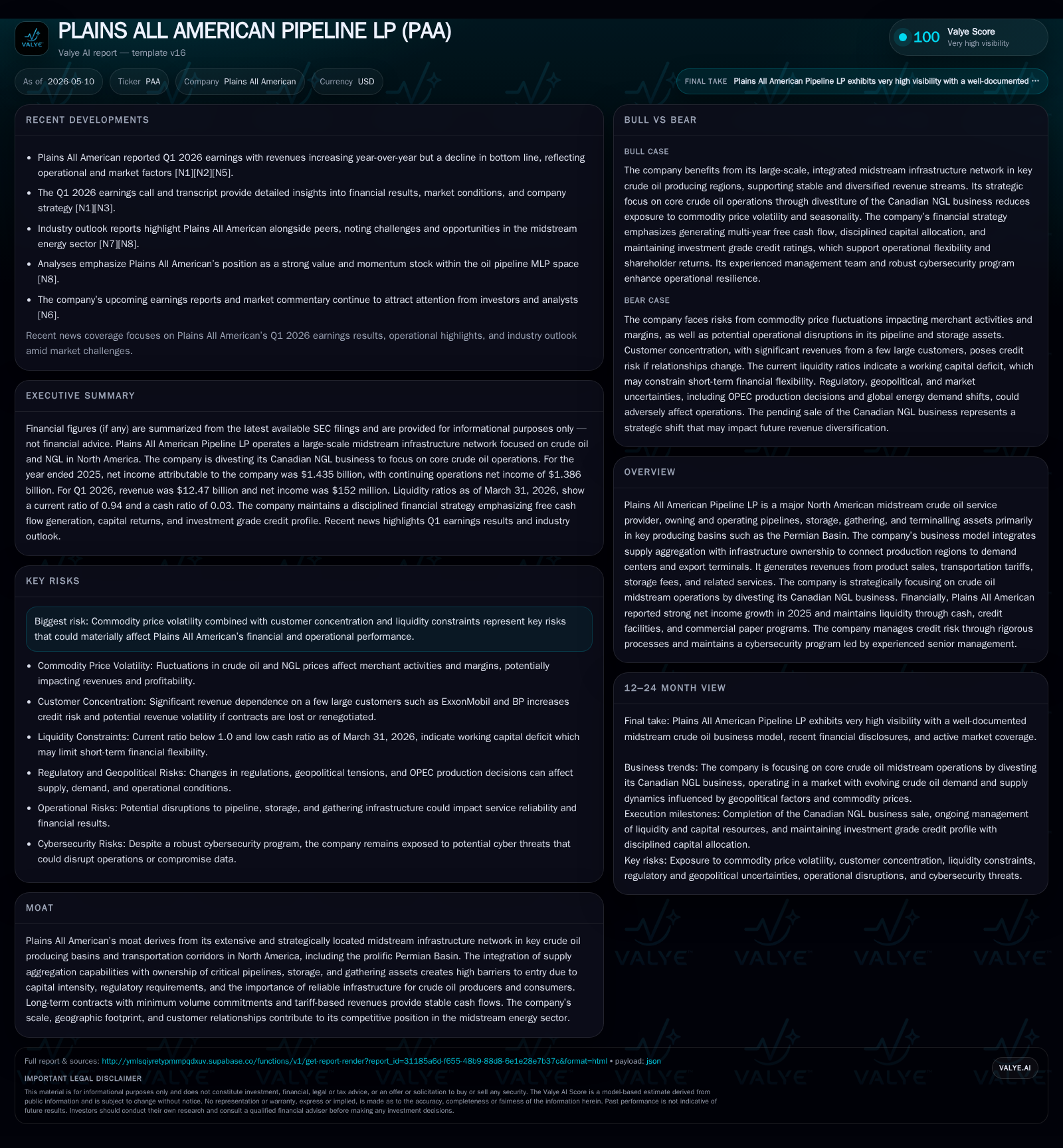
Plains All American Pipeline LP reported firm first-quarter 2026 operating results with revenue growth driven by its core crude oil midstream services, despite a modest earnings miss and margin pressures. The company’s divestiture of its Canadian NGL assets and concentration on integrated pipelines and storage in prolific basins like the Permian underpin a resilient cash flow profile supported by long-term contracts with minimum volume commitments. Operating risks include commodity price fluctuations, customer concentration, and a current ratio below parity, while cybersecurity remains an active governance focus. Near-term growth hinges on expanding Permian volumes, tariff optimizations, and the closing of the Canadian NGL sale to reduce leverage.
Latest Quarterly Operating Update Highlights
Plains All American Pipeline LP released its first-quarter 2026 results on May 8th [S2], marking a period of strategic consolidation during evolving crude market dynamics. Revenue growth was evident but accompanied by a net income miss relative to analyst expectations [N2]. This shortfall stemmed from increased operating costs and expenses linked to integration activities following recent acquisitions as well as higher maintenance spending. The transportation tariffs remain core revenue drivers within Plains’ midstream segments — predominantly crude oil pipelines and storage facilities servicing prolific basins such as the Permian [S1].
A notable operational development was progress toward divesting its Canadian natural gas liquids (NGL) business [S3]. The sale agreement signed mid-2025 anticipates closing soon with expected proceeds of roughly $3.2 billion post-tax. Management plans to deploy these funds for debt repayment to strengthen balance sheet flexibility and lower leverage burden [S26]. Additionally, contemporaneous event filings noted stable contract renewals with stipulated minimum volume commitments (MVCs), essential for securing baseline tariff revenues during commodity price volatility.
Despite solid underlying fundamentals in volumes transported and fee structures, Plains encountered margin pressure reflecting both external pricing environments and internal cost inflation impacting short-term profitability. Nonetheless, the quarterly disclosures underscored robust cash flow generation capacity anchored in firm customer contracts backed by MVCs.
Business Model and Asset Quality
Plains operates an integrated midstream platform comprising pipelines, gathering systems, storage tanks, terminalling infrastructure, and supply aggregation tailored primarily toward crude oil markets [S1]. Revenues derive principally from transportation tariffs under long-term agreements that often include MVCs providing predictable volumetric throughput fees irrespective of commodity price swings. Additional income streams stem from product sales—leveraging inventory positions—and fees for storage or terminalling services.
The company's strategic asset location focuses heavily on dominant North American producing basins — notably the Permian — enabling Plains to capture upstream production flows efficiently en route to refiners or export hubs [S1]. Such capital-intensive infrastructure engenders formidable economic moats: initial construction barriers deter new entrants; regulatory approvals impose time-consuming processes; and entrenched customer relationships foster stickiness through contract terms designed to minimize switching.
Quality considerations are paramount given the need for reliable infrastructure in energy logistics where downtime incurs outsized financial penalties. Plains invests materially in maintenance capex (£138 million reported annually [S25]) to uphold operational integrity of its extensive asset base alongside incremental investment capital targeting expansions or technological enhancements.
Competitive and Industry Positioning
Within North America’s midstream oil sector—characterized by a handful of large operators controlling critical pipeline corridors—Plains holds a strategically valuable footprint enhanced by scale advantages and geographic alignment to high-growth production zones [S1]. Its integration of supply aggregation with infrastructure ownership differentiates it from pure transportation providers lacking upstream market interfaces.
The industry grapples with mixed cyclical forces: while crude volumes ebb and flow based on macroeconomic conditions including OPEC output decisions or geopolitical shocks, basin-specific production trends like those in the Permian demonstrate largely structural growth due to advances in drilling technologies. Pricing power is somewhat constrained by regulatory scrutiny over pipeline expansions amid environmental concerns but remains durable through contractual MVCs ensuring stable tariff income.
Capacity constraints at certain chokepoints necessitate ongoing capital allocation discipline balanced against regulatory timelines—a dynamic Plains navigates leveraging both scale economies and collaborative posture with regulators.
Growth Drivers and Expansion Opportunities
Demand catalysts reside predominantly in rising crude production volumes from core basins served by Plains’ pipeline network. The continued shift toward U.S. energy exports via Gulf Coast terminals benefits companies positioned within these corridor conduits [S2][S3]. Contract renewal cycles offer potential tariff renegotiation upside while maintaining MVC floors that buttress revenue visibility.
Divesting non-core Canada-based NGL operations streamlines Plains’ portfolio allowing management focus on refining midstream operations linked strictly to crude flows across their high-barrier assets. This reallocation enhances unit economics through cost efficiencies and capital redeployment toward accretive projects or sustainable debt reduction [S26].
Incremental growth may also arise from targeted infrastructure upgrades improving throughput capacity or reliability—parameters closely monitored by customers seeking secure takeaway options amid volatile market conditions.
Operational Risks and Market Constraints
A salient risk theme is commodity price volatility directly influencing producer activity levels—and hence throughput volumes underpinning tariff revenues—introducing demand cyclicality into an otherwise stable cash flow model hinging on MVCs [S1][S2]. Customer concentration presents another layer of exposure; reliance on key counterparties amplifies operational dependency which if unsettled could disrupt revenue streams.
Financially, Plains faces leverage concerns given reported net debt approximating $10.8 billion against modest cash reserves (~$171 million) resulting in a current ratio marginally below unity at 0.94 as of quarter-end March 2026 [F1]. This situation places emphasis on deleveraging initiatives bolstered by pending Canadian NGL divestiture proceeds prioritized for debt paydown [S3][S26].
Cybersecurity oversight is prominently institutionalized within management governance frameworks led by seasoned professionals overseeing IT risk across operational technology (OT) environments essential for pipeline safety and continuity [S1]. Maintaining resilience here is vital given potential impacts from security breaches on operational reliability.
Upcoming Catalysts and Key Metrics to Monitor
Quarterly guidance updates will shed light on how effectively Plains mitigates cost pressures observed in Q1 while sustaining tariff revenue growth amid evolving market conditions [S2].
Contract renewals incorporating MVCs will provide insight into Plains’ pricing power trajectory alongside underlying production activity within primary basins.
Key operating KPIs to watch include adjusted EBITDA margins reflecting operational efficiency initiatives; throughput volumes indicating utilization levels; and capital expenditure execution aligned with pipeline maintenance or enhancement projects.
Market developments affecting crude supply-demand dynamics—such as OPEC output decisions or U.S. shale performance—will indirectly influence Plains’ volume prospects shaping medium-term growth outlook.
Current Financial Health Snapshot
Balance sheet metrics as of March 31, 2026 emphasize close liquidity management amid significant indebtedness [F1]. The net debt figure reflects total borrowings less available cash reserves underscoring leverage sensitivity that management aims to address via proceeds from asset sales including the Canadian NGL divestiture [S3][S26]. It does not constitute investment advice or recommendations.*
Disclaimer: This is research-only, informational analysis and not investment advice. It may include AI-generated interpretation and general industry context. Always verify important details using primary sources.

Comments