
Galaxy Digital Expands AI/HPC Infrastructure Amid Regulatory and Market Challenges
Q1 2026 filings reveal Galaxy Digital's transition toward high-performance computing infrastructure, paired with ongoing risks from digital asset volatility and regulatory scrutiny.
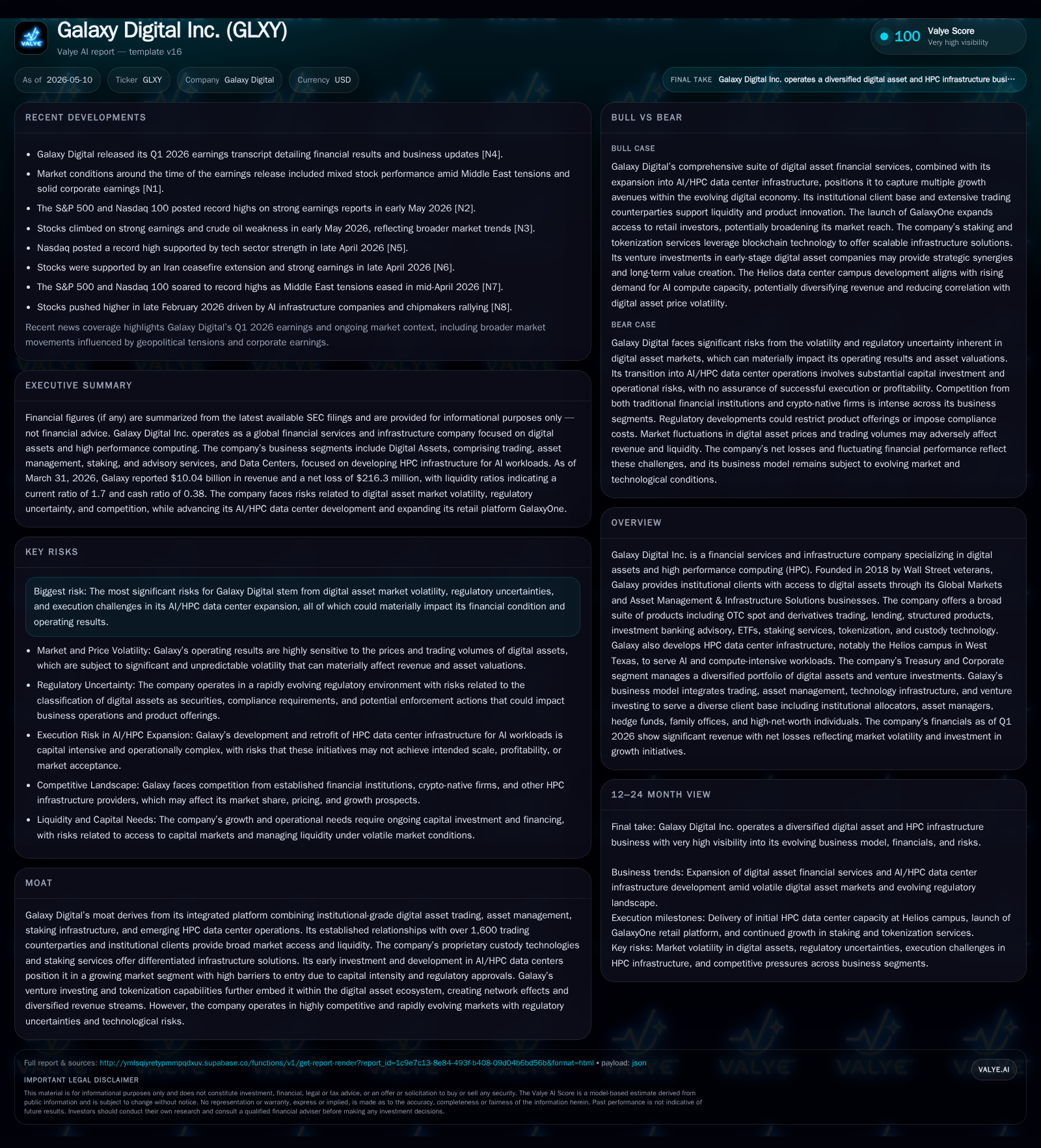
Galaxy Digital’s Q1 2026 report highlights strategic shifts in its business model, notably the conversion of its Helios mining campus into AI/HPC data centers to capture growing demand for scalable compute power driven by AI. Meanwhile, the company sustains its integrated digital asset platform catering to institutional clients across trading, asset management, staking, and custody. The recent establishment of an at-the-market equity offering program underscores a capital-raising intent to fund further infrastructure expansion. Persistent regulatory risks and legal contingencies related to prior LUNA exposures remain material concerns affecting operational outlook.
Recent Operating Update
Galaxy Digital's latest quarterly SEC filing dated May 8, 2026 ([S2]) confirms ongoing strategic transformation commencing Q1 2026. While maintaining a diversified platform spanning institutional digital asset trading and asset management with $12.3 billion in platform assets at end-2025, Galaxy is pivoting significantly towards developing high-performance computing (HPC) data center infrastructure. This includes reconfiguring the existing Helios bitcoin mining campus in West Texas into an HPC hub to serve accelerating AI-driven workloads ([S1], [S2]). This transition marks a material evolution beyond digital assets finance into capital-intensive compute infrastructure.
Concurrent with this shift, Galaxy also announced an Open Market Sale Agreement (ATM Offering) on May 8, 2026 ([S3]), allowing sale of Class A common stock through agents such as Jefferies LLC. This move signifies intent to raise growth capital flexibly to support HPC expansion and corporate initiatives.
The company's liquidity position remains healthy as of March 31, 2026, with $910.7 million in cash and equivalents versus $432.7 million total debt—producing a net cash stance of approximately $478 million and a comfortable current ratio of 1.7 ([F1]). Additionally, project financing via Deutsche Bank supports the Helios data center development subject to financial maintenance covenants detailed in the credit agreement ([S4], [S16]).
Business Model and Strategic Positioning
Galaxy Digital operates primarily through two core segments: Digital Assets and Data Centers ([S1]).
Digital Assets: Provides institutional clients access to digital markets via Global Markets trading (spot/derivatives OTC trading, structured products, lending), Asset Management with ETFs & alternatives strategies, staking infrastructure services including liquid staking protocols, tokenization solutions, investment banking advisory for M&A/capital markets within crypto-related industries, and proprietary custody technologies. This integrated suite leverages Galaxy's scale and extensive counterparty network to offer differentiated liquidity and risk management capabilities during complex crypto markets. As noted, the company maintains over 1,600 trading counterparties spanning both crypto-native and traditional financial entities.
Data Centers: Emerging as a strategic growth pillar driven by surging demand for AI compute capacity globally. The company repurposes its existing industrial-scale bitcoin mining infrastructure into HPC data centers capable of supporting diverse AI workloads ([S1], [S2]). Partnerships such as leases with CoreWeave provide cloud services tailored for AI applications at Helios campus ([S11]). This represents significant capital investment to establish presence in a market characterized by high entry barriers—capital intensity, reliable power supply needs, scaling challenges, and regulatory approvals.
Complementing these are Treasury & Corporate functions managing venture/private equity investments across early-stage blockchain projects enhancing ecosystem embedding ([S1]).
Industry Structure and Competitive Position
Galaxy operates at the intersection of several rapidly evolving sectors:
Institutional Digital Asset Financial Services: Competing with crypto exchanges like Coinbase Institutional, Circle's Centre ecosystem products, institutional brokers such as Cumberland/DRW’s Jump Trading entity in crypto OTC markets, alongside decentralized finance alternatives offering staking or lending protocols. Galaxy's competitive advantage lies in integration across multiple product lines—trading liquidity provision combined with regulated asset management funds—and proprietary custody/staking tech facilitating seamless client onboarding.
AI/HPC Infrastructure: The shift into HPC data centers places Galaxy alongside hyperscale cloud providers (AWS/GCP/Azure), specialized AI-compute players (CoreWeave among others), and emerging dedicated AI hardware/data center operators. Its experience operating large-scale bitcoin mining facilities confers operational fluency in managing power logistics but requires additional expertise scaling for broader HPC workloads. Regulatory constraints on power usage/sustainability have become increasingly pivotal variables within this sector.
Retail Fintech Platforms: Through GalaxyOne launched October 2025 ([S19]), Galaxy targets individual investors seeking regulated access to crypto alongside traditional equities using commission-free brokerage services combined with FDIC-insured deposit products offered via Cross River Bank partnership. It broadens user acquisition funnel while retaining linkages to core institutional capabilities.
Growth Drivers
Key growth vectors explicitly identified are:
Expansion of Staking & Lending Products: Providing liquid staking options responds to growing client appetite for yield generation on digital assets while maintaining flexibility—allowing Galaxy to earn origination/management fees plus interest spread revenues.
New Retail Platform User Acquisition: GalaxyOne introduces cross-market accessibility targeting retail investors who remain underserved by traditional finance yet wary of unregulated crypto platforms ([S19]). Interest income from deposited funds convertible into bitcoin or other cryptos fuels fee streams.
AI/HPC Data Center Build-Out: The multi-phase Helios campus delivers incrementally increasing MW capacity backed by secured power agreements enabling leasing arrangements to specialized cloud service providers like CoreWeave ([S11], [S23]). Built-in scalability allows for capturing surging AI compute demand structurally driven by advances in generative AI and model training workloads.
Institutional Market Penetration: Deepening relationships with over 1600 institutional clients facilitates cross-selling across trading desks, derivatives products, structured lending opportunities leveraged through collateralized loans aligned with client strategic needs.[S19]
Investment Banking Advisory & Capital Raising: Active engagement within crypto ecosystem companies captures deal-flow around M&A activity along with equity/debt capital issuance providing fee income plus potential upside exposure.
Risks and Watchpoints
Galaxy faces layers of material risk factors influencing near-to-medium term operating outcomes:
Digital Asset Volatility: Sharp fluctuations in crypto markets directly impact trading volumes/income and valuation of treasury-held digital assets altering capital adequacy metrics ([S21],[S22],[S28]).
Regulatory Environment: Continuous legal scrutiny following LUNA settlement costing over $120 million payable through scheduled installments raises reputation risks plus potential future enforcement actions or additional compliance burdens reducing operational freedom ([S5],[S6],[S22]). Pending class action certifications present unresolved litigation exposure.
Execution Risk on HPC Transition: While familiar with industrial-scale power usage from mining operations, Galaxy has limited direct experience managing multi-use HPC facilities targeting complex AI workloads; failures or delays could impair expected returns on invested capex ([S2],[S21]).
Capital Raising Dilution Risk: Use of ATM offering for share sales may dilute existing shareholders but is necessary to fund growth capex; timing depends on market conditions ([S3]).
Credit Facility Covenants: Project financing terms impose minimum coverage ratios post-Stabilization phase; failure could accelerate repayments or restrict financial flexibility ([S4],[S16]).
Operational Risk Exposure: Errors or misconduct by employees or partners could lead to financial losses or regulatory penalties given involvement in financial services employing complex trading instruments ([S7],[S18]).
Geographic Expansion Complexities: New international jurisdictions pose political/regulatory unknowns complicating growth outside North America ([S16]).
What to Watch Next
Key milestones signaling execution progress include:
- Status updates on AI/HPC Helios campus build phases including power capacity ramp-ups beyond baseline mining operations;
- Utilization metrics or leasing commitments secured from cloud service providers beyond CoreWeave;
- Adoption rates for GalaxyOne retail fintech platform including deposit inflows and active users;
- Quarterly asset under management (AUM) figures across ETFs and alternative investment mandates;
- Loan book performance trends especially margin lending volumes coupled with delinquencies;
- Legal developments regarding LUNA-related settlements or class action certification outcomes;
- ATM offering utilization levels indicating capital adequacy trajectory;
- Regulatory filing updates reflecting evolving compliance frameworks impacting product launches or geographic footprints.
Financial Profile (Latest Snapshot)
Latest financial snapshot
| Metric | Value | Period |
|---|---|---|
| Cash & equivalents | $911mm | |
| 2026-03-31 | ||
| Total debt | $433mm | |
| 2026-03-31 | ||
| Net debt | $-478mm | |
| 2026-03-31 | ||
| Current assets | $6.9bn | |
| 2026-03-31 | ||
| Current liabilities | $4.1bn | |
| 2026-03-31 | ||
| Current ratio | 1.7x | |
| 2026-03-31 |
Source: SEC companyfacts cache [F1].
The balance sheet at Q1 ended March 31, 2026 shows a comfortable liquidity buffer supporting ongoing investments:
| Metric | Value | Period End |
|---|---|---|
| Cash & Equivalents | $910.7M | |
| 2026-03-31 | ||
| Total Debt | $432.7M | |
| 2026-03-31 | ||
| Current Assets | $6.94B | |
| 2026-03-31 | ||
| Current Liabilities | $4.08B | |
| 2026-03-31 | ||
| Current Ratio | 1.7x | |
| 2026-03-31 | ||
| Net Debt | -$478M | |
| 2026-03-31 |
Revenue reported from the last full year-ended December 31, 2025 was approximately $60.4 billion reflecting consolidated revenues across all operating lines [F1]. However net income returned negative $241 million reflecting costs associated with investments in growth initiatives including the data center expansion [F1].
Overall Galaxy Digital sits at a crossroads between leveraging its established institutional digital asset franchise while investing decisively into complementary HPC infrastructure assets critical to capturing structural tailwinds around artificial intelligence compute demand. The company must navigate intensifying regulatory scrutiny while executing complex operational transitions that will define its medium-term growth trajectory.
This analysis is based solely on publicly available SEC filings dated through May 8, 2026, company disclosures and corroborated news reports without offering investment advice.
Disclaimer: This is research-only, informational analysis and not investment advice. It may include AI-generated interpretation and general industry context. Always verify important details using primary sources.

Comments