
AirSculpt Technologies Faces Growth and Liquidity Challenges in Minimally Invasive Body Contouring
AirSculpt’s patented fat removal techniques support its premium brand, but profitability and demand headwinds are intensifying.
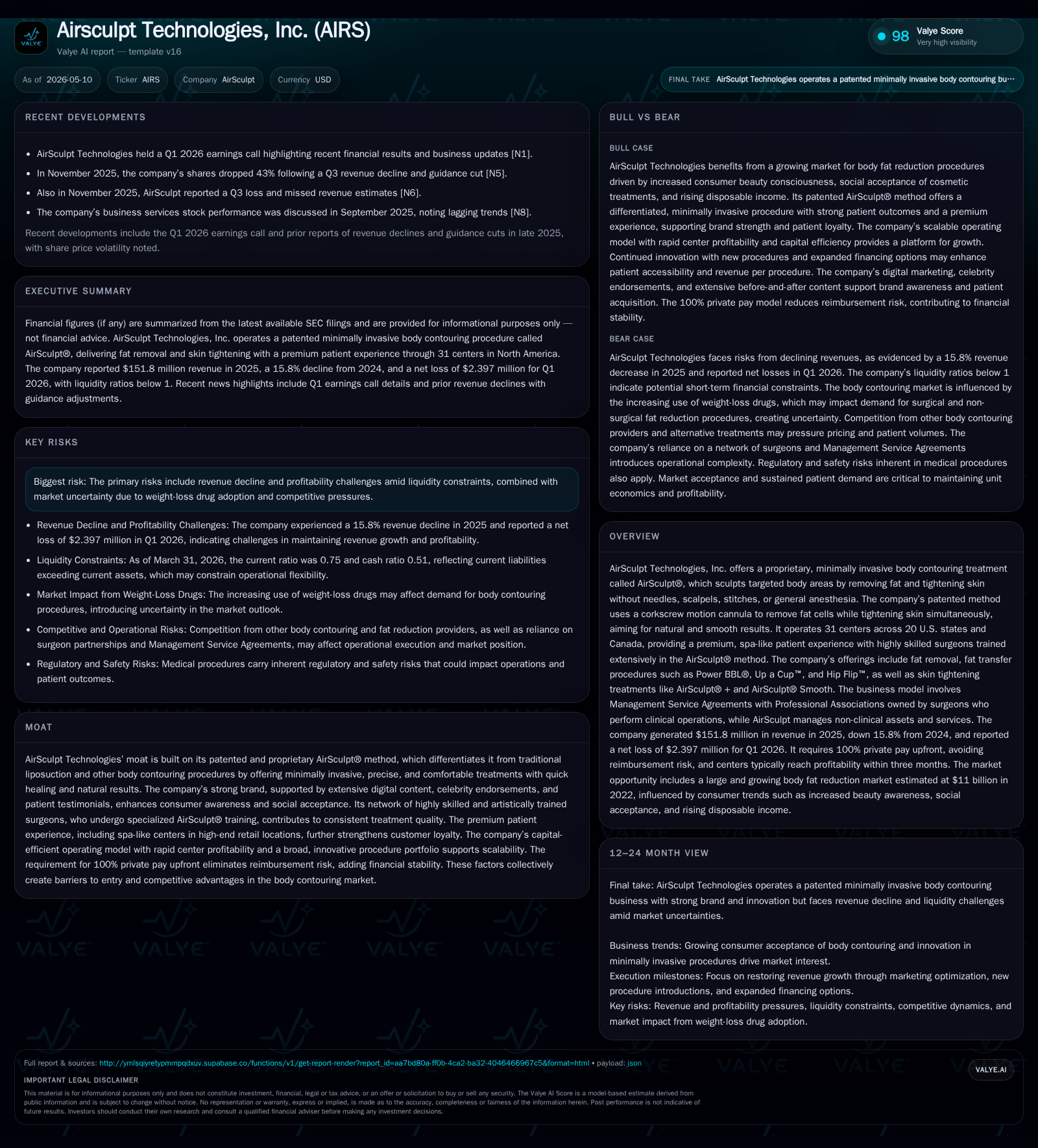
AirSculpt Technologies, Inc. reported mixed quarterly results with ongoing pressure on revenue growth and liquidity constraints highlighted in its latest 10-Q. Its differentiated AirSculpt® method remains strategically compelling within the body contouring industry, supported by a skilled surgeon network and innovative product portfolio including fat transfer procedures and skin tightening treatments. However, rising competition from weight-loss drugs and macroeconomic uncertainties dampen near-term growth visibility. Key risks include operational scalability and patient demand fluctuations, while future execution will hinge on surgeon recruitment, digital brand expansion, and effective cost control.
Recent Operating Update
AirSculpt Technologies’ latest quarterly filing for Q1 ended March 31, 2026 presents a challenging operating environment marked by continued pressure on revenue growth and profitability. The company disclosed an operating loss consistent with prior periods while highlighting ongoing liquidity pressures stemming from a cash balance of approximately $16.7 million against total debt nearing $45.6 million as of quarter-end [F1][S2][S3]. Despite these headwinds, no significant changes to risk factors were noted compared to the annual filing earlier in the year [S2][S6].
The accompanying May 8 event filing reinforced that AirSculpt is actively managing through competitive stressors including the growing adoption of weight-loss pharmaceuticals which may be dampening demand for body contouring procedures [S3]. However, the company continues to emphasize its unique clinical value proposition centered on minimally invasive sculpting without needles or scalpels providing quick healing times.
Business Model
AirSculpt operates a specialized body contouring platform differentiated by its patented AirSculpt® technology—a minimally invasive procedure that simultaneously removes fat cells using a corkscrew motion cannula while tightening skin without the need for stitches or general anesthesia [S1]. This procedure ecosystem includes not only fat removal but also proprietary fat transfer offerings like Power BBL®, Up a Cup™, and Hip Flip™, allowing for augmentation of breasts, buttocks, or hips using patients' own fat rather than implants.
Revenue is primarily driven by fees paid by patients undergoing cosmetic procedures at one of AirSculpt’s 31 centers spanning across 20 U.S. states plus Canada. The company employs Management Service Agreements with Professional Associations where surgeons’ groups hold ownership stakes—aligning incentives toward high procedural volume and consistent quality delivery [S1].
Margins are influenced by surgeon compensation structures, center operating leverage (fixed vs variable costs), pricing power largely supported by brand strength, mix shifts between higher-value transfer procedures versus standard fat removal, and utilization rates of clinical capacity. Patient volume depends heavily on brand-driven demand generation leveraging extensive digital content galleries featuring over 300,000 “before and after” photos plus active social media engagement including AirSculpt® TV programming showcasing live surgeries [S1].
The company’s ability to maintain a premium spa-like patient experience supported by highly trained surgeons serves as a key retention and referral driver—creating switching costs given the artistic skill required for consistent aesthetic results.
Industry Structure and Competitive Position
The cosmetic body contouring industry is fragmented with numerous providers ranging from traditional liposuction clinics to emerging non-invasive technologies such as cryolipolysis (CoolSculpt), laser treatments, and injectable adjuncts. AirSculpt has carved out a defensible niche through exclusivity of its patented minimally invasive technique that claims lower complication risk and less downtime than surgical liposuction alternatives.
Competition increasingly comes from broader health & wellness offerings including new classes of FDA-approved weight-loss drugs which can reduce the volume of patients seeking elective fat removal.
Surgeon recruitment is another competitive battleground; AirSculpt’s selective hiring process involving rigorous vetting through background checks and review of each surgeon’s portfolio supports consistent outcomes but limits rapid expansion capability versus lower-barrier entrants [S1]. Regulatory oversight in healthcare provision and cosmetic medical devices is moderate but evolving; compliance requires vigilance especially around advertising claims.
Growth Drivers
AirSculpt identifies several clear levers for growth:
- Surgeon Network Expansion: Recruiting more qualified surgeons to join affiliated Professional Associations extends geographic coverage and procedural capacity enabling new center openings.
- Procedure Mix Innovation: Expanding offerings such as AirSculpt Smooth™ for cellulite reduction or advanced skin tightening enhances per-patient spend beyond simple fat removal and differentiates from peers.
- Digital Marketing Leadership: Leveraging massive curated photo galleries along with influencer endorsements amplifies consumer awareness in a visually driven purchase category.
- Geographic Expansion: Continuing to open new centers in affluent urban locations increases market penetration where demand for premium cosmetic services is concentrated.
- Patient Experience Enhancements: Spa-like facility environments combined with seamless consultation-to-procedure pathways improve conversion rates.
These drivers cumulatively target sustained top-line ramp alongside operational scaling efficiencies.
Risks / Watchpoints / Growth Constraints
Several notable risks temper optimism:
- Liquidity Constraints: The current ratio of ~0.75 signals short-term coverage issues necessitating careful cash flow management or refinancing to avoid disruption [F1].
- Changing Consumer Preferences: The rising popularity of weight-loss drugs reduces the pool of patients motivated to seek invasive body contouring.
- Surgeon Talent Competition: Limited supply of skilled surgeons willing and able to master AirSculpt restricts rapid scaling flexibility.
- Macroeconomic Sensitivity: Cosmetic elective spending is discretionary; inflationary pressures or recession fears may depress volumes.
- Regulatory Shifts: Potential changes regarding telemedicine consultations or approval status for complementary technologies could impact access or procedural mix.
- Reputation Risk: Heavy reliance on social media necessitates vigilance against adverse publicity affecting patient flow or compliance fines.
Operationally, delays in new center launches or inability to maintain uniform quality standards across expanding locations can stall growth momentum.
What to Watch Next
Key milestones include monitoring quarterly procedural volume trends reflecting underlying demand shifts post-Q1 softness reported explicitly in earnings commentary [N1], surgeon affiliation growth metrics indicating network scalability progress, price realization patterns assessing mix improvement towards higher-value treatments like Power BBL®, along with operating cash flow trends addressing liquidity concerns.
Additional indicators could be updates on new center openings tied to expansion strategy disclosures or competitive responses within aesthetic medicine broadly.
Patient satisfaction metrics drawn from ongoing user-generated content assessments will offer qualitative color around brand health.
Financial Profile (Brief)
Latest financial snapshot
| Metric | Value | Period |
|---|---|---|
| Cash & equivalents | $17mm | |
| 2026-03-31 | ||
| Total debt | $46mm | |
| 2026-03-31 | ||
| Net debt | $29mm | |
| 2026-03-31 | ||
| Current assets | $24mm | |
| 2026-03-31 | ||
| Current liabilities | $32mm | |
| 2026-03-31 | ||
| Current ratio | 0.75x | |
| 2026-03-31 |
Source: SEC companyfacts cache [F1].
As of March 31, 2026, AirSculpt Technologies held approximately $16.7 million in cash against total debt near $45.6 million resulting in net debt around $28.9 million with a current ratio below unity at roughly 0.75—signaling elevated liquidity risk though without explicit recent covenant breaches noted [F1]. Operating losses remain entrenched through late 2025 at about $11.56 million per annum predated by similar net losses reflecting early-stage scale-up costs combined with moderate revenue growth ambition [F1].
Capital expenditures focus prominently on opening new high-end storefront centers designed to support premium positioning but increase near-term fixed costs before achieving breakeven utilization levels.
This analysis leverages the latest quarterly SEC filings complemented by recent event disclosures providing the freshest insight into AirSculpt Technologies’ operational standing as of early 2026. While the company demonstrates proprietary technology leadership and robust brand-building assets within a selectively scalable business model, demand uncertainty represents significant near-term navigational challenges requiring close observation of execution against stated growth initiatives.
Disclaimer: This report is a factual analysis based on publicly available SEC filings as referenced; it does not constitute investment advice or recommendations of any kind.
Disclaimer: This is research-only, informational analysis and not investment advice. It may include AI-generated interpretation and general industry context. Always verify important details using primary sources.

Comments