
SunHydrogen Poised to Advance Solar-Powered Renewable Hydrogen Production
SunHydrogen’s Q1 2026 update highlights steady progress in scaling its nanoparticle-based tandem semiconductor technology for commercial renewable hydrogen generation.
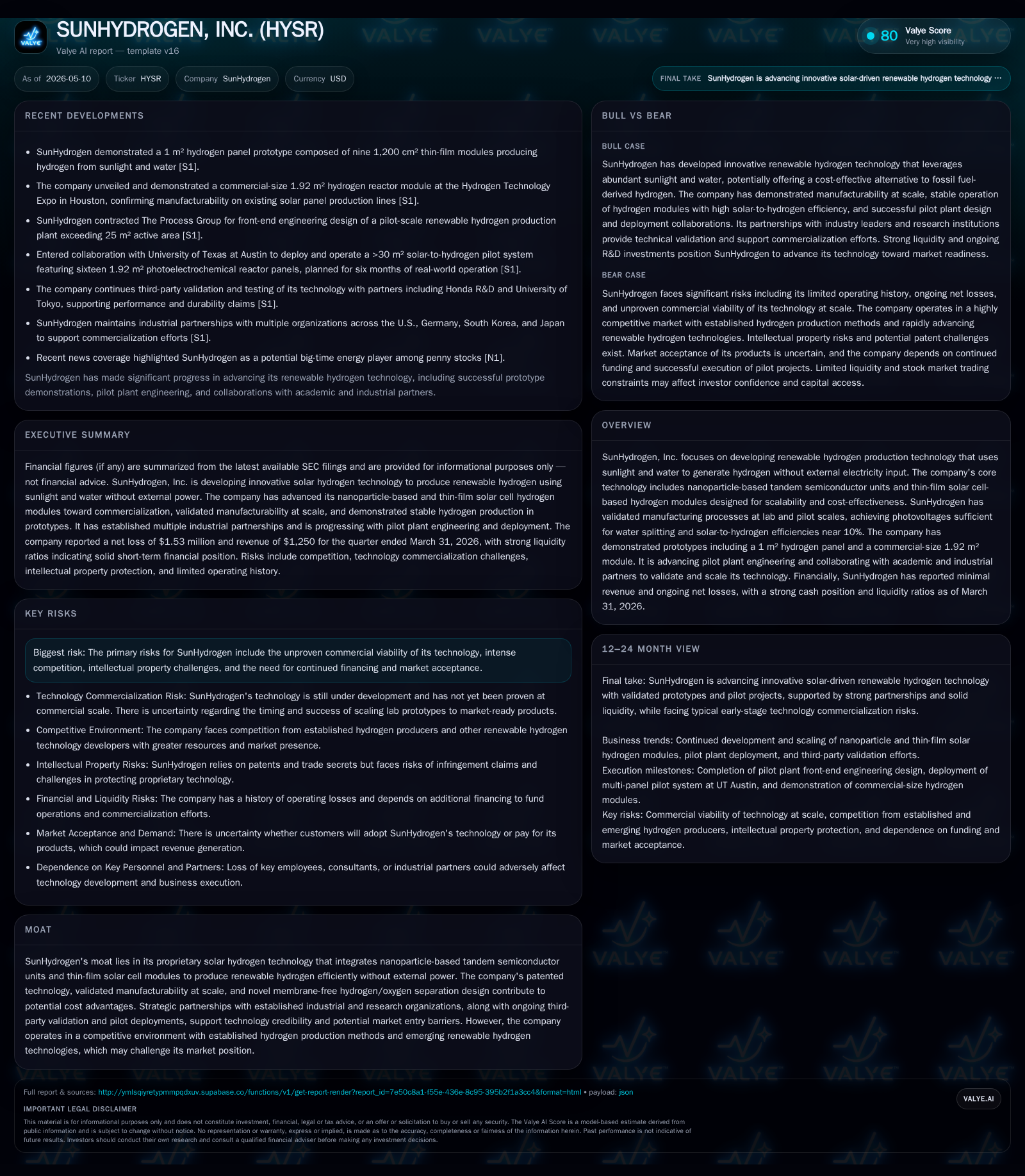
In its latest 10-Q filing for Q1 2026, SunHydrogen reports continued development milestones validating its solar-driven hydrogen production technology poised for market entry. The company’s business model centers on cutting-cost renewable hydrogen via proprietary nanoparticle and thin-film solar modules that require no external electricity. Despite operating losses and an unproven commercial prototype, SunHydrogen’s collaborations and pilot plant engineering underscore growth opportunities amid a competitive landscape dominated by electrolyzer OEMs and large industrial gas firms. Key risks remain execution uncertainty, technology adoption timing, and financing needs. Upcoming scale-up milestones will be critical signals of commercial viability.
Q1 2026 Operating Update: Progress and Implications
SunHydrogen’s May 8, 2026, quarterly report ([S2]) reveals steady operational progress without significant changes in risk factors previously disclosed in the 2025 annual report ([S1]). The company continues its focus on scaling nanoparticle-based tandem semiconductor units capable of splitting water into hydrogen using only sunlight as the energy source. Current activities concentrate on front-end engineering design for a pilot plant exceeding 25 m² of active area and multi-panel pilot system installation exceeding 30 m² at the University of Texas at Austin ([S27]). This marks a pivotal phase where lab-scale successes are transitioning into real-world environments designed to gather durability and performance data over at least six months—critical for de-risking commercialization.
The absence of material legal proceedings or risk factor updates underscores consistency but also highlights that SunHydrogen remains early stage with no revenue beyond a modest $1,250 recorded in Q1 2026 ([F1]). The technological advancements reported support the narrative of incremental validation toward scalable manufacturing processes necessary for eventual marketable products.
SunHydrogen’s Business Model and Technological Edge
SunHydrogen generates potential future revenues through the sale or licensing of its proprietary solar hydrogen production modules ([S1], [S9]). Its core innovation lies in nanoparticle-based tandem photoelectrosynthetic heterostructures that autonomously split water molecules into hydrogen and oxygen when exposed to sunlight—without external electrical input or grid dependence ([S9], [S24]). This contrasts sharply with conventional electrolyzers requiring electricity from potentially carbon-intensive grids or costly power electronics.
Beyond nanoparticle reactors, SunHydrogen also leverages commercially mass-produced thin-film solar cells reengineered with proprietary module designs to improve fault tolerance and production efficiency ([S13]). This dual approach offers scalability advantages by marrying breakthrough nanotechnology with mature solar panel manufacturing infrastructures—potentially lowering costs and accelerating time to market.
A distinctive feature is their membrane-free separation design integrated into generator housings which enhances safety while preserving high proton transport rates essential for improving solar-to-hydrogen conversion efficiency targeting around 10% ([S16], [S26]). The company's aspirational cost target of $2.50/kg positions it competitively against fossil fuel hydrogen typically produced through steam methane reforming (SMR), aiming to disrupt entrenched supply chains burdened by high capital costs and carbon emissions associated with long-distance hydrogen transportation ([S1], [S24]).
Competitive Landscape and Industry Structure
The renewable hydrogen industry is intensely competitive with rapid technological evolution. Dominant players include electrolyzer manufacturers such as Nel ASA, specializing in alkaline and PEM electrolyzers; ITM Power focusing on PEM electrolysis stacks; Fusion Fuel developing solar-to-hydrogen micro-electrolyzers; along with emerging photocatalytic innovators like Sparc Technologies ([S7], [S22]). Large industrial gas conglomerates (Linde, Air Liquide, Air Products) maintain expansive hydrogen infrastructure networks that present formidable barriers due to scale, funding, and customer relationships.
SunHydrogen differentiates itself via integration of photovoltaic-driven water splitting absent external power needs—a salient feature in decarbonization efforts minimizing grid reliance. However, this advantage competes against extensive DOE-supported R&D advances improving electrolyzer efficiency and cost reductions ([S14]). Reduced federal funding allocations may temper sector growth momentum domestically ([S14]). Barriers to entry remain relatively low technologically but scaling manufacturing efficiencies while protecting intellectual property represents ongoing challenges given incomplete patent coverage adjustments and evolving process designs ([S14], [S16]).
Growth Catalysts Driving Renewable Hydrogen Adoption
Global momentum behind clean hydrogen is rising sharply. According to Deloitte studies referenced in SunHydrogen's filings, the renewable hydrogen market could reach approximately $1.4 trillion annually by 2050 driven by decarbonization demands across transportation, industrial feedstocks, power generation, and mobility sectors ([S1]). The IEA documents a doubling in low-emission hydrogen projects reaching final investment decisions (FID) within the past year implying accelerated deployment pipelines ([S1]).
SunHydrogen's scalable modular panels promise localized hydrogen generation eliminating costly transport logistics and significantly reducing carbon footprint compared to centralized SMR plants relying on natural gas pipelines or trucking compressed hydrogen ([S1], [S24]). Collaborative alliances with research institutions like University of Iowa and Michigan, industrial partners including Honda R&D Co., Ltd., CTF Solar GmbH, and others enhance validation credibility alongside third-party testing protocols overseas ([S27], [S11]). These partnerships broaden technical know-how while anchoring pilot deployments vital for demonstrating long-term operational viability.
Challenges and Risks Constraining Commercialization
Despite technological promise, SunHydrogen faces headwinds typical of early-stage cleantech ventures. It lacks a completed large-scale commercial prototype with uncertainty over timing complicating customer adoption timelines ([S1], [S6]). Ongoing operating deficits reflect pre-commercial status; net losses exceed $8 million in fiscal year ending June 2025 with revenue effectively nil beyond nominal test sales ([F1], [S12]). The path from pilot validation to full commercial rollout involves financial risks given anticipated incremental R&D expenses coupled with limited visibility on sustainable financing beyond current cash reserves.
Competition intensifies as entrenched electrolyzer companies bolster capacity expansions (Ohmium International ramping gigafactories) while electrolysis efficiency gains compress margins across the board ([S7], [S22]). Intellectual property protection gaps remain notable following abandonment of some earlier patent applications causing potential infringement concerns or licensing dependencies ([S14], [S16]). Retention of key scientific personnel such as CTO Dr. Syed Mubeen is critical given specialized knowledge prerequisites embedded into complex photoelectrochemical constructs ([S8]).
Milestones to Watch: Execution and Market Signals
SunHydrogen’s future execution hinges on achieving several key technical milestones: completing FEED for the >25 m² pilot plant currently under engineering; successful multi-panel installations that can demonstrably sustain at least six months operation under realistic environmental exposures; publication of validated solar-to-hydrogen efficiency metrics nearing the targeted ~10%; extension or establishment of licensing arrangements evidencing market traction; initiation of first meaningful revenue streams beyond lab-scale tests; further industry partnerships solidifying supply chain capabilities; incremental IP filings reinforcing competitive moats; regulatory approvals if applicable for onsite generation systems; plus iterative cost optimizations moving toward the $2.50/kg goal—all provide quantifiable indicators guiding investor confidence ([S1], [S9], [S27]).
Financial Position and Liquidity Snapshot
Latest financial snapshot
| Metric | Value | Period |
|---|---|---|
| Cash & equivalents | $13mm | |
| 2026-03-31 | ||
| Current assets | $34mm | |
| 2026-03-31 | ||
| Current ratio | 44.47x | |
| 2026-03-31 |
Source: SEC companyfacts cache [F1].
At quarter-end March 31, 2026, SunHydrogen holds approximately $13.07 million in cash and equivalents against minimal debt obligations estimated at about $177.5 thousand as per latest available data ([F1]). Current assets stand near $33.78 million compared to current liabilities below $760 thousand yielding an unusually robust current ratio exceeding 44—indicative largely of working capital buffers rather than revenue-backed liquidity given nascent sales levels (~$1,250 reported) ([F1]).
However, persistent net losses evident from past fiscal quarters underscore reliance on continual capital injections or collaboration agreements to sustain R&D expenditures needed for pilot plant commissioning and scaling efforts. Absent accelerated commercialization or revenue ramp-up within foreseeable horizons poses solvency risks typical among deep-technology startups venturing into capital-intensive clean energy markets ([F1], [S12]).
This analysis synthesizes SEC filings up through May 8, 2026 alongside field-specific insights evaluating SunHydrogen's position within emerging green hydrogen production technologies. While its innovative membrane-free photovoltaic water splitting approach offers promising scalability advantages tailored for true renewable energy integration without grid power dependence, commercial viability will depend heavily on successful scale-up execution amid accelerating competition from mature electrolysis providers backed by considerable institutional capital. Investors should monitor demonstrable pilot plant performance data alongside partnership developments as practical barometers of market readiness absent explicit investment recommendations.
Disclaimer: This is research-only, informational analysis and not investment advice. It may include AI-generated interpretation and general industry context. Always verify important details using primary sources.

Comments