
TriCo Bancshares Advances California Banking With Diversified Portfolio and Tech Initiatives
Latest quarterly filings highlight TriCo Bancshares’ steady operational performance, reinforced by a broad product mix and strategic technology investments in a competitive California market.
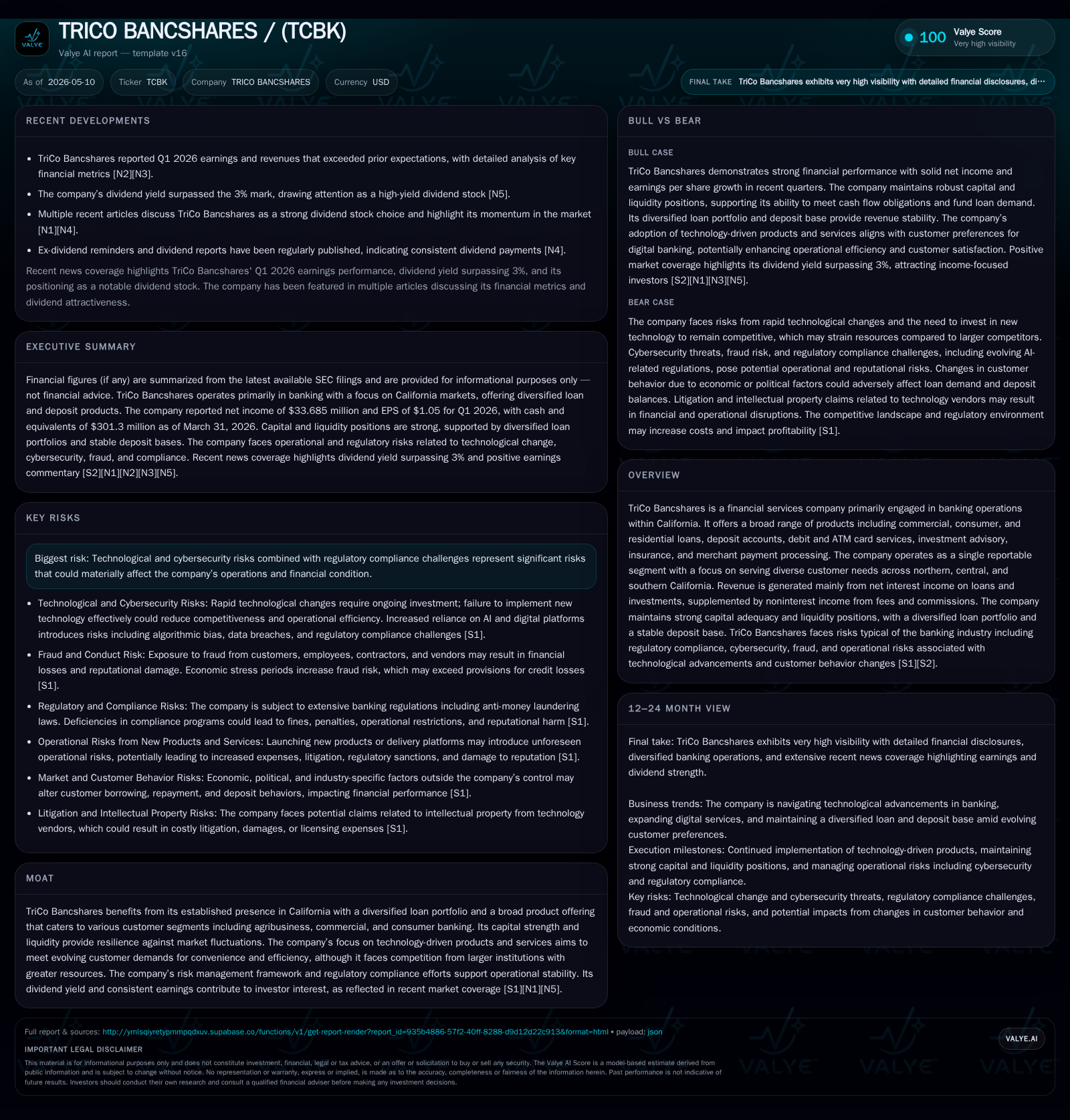
TriCo Bancshares reported in its May 8, 2026 10-Q filing consistent execution with stable loan portfolio composition and deposit growth, underpinning its revenue base primarily from net interest income. The company’s business model leverages diverse financing products for commercial, consumer, and agricultural segments across California, supplemented by fee-based services such as merchant payment processing. While competing against larger banks with deeper resources, TriCo emphasizes tailored customer engagement through regional footprint and technology-driven convenience. Growth is driven by expansion in digital banking capabilities and loan diversification amidst a cautious regulatory environment focused on cybersecurity and compliance risks. The bank’s solid capital and liquidity position provide resilience to cyclical market pressures, albeit with watchpoints on evolving technology risks and market demand fluctuations.
Latest Quarterly Operating Highlights
The May 8, 2026 10-Q filing serves as the primary near-term operating snapshot for TriCo Bancshares. As of March 31, 2026, the bank's loan portfolio remains broadly balanced between commercial real estate (owner-occupied and non-owner occupied), agricultural lending, single-family residential mortgages (first trust deeds), home equity loans, and other consumer loans [S2][S23]. There has been no material shift in portfolio concentration signaling cautious consistency in credit deployment aligned with regional economic conditions. Deposit balances saw modest organic growth supported by an emphasis on non-interest bearing demand accounts and money market checking deposits noted in prior disclosures. The combination of stable asset quality metrics and ongoing deposit acquisition efforts supports TriCo’s core net interest income engine.
Technological initiatives highlighted in recent event filings emphasize the bank's continuing rollout of digital banking platforms designed to increase customer convenience without sacrificing branch presence. TriCo management acknowledged the competitive challenge posed by larger institutions’ scale but underscored its intent to leverage technology to complement personalized local service [S3]. No new material regulatory or litigation developments were reported; however, references reaffirm ongoing management focus on cybersecurity risk mitigation following past incidents in 2023 [S1][S4].
Comprehensive Banking Business Model and Product Suite
TriCo Bancshares operates principally through its subsidiary bank across California offering a comprehensive suite of banking products including commercial loans (notably CRE), consumer loans (mortgages and home equity), deposit accounts (noninterest-bearing demand to CDs), debit/ATM services, investment advisory, insurance products, and merchant payment processing solutions [S1][N1]. Revenue is predominantly derived from net interest income – the spread between interest earned on loans/investments versus interest paid on deposits – supplemented materially by noninterest income from fees tied to transactional services.
This multi-product approach fosters diversified sources of income while promoting cross-selling opportunities that enhance customer retention. The company’s footprint spans northern to southern California through 65 traditional branches plus nine dedicated loan production offices that facilitate regional lending expertise tailored to agricultural clients as well as commercial enterprises [S1]. Merchant payment processing adds fee-based revenue streams that align well with the broader trend towards digital commerce. By binding customers through a broad array of financial needs and modern delivery platforms, TriCo creates switching costs vital for competitive endurance.
Competitive Dynamics and Industry Positioning in California
Operating within California’s complex banking ecosystem subjects TriCo to intense competition from both large national banks wielding scale advantages and aggressive fintech entrants reshaping customer expectations around convenience and pricing. TriCo’s local branch-intensive model supports relationship banking especially valued by agribusinesses and small- to mid-sized commercial firms less targeted by bigger peers [S1]. Yet this comes at the cost of higher fixed infrastructure expenses that scale-driven rivals can leverage more efficiently.
The industry is experiencing structural shifts accelerated by evolving digital preferences where physical branch usage declines but clients still seek hands-on advisory services. TriCo must balance maintaining sufficient brick-and-mortar accessibility while investing in compelling digital tools without eroding its traditional customer base [N4]. Regulatory factors specific to California add complexity regarding privacy laws impacting data handling practices alongside strict anti-money laundering regimes mandated federally [S4]. The company emphasizes compliance adherence buttressed by risk frameworks aimed at mitigating reputational risks common to regional banks.
Growth Catalysts: Technology Integration and Loan Portfolio Diversification
Growing demand for seamless digital access drives TriCo’s push into mobile banking enhancements enabling customers to manage accounts, initiate payments, or access advice remotely—critical for younger demographics favoring app-based engagement [N3][S1]. This technology-driven pivot complements their existing reliance on lending products across commercial real estate segments including multifamily housing projects, owner-occupied properties, agriculture loans reflecting California's sizable farming sector, plus residential mortgage products underpinned by strong property values.
Expanding fee-based income via merchant payment processing aligns with broader fintech adoption trends generating incremental profits unrelated directly to interest rate cycles. Prospectively measurable KPIs include increases in digital user adoption rates, fee income growth trajectories tied to transactional volumes, new loan bookings segmented by portfolio type reflecting economic optimism or constraints [N4]. Such diversification supports structural resilience beyond cyclicality typically seen in interest rate dependent earnings.
Risk Factors: Regulatory, Cybersecurity, and Market Sensitivities
Despite operational stability, TriCo confronts substantial risks typical of regional banks exposed to tightening regulatory oversight around privacy laws and AML controls that could involve costly remediation or restrictions if compliance lapses occur—risks heightened given prior cyberattack disruptions in early 2023 that triggered both litigation inquiries and reputational concerns [S4][S12].
Cybersecurity remains pivotal within enterprise risk management given increasing threats coupled with digitization ambitions potentially introducing new vulnerabilities if controls lag innovation speed. Fraud risk is acute particularly during periods of economic stress affecting borrower capacity or deposit integrity. Additionally, interest rate fluctuations influence deposit beta—how sensitive deposit rates are relative to market changes—and consequently impact net interest margins amid competitive deposit pricing pressures [S16]. The company acknowledges that failure to adapt technologically or implement adequate operational safeguards could materially undermine results.
Upcoming Milestones and Monitoring Points for Investors
Key near-term indicators include second quarter earnings releases expected to clarify momentum behind loan growth initiatives along with updates on technology platform deployments meant to expand digital adoption rates while optimizing branch footprint efficiency [S2][S3]. Monitoring regulatory developments focusing on data privacy enforcement will be critical as any unexpected administrative actions or fines could impact operating expense structures.
Investor attention should also track deposit inflows versus outflows under competitive pressure scenarios alongside credit quality metrics within commercial real estate portfolios sensitive to state economic shifts. Any pronounced changes here may presage demand cycle inflections affecting future profitability.
Concise Financial Overview: Capital Adequacy and Earnings Snapshot
As of March 31, 2026, TriCo Bancshares held cash & equivalents totaling approximately $301 million supporting strong liquidity positions capable of meeting depositor demands or opportunistic lending use cases under uncertainty [F1]. Fiscal year-end net income was $121.56 million supporting sustainable dividend distribution policies consistent with a moderate payout ratio exercised prudently through multiple share repurchase plans recently transitioned under Board authorization [F1][S2][S6].
This financial base underpins ongoing strategic initiatives including technology investments envisaged not only as cost centers but enablers for long-term top-line growth amid evolving competitive dynamics.
This analysis is grounded exclusively in recent SEC filings complemented by referenced news sources highlighting verified operating facts without projection or recommendation intentions.
Disclaimer: This is research-only, informational analysis and not investment advice. It may include AI-generated interpretation and general industry context. Always verify important details using primary sources.

Comments