
Physical Palladium Exposure Refined: Insights from abrdn’s Latest Quarterly Update
Abrdn Palladium ETF Trust’s recent 5-for-1 share split aims to enhance retail accessibility and trading liquidity amidst evolving palladium market dynamics.
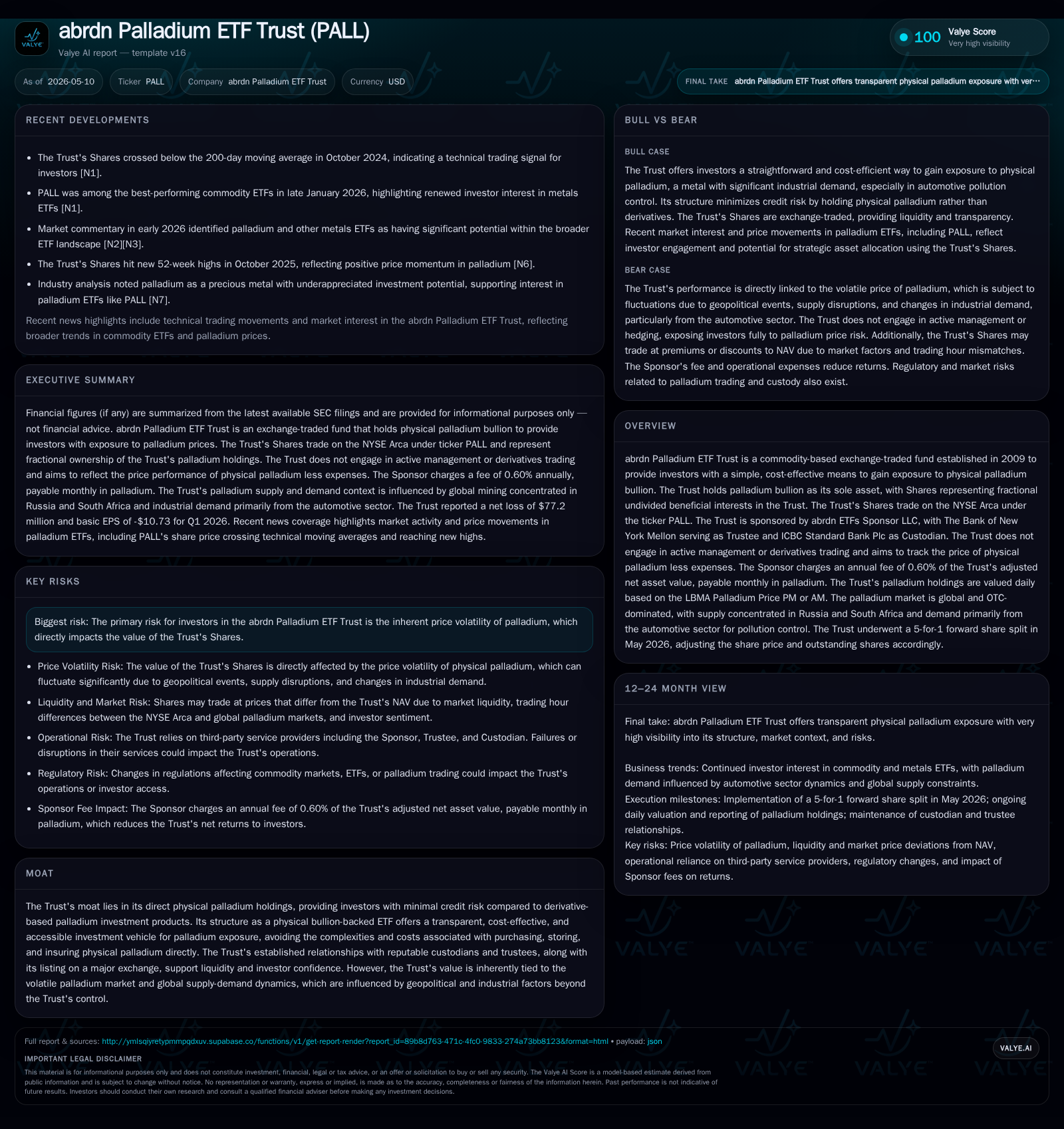
The abrdn Palladium ETF Trust (PALL) announced a 5-for-1 forward share split effective May 18, 2026, as disclosed in its latest quarterly and event filings. This corporate action lowers per-share prices, potentially attracting a broader investor base and improving market liquidity. The Trust operates as a physically backed palladium bullion vehicle, providing transparent, low-credit-risk exposure to the metal through NYSE Arca-listed shares. Palladium’s primary industrial demand remains concentrated in autocatalyst applications, though regional automotive sector fluctuations pose cyclical challenges. The share split and prior reductions in creation unit size reflect deliberate structural moves to boost market participation. Key risks are centered on palladium price volatility driven by supply constraints and macroeconomic factors. Investors and analysts should watch post-split trading metrics and industrial demand signals for cues on inflows and performance.
Latest Quarterly Developments and Market Impact
On April 22, 2026, abrdn Palladium ETF Trust (PALL) formally announced a 5-for-1 forward share split to be executed after market close on May 15, with the new shares trading at adjusted prices starting May 18 on NYSE Arca [S2][S3][S5]. This strategic move reduces the price per share proportionally while increasing shares outstanding fivefold. The rationale is clear: improve the affordability of shares for retail investors and enhance overall market liquidity by broadening potential participation. Post-split prices will be exactly one-fifth of pre-split NAV per share without any change to ticker symbol or CUSIP number.
By lowering the financial entry threshold per share, such splits can stimulate secondary market volume while aligning the share price scale more closely with prevailing retail investment norms in precious metals ETFs. For a niche vehicle like PALL—tracking a high-value but often volatile commodity—this adjustment could unlock incremental demand from smaller accounts seeking straightforward physical palladium exposure.
Investment Objective and Business Model Overview
The abrdn Palladium ETF Trust is designed to provide investors direct exposure to physical palladium bullion through an NYSE Arca-traded exchange-traded fund structure [S1]. Shares represent fractional undivided interests in exclusively palladium bullion held by the Trust; there are no futures contracts or derivative instruments employed within the portfolio.
This pure physical backing eliminates credit risk associated with counterparties inherent in derivative-based products—critical for investors prioritizing safe-keeping of tangible assets without complex counterparty exposures. The Sponsor levies an annual management fee of 0.60% of adjusted net asset value (NAV), paid monthly via palladium allotment from the Trust's holdings. The NAV valuation relies daily on pricing derived from the LBMA Palladium Price PM or AM benchmarks [S1].
The Trust itself does not engage actively in trading or speculative positioning; its primary operations revolve around creating or redeeming shares upon authorized participant orders that transfer physical metal accordingly.
Structural Essence of Physical Palladium Holdings
The hallmark feature of PALL is its preservation of physical palladium bullion as sole assets [S1]. Custody is entrusted to ICBC Standard Bank Plc’s vault facilities in London—with BNY Mellon serving as Trustee responsible for administrative duties such as NAV calculation, processing creation/redemption orders, fee distributions, and regulatory filings [S1][S18].
Share creations or redemptions only occur in "baskets," currently defined since June 2024 as blocks of 12,500 Shares—a significant reduction from the initial basket size of 50,000 shares at inception [S1][S22]. These baskets facilitate large-scale transfers denominated in physical palladium ounces matching corresponding NAV values. Individual shareholders transact secondary market shares but rely on Authorized Participants for basket-level creation/redemption.
This structure mitigates counterparty risk prevalent in synthetic ETFs backed by derivatives. The physical holdings remain segregated with minimal unallocated holdings temporarily used only during basket formation processes. Fees payable to the Sponsor are settled mostly in-kind with palladium bullion transfers rather than cash, reinforcing alignment with asset exposure [S1]. Such strict custody protocols provide transparency to investors regarding actual metal backing unlike funds betting solely on paper contracts or swaps.
Competitive Landscape in Palladium ETFs
Within precious metals ETFs focused strictly on palladium, PALL stands out due to its fully allocated physical backing listed on a major exchange [S1][S3]. Compared to derivative-based palladium ETVs or ETNs which carry higher counterparty risks and regulatory complexities, PALL combines ease-of-access with safer structural integrity.
Liquidity benefits arise from listing on NYSE Arca where institutional and retail investor order flows converge efficiently—especially after adjustments like basket size reduction and now this share split aimed at optimizing tradability [S3][S22]. Switching costs for investors traditionally stem from differences between direct metal ownership versus synthetic ETFs including storage burdens versus counterparty default probability.
While PALL clients do not enjoy traditional equity shareholder rights such as voting or dividends—shares represent simple bullion claims optimized for investment rather than corporate governance engagement.
Growth Drivers Amidst Industrial Demand and Market Accessibility
The primary driver underpinning palladium demand remains its dominant use (~85%) in automotive autocatalysts employed for emissions controls [S1]. Although shifts toward electric vehicles threaten long-term demand structurally via reduced combustion engine reliance, recent policy changes such as U.S. EV tax credit cessations have temporarily reinforced internal combustion engine vehicle offerings leveraging palladium catalytic technologies [S26].
Geographically divergent trends are noteworthy: China and U.S. markets show recovery signs catalyzing autocatalyst demand liftings, while Europe faces softness arguably driven by slowing automotive sales plus solvency considerations among manufacturers [S1].
Reducing basket sizes over time—from initial blocks of 50,000 shares down to current 12,500—and the recent share split effectively lower minimum investment increments allowing smaller investors easier entry points. This incrementally enhances fund inflows by accommodating retail investors previously deterred by larger upfront capital commitments or high single-share price levels post fluctuations [S3][S24].
Additional growth stimuli include elevated palladium spot prices seen since mid-2025 triggered by supply disruptions from South Africa/Russia geopolitical sensitivities combined with constrained secondary supply recycling rates [S26], augmenting appeal for physical-backed exposure vehicles like PALL.
Risks and Constraints Shaping Investment Outcomes
Price volatility is by far the largest risk factor for PALL investors—as each share's value correlates almost directly with fluctuating spot prices of palladium [S1][S12]. Potential triggers for sharp declines include increased hedging activity by producers financing future output sales which depress spot prices or broad negative shifts among speculators/central banks disposing reserves [S1].
Political upheavals affecting major suppliers (particularly Russia accounting for ~41% of production) pose periodic supply interruptions impacting availability [S25]. Pandemic-style economic shocks can induce forced sales as seen during the 2008 financial crisis suppressing metal prices sharply.
Structural risks inherent to ETF mechanics include possible delays or complications during creation/redemption processes impacting arbitrage efficiencies; deviations from NAV; thin liquidity magnifying spreads; authorized participant withdrawal reducing active market makers; or unforeseen disruptions affecting custody arrangements—all potentially leading to premiums/discounts disconnected from underlying metal value [S17][S29].
No new material risks were identified in Q1 filings indicating stable operational environment although vigilance remains prudent given commodity price cyclicality.
Forward-Looking Indicators and Key Milestones
Stakeholders should watch how post-split liquidity evolves—proxying retail uptake impact by tracking average daily volume changes and bid-ask spreads against historical baselines pre-split [S2][S3]. Furthermore, insights into industrial input demand patterns especially for European auto manufacturing facing headwinds compared against rebound trajectories in China/U.S serve as leading indicators influencing sustainable metal prices affecting fund NAVs.
Additionally monitoring authorized participant involvement level stabilizations—since they facilitate creation/redemption maintaining tight price alignment—is critical given increasingly smaller basket sizes necessitate more frequent transactions during scaling phases.
Market observers might also track any shifts relating to key benchmark setting entities like LBMA transitioning price administration from LME to ICE Benchmark Administration mid-2026 which could introduce short-term benchmark volatility affecting daily NAV calculations [S28].
Financial Context Supporting Operational Considerations
Financial disclosures confirm absence of liabilities or indebtedness related burdens at quarter-end, consistent with the fund’s straightforward asset-backed model focused solely on held metal inventories rather than leverage-driven exposures [F1][S2]. The annualized expense ratio approximates a modest drag on returns at around 0.60%, paid via physical palladium allocation rather than cash outlay ensuring fees scale proportionally with assets under management values [S1].
Net income figures pertain largely to ancillary operational results rather than traditional earnings attributable absent since PALL is not an operating company but a declared trust entity holding physical inventory [F1]. Thus financial metrics primarily serve contextually—to affirm structural soundness and cost incidence rather than profitability metrics relevant for corporations.
This analysis synthesizes information as stated in abrdn Palladium ETF Trust SEC filings through May 8, 2026 (10-Q), supplemented with contextual data from earlier annual reports and company disclosures. No forecasts or investment recommendations are implied.
Disclaimer: This is research-only, informational analysis and not investment advice. It may include AI-generated interpretation and general industry context. Always verify important details using primary sources.

Comments