
PAMT CORP’s Q1 Shift: Revenue Mix and Operational Efficiency Under Pressure
The latest quarterly filing reveals tactical operational adjustments as PAMT contends with tariff-related complexities and litigation expenses, amid concentrated automotive sector demand.
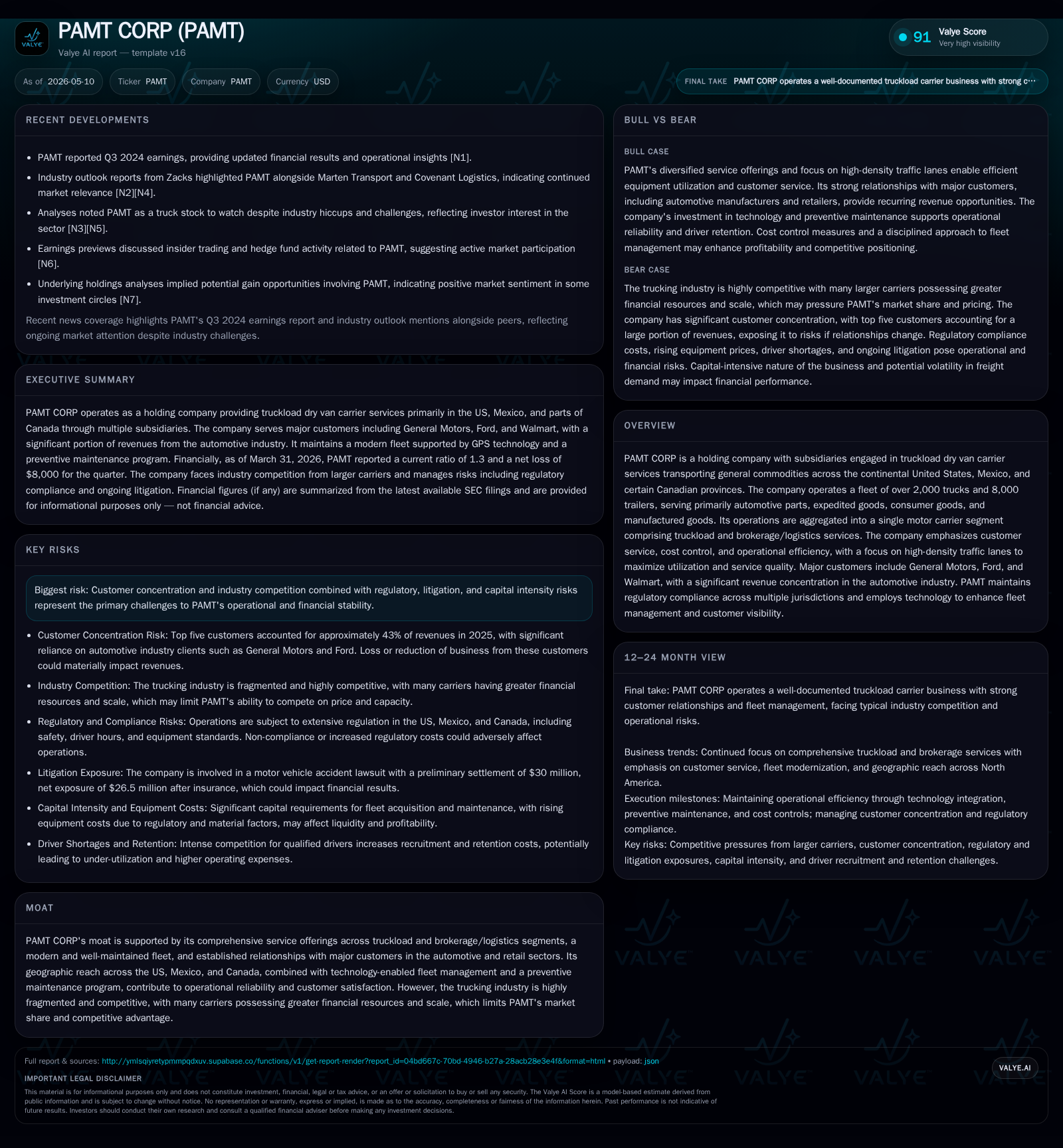
PAMT CORP's Q1 2026 update shows targeted efforts to manage revenue mix shifts and operational efficiency under tariff uncertainty across its North American trucking corridors. The company's integrated truckload and brokerage services focus on high-density traffic lanes to optimize fleet utilization, although cross-border volumes face pressure from potential tariffs impacting key automotive customers. Litigation settlement expectations and driver-market constraints add layers of operational challenges. PAMT's business model leverages a modern fleet and technology-driven maintenance but remains exposed to customer concentration and industry fragmentation risks.
Q1 2026 Operating Update Reflects Tactical Adjustments
In its May 8, 2026 Form 10-Q filing [S2], PAMT CORP presented its first-quarter operational picture emphasizing incremental improvements in fleet utilization against a backdrop of tariff-induced cross-border volume fluctuations. While no material changes were reported in risk factors [S2], the company disclosed plans to accelerate share repurchases during Q2 under existing authorizations [S4], signaling confidence in cash flow generation despite mounting pressures.
The filings underscore PAMT's ongoing tactical adjustments within defined high-density traffic lanes—strategically chosen routes aiming to maximize revenue per truck by minimizing empty miles between loads. These corridors span its North American network where cross-border freight is critical but increasingly impacted by uncertain tariff regimes between the U.S., Mexico, and Canada.
The recent event filing (8-K dated May 5) affirmed no emerging internal disruptions while confirming timely progress on legal settlements linked to a substantive auto-liability exposure from an incident in late 2024 [S3]. This settlement dynamic adds a near-term financial overlay to operations execution.
Integrated Business Model Centered on Truckload and Brokerage Services
PAMT operates primarily via wholly owned subsidiaries providing truckload dry van carrier services combined with brokerage logistics offerings aggregated into a unified motor carrier segment [S1]. With a fleet consisting of approximately 2,094 trucks—including nearly 500 independent contractors—and about 8,000 trailers distributed across the U.S., Mexico, and select Canadian provinces [S22], the company manages significant transport volumes.
Core freight comprises automotive parts, expedited goods for time-sensitive delivery schedules, consumer retail merchandise, and manufactured goods such as HVAC units [S21]. The company emphasizes servicing high-density traffic lanes tailored to customer regional needs — boosting consistency in equipment capacity deployment while fostering superior service levels demanded by clients like General Motors (14% revenue share), Ford (9%), and Walmart (8%) [S22].
This business strategy supports generating recurring revenue streams reflective of service sensitivity rather than pure price competition. Sales teams focus intensively on balancing origin-destination freight flows to maintain high utilization within disciplined lane structures that help attract drivers by offering route familiarity and safer conditions [S23].
Competitive Dynamics in a Fragmented North American Trucking Market
The trucking industry’s highly fragmented nature weighs on PAMT’s scale advantages. Although PAMT holds a modern well-maintained fleet supported by predictive maintenance programs enabled through digital monitoring technologies, many competitors enjoy larger asset bases and stronger capital resources [S1], constraining market share expansion.
Pricing power is limited due to excess industry capacity typical during economic softness or tariff disruptions affecting trade flows. Regulatory compliance requirements spanning U.S., Mexican federal rules as well as Canadian provincial mandates increase operational complexity and costs [S10]. Driver shortages persist as an industry-wide issue diminishing capacity flexibility.
Economic cycles also affect end-market demand notably within automotive segments—where labor disputes or plant shutdowns propagate volume volatility impacting freight demand patterns over multiple quarters [S25]. Such cyclical sensitivities compound competitive pressures for carriers like PAMT.
Growth Catalysts: Technology, Customer Concentration, and Market Expansion
Key growth drivers center on deploying technology-enabled fleet management tools that enhance preventive maintenance schedules—minimizing unplanned downtime to improve overall equipment effectiveness rates. High-density lane optimization continues reducing empty miles thus enhancing revenue per mile metrics.
While major client relationships are concentrated—with the top five customers constituting over 40% of revenues—this concentration provides steady volume underpinned by stringent service requirements forming switching cost barriers albeit elevating sector-specific demand risk [S26]. Expansion into brokerage services across contiguous North American markets offers ancillary revenue potential through integrated logistics solutions reflecting evolving customer preferences for bundled transport-spanning capabilities.
Cross-border freight engagement remains strategically important despite policy uncertainties with trade tariffs creating headwinds. The company's geographic footprint including direct operations in Mexico under local partnerships confers adaptability advantages should supply chain reconfigurations or rerouting become necessary [S21].
Risks and Constraints: Tariffs, Industry Fragmentation, and Litigation Exposure
Uncertainty around tariffs imposed on goods moving between the U.S., Mexico, and Canada continues weighing on PAMT’s operations—particularly affecting automotive parts transport channels exposed to additive cost burdens potentially dampening shipment volumes [S1]. Volatility in diesel fuel prices further accentuates cost pressures given no formal hedging against fuel price moves.
A notable litigation risk persists from the December 29, 2024 motor vehicle accident lawsuit settled preliminarily for $30 million total exposure ($26.5 million net after insurance), expected for final approval imminently [S9][S20]. Such claims strain earnings stability with sizeable uninsured components exposing PAMT to potential earnings volatility amid claims inflation risks.
Operationally, driver labor market tightness impairs scalability while fluctuating regulatory landscapes impose compliance burdens adding incremental expenses. The structural nature of these constraints tempers margin expansion outlooks absent significant pricing power or productivity breakthroughs.
Key Upcoming Milestones to Monitor Execution Progress
Investors should monitor approval timing of the accident settlement that will crystallize cash flow impact during early fiscal quarters following this filing cycle. Additionally, tracking sequential shifts in truck utilization metrics will provide visibility into how effectively PAMT navigates tariff-induced volume swings across its cross-border corridors.
Further developments regarding uptake rates under the accelerated stock repurchase program introduced May 1 denote management’s confidence level amid external headwinds [S4]. Updates on driver hiring or retention incentives introduced will also be meaningful for operational resilience metrics.
Continuous reporting around brokerage/logistics unit growth may elucidate diversification benefits within core single-segment reporting structures sustaining revenue stability.
Latest Financial Snapshot: Liquidity, Leverage, and Capital Strategy
Latest financial snapshot
| Metric | Value | Period |
|---|---|---|
| Cash & equivalents | $41mm | |
| 2026-03-31 | ||
| Current assets | $181mm | |
| 2026-03-31 | ||
| Current liabilities | $139mm | |
| 2026-03-31 | ||
| Current ratio | 1.3x | |
| 2026-03-31 |
Source: SEC companyfacts cache [F1].
As of March 31, 2026, cash and cash equivalents stood at $40.5 million providing a moderate liquidity cushion amidst operating challenges. Current assets totaled approximately $181 million while current liabilities were about $139 million yielding a comfortable current ratio of roughly 1.3 indicating reasonable short-term financial health [F1][S2].
Total debt reference at $107.5 million from companyfacts carries caveats due to vintage data; contemporaneous leverage position is better inferred from subsequent disclosures which do not signal immediate refinancing risk or covenant breaches [F1].
Disclaimers: This analysis synthesizes latest publicly available SEC filings without investment advice or valuation judgments. Financial metrics are presented as reported or explicitly referenced within source documents without extrapolation or forecasting assumptions.
Disclaimer: This is research-only, informational analysis and not investment advice. It may include AI-generated interpretation and general industry context. Always verify important details using primary sources.

Comments