
Creative Medical Technology’s Clinical Progress and Market Challenges Revealed in Q1 Filing
The company advances stem cell regenerative therapies amid limitations in sales capacity and financial resources.
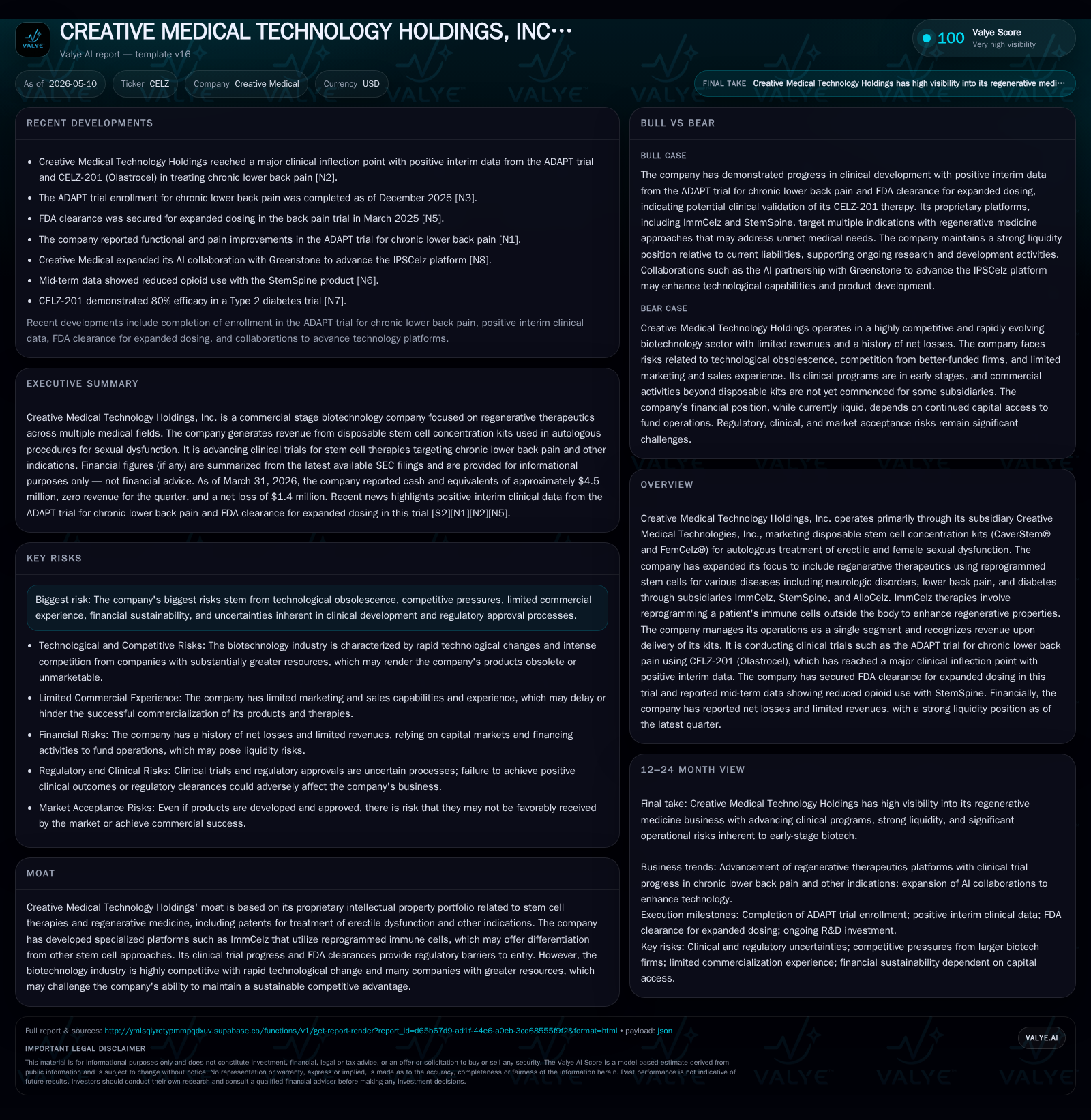
Creative Medical Technology Holdings disclosed Q1 2026 results showing continued clinical advancement of their regenerative therapeutics platforms alongside explicit constraints in marketing capability and budget. Revenue recognition centers on delivery of proprietary stem cell kits for erectile and female sexual dysfunction, while next-generation immune cell reprogramming therapies advance through pivotal trials such as the ADAPT study for chronic lower back pain. Despite a promising intellectual property base and differentiated technology, the company faces challenges from limited capital to scale sales and risks related to rapid technological change. Upcoming clinical milestones and debt repayments will be key operational and financial indicators.
Q1 2026 Operating Highlights: Clinical Momentum Meets Resource Constraints
Creative Medical Technology Holdings’ latest quarterly filing for Q1 ended March 31, 2026 [S2] reveals a company vigorously pushing forward its clinical pipeline while simultaneously flagging significant headwinds stemming from limited marketing capacity and capital availability. The company explicitly states that its marketing efforts may fall short relative to competitors due to scarce resources. This candid acknowledgement frames the operating environment where clinical progress contrasts with commercial scaling constraints.
The filing underscores ongoing operational costs related to license agreements necessitating upfront initial fees and annual maintenance payments credited toward royalties tied to product sales [S2]. Despite these financial obligations, CELZ continues active research investments in trials such as the ADAPT study targeting chronic lower back pain using CELZ-201 (Olastrocel), which has demonstrated an inflection point in key clinical endpoints.
CELZ also highlights risks of rapid technological innovation potentially rendering its products obsolete without timely R&D responsiveness [S2]. This is salient in a regenerative medicine segment characterized by volatile scientific breakthroughs.
Business Model and Product Portfolio: Differentiated Stem Cell Therapies Targeting Sexual Dysfunction and Beyond
CELZ primarily generates revenue through Creative Medical Technologies, Inc. (CMT), its commercial subsidiary that sells proprietary disposable autologous stem cell concentration kits branded CaverStem® (for erectile dysfunction) and FemCelz® (for female sexual dysfunction) [S1]. Physicians purchase these kits to perform same-day procedures using a patient’s own cells — a model that recognizes revenue upon kit delivery per ASC 606 guidelines [S12]. These transacted unit sales drive revenue volume.
Beyond commercial kit sales, CELZ develops next-generation regenerative therapeutics through subsidiaries ImmCelz, StemSpine, and AlloCelz targeting indications like neurological disorders, diabetes type 1, and musculoskeletal pain [S1]. ImmCelz notably utilizes reprogrammed T-regulatory immune cells cultured outside the body with optimized factors — posited to exponentially enhance regenerative potential compared to traditional stem cells [S16].
While these pipelines are pre-revenue or minimal-revenue ventures currently not generating material top line growth, they represent strategic diversification into broader regenerative medicine markets expected to yield long-term value if clinical milestones are met.
Industry Context: Stem Cell and Regenerative Therapeutics Competitive Landscape
CELZ operates within a high-barrier but fiercely competitive bioscience sector distinguished by rapidly evolving technologies and evolving customer demands [S2]. The firm holds issued U.S. patents underpinning its ED treatment kits but must navigate continuous innovation pressures threatening product relevancy.
Moreover, the burgeoning field of immune cell reprogramming places CELZ alongside rival ventures with greater funding and commercialization heft. CELZ’s explicit disclosure of constrained internal sales capacity reflects challenges competing against better-resourced peers with institutional marketing infrastructures [S2][S3].
Regulatory approvals represent stringent hurdles but offer differentiation once cleared; CELZ's acquisition of FDA clearances supporting ongoing trials instills some protective moats versus new entrants. However, industry incumbency is fragile without sustained innovation.
Growth Catalysts: Clinical Trials, Intellectual Property, and Technological Advancement
Key growth drivers stem from robust clinical development execution — notably the pivotal ADAPT Phase I/II trial evaluating AlloStemSpine's CELZ-201-DDT for chronic lower back pain that has cleared safety benchmarks including Data Safety Monitoring Board endorsements [S25]. Expanding patient cohorts' follow-on data readouts will materially influence investor confidence and partnership prospects.
Regulatory pathway progress on CELZ-201 CREATE-1 for newly diagnosed Type 1 Diabetes is another catalyst following Orphan Drug Designation awarded by FDA in March 2024 [S24], enhancing exclusivity prospects.
Intellectual property remains foundational: patents claim novel allogeneic stem cell compositions addressing diverse indications plus proprietary ImmCelz™ immune cell reprogramming techniques characterized by markedly higher purity (>95%) versus industry standards (~80%) alongside enhanced functional potency metrics validated via independent studies [S24]. Such IP could underpin licensing or collaboration revenue streams.
Collaborations like that with Greenstone Biosciences for induced pluripotent stem cells (iPScelz™) aim to broaden therapeutic versatility further fueling future opportunity pipeline depth [S20].
Risks and Challenges: Competitive Pressure, Limited Sales Infrastructure, and Financial Sustainability
CELZ candidly admits substantial barriers restricting growth. Its internal sales experience is minimal with limited capital allocated to marketing — impairing ability to cultivate broad distribution or compete against established medtech firms wielding extensive salesforces [S2][S3]. The lack of scale creates an elevated risk that clinical successes do not translate into commercial gains.
Technological obsolescence risk looms due to swift advances elsewhere in stem cell engineering or immunotherapy approaches potentially outdating current patented methods without escalated R&D investment or agile adaptation strategies [S2].
Clinical development uncertainties persist with dependence on achieving favorable efficacy/safety outcomes within planned trial timelines — delays or failures would stall market entry significantly.
Financially, reliance on milestone payments tied to licensing or collaboration revenue may expose volatility amid cash burn pressures inherent in biotech development cycles [S2]. Furthermore, global macroeconomic factors such as supply chain disruptions or geopolitical conflicts could further strain operations or capital access.
Upcoming Milestones and What to Monitor Next
Attention should focus closely on trial enrollment completion rates across ADAPT cohorts advancing toward full data sets that will guide regulatory submissions. Any interim analyses or DSMB updates can provide directional clarity on therapeutic viability [S25][S26].
Progress updates on Type 1 Diabetes CELZ-201 CREATE-1 trial regulatory engagements following initial patient recruitment are critical near-term events impacting broader pipeline credibility.
Watch also for announcements regarding business development activities such as licensing deals stemming from unique ImmCelz™ platform advantages or iPScelz collaborations expanding indication scope.
Investor communications describing tactical plans mitigating limited sales reach—potentially pivoting towards partnerships or OEM arrangements—would signal strategic commercial evolution necessary given internal resource shortfalls.
Finally, monitoring debt repayment adherence is pivotal since upcoming convertible promissory notes are amortized monthly July through December 2026 at amounts ranging from $2,500 up to $15,125 per payment date [S2].
Financial Snapshot: Liquidity Position and Convertible Debt Overview
Latest financial snapshot
| Metric | Value | Period |
|---|---|---|
| Current assets | $6.06 million | |
| 2026-03-31 | ||
| Current liabilities | $307,649 | |
| 2026-03-31 | ||
| Current ratio | 19.69x | |
| 2026-03-31 |
Source: SEC companyfacts cache [F1].
As of fiscal Q1 ending March 31, 2026, CELZ reported $6.06 million in cash and cash equivalents against modest current liabilities at approximately $0.31 million yielding a robust current ratio near 19.7x supportive of short-term liquidity needs [F1][S2]. Total assets totaled about $6.06 million with negligible debt recorded.
The company has scheduled convertible note repayments cumulatively exceeding $50,000 spread evenly from July through December 2026 requiring disciplined cash management [S2].
Operational cash burn remains a concern given sustained research & development expense run rate exceeding half a million dollars per quarter alongside growing administrative outlays related primarily to license maintenance fees and professional services [S12][S13].
This analysis synthesizes recent SEC filings revealing Creative Medical Technology Holdings’ advancement along crucial regenerative medicine fronts against an operational backdrop marked by restrained sales expansion capabilities coupled with prudent yet pressured financial stewardship. Near-term developments pivot critically on successful clinical readouts balanced against managing capital allocation amid intense industry competition.
This memorandum does not constitute investment advice but aims to illuminate internally relevant operating dynamics shaping CELZ’s evolving business case as derived strictly from disclosed facts.
Disclaimer: This is research-only, informational analysis and not investment advice. It may include AI-generated interpretation and general industry context. Always verify important details using primary sources.

Comments