
Wilson Bank Holding Bolsters Local Market Stability Despite Rate Volatility
Wilson Bank Holding’s recent quarterly update underscores steady regional banking operations amid interest rate pressures and real estate lending risks.
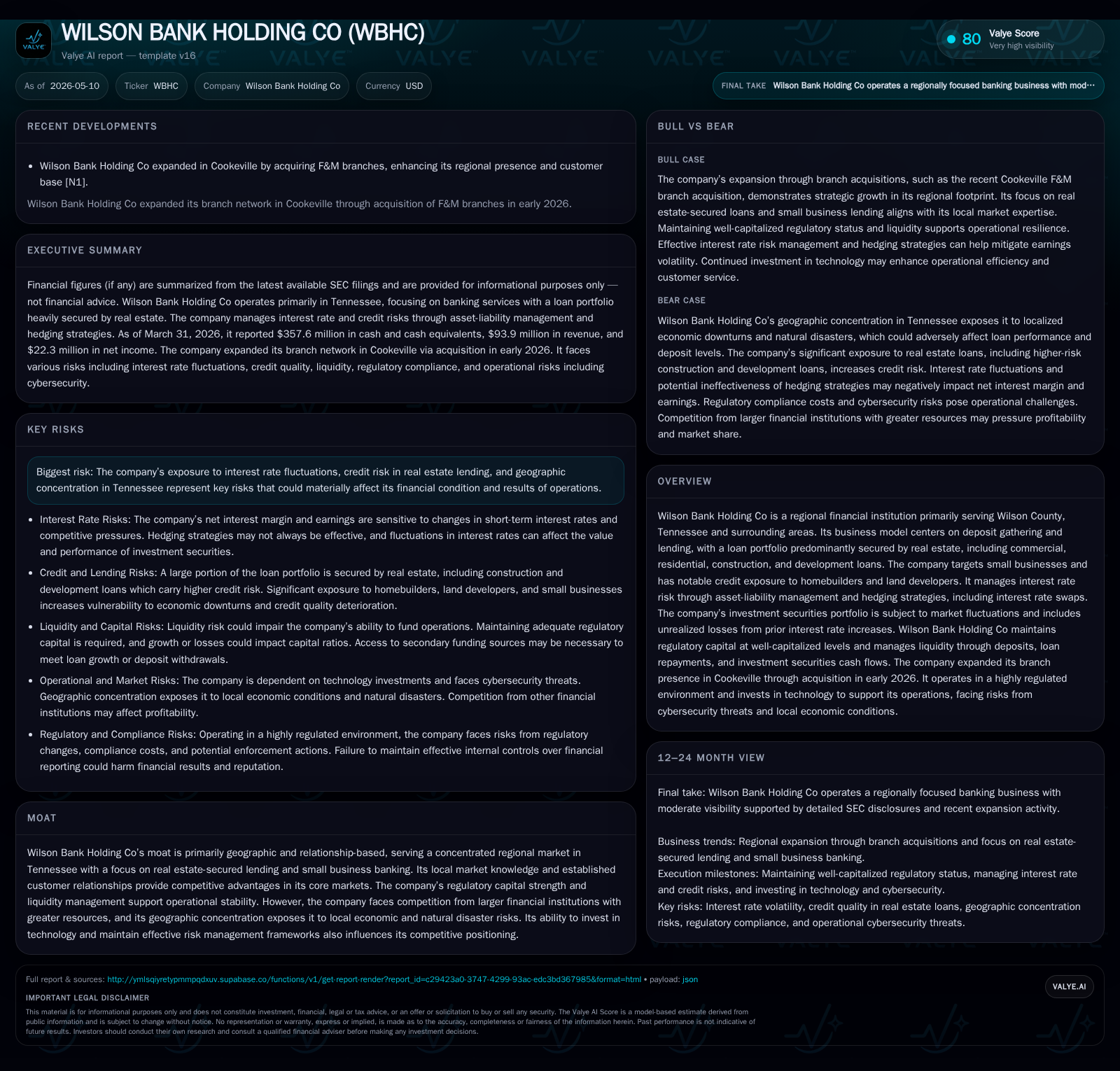
In its 2026 Q1 10-Q, Wilson Bank Holding Co (WBHC) affirmed solid operational trends with proactive asset-liability management despite headwinds from elevated interest rates and unrealized securities losses. The bank’s core business revolves around real estate-secured loans in Tennessee’s Wilson County area, serving primarily small businesses and real estate developers. Its localized market presence creates a protective moat based on customer relationships, yet exposes WBHC to geographic and sector-specific concentration risks. Recent branch expansions and deposit growth initiatives position the bank for measured loan portfolio growth amid a challenging rate environment. Key risks include interest rate volatility impacting net interest margin, credit exposure to construction loans, and regulatory constraints.
Latest Quarterly Operating Update: Solid Trends and Critical Changes
Wilson Bank Holding Company’s Q1 2026 10-Q filing dated May 8th, 2026 [S2] provides insight into an operating environment marked by persistent interest rate volatility impacting bank earnings but sustained by conservative risk and capital management. The company reports unrealized losses in its investment securities portfolio attributable to prior rate increases during 2023-2025; these mark-to-market effects exert downward pressure on reported equity but have not yet crystallized into realized losses given the intent to hold securities to maturity [S2][S8].
Loan portfolio composition remains stable with the majority of loans secured by real estate assets; lending focus continues on commercial real estate, multifamily housing, as well as residential construction and development projects. Loan demand has shown resilience driven by local market activity with cautious underwriting given elevated credit risk intrinsic in construction and land development finance sectors [S2][S8]. Asset-liability management strategies include the active use of interest rate swaps aiming to neutralize negative impacts from short-term rate increases, although the company concedes that such hedges are subject to model risk and effectiveness limits especially when rates move unpredictably [S2][S1].
The company’s capital position is robust and meets “well-capitalized” regulatory thresholds with no immediate concerns noted in terms of liquidity or default risk. Deposit levels benefit from branch expansion initiatives cited in the recent event filing dated April 27th [S3], placing WBHC strategically to capture regional small business deposit inflows critical for funding further loan originations.
Core Business Model: Regional Banking with Real Estate Lender Focus
WBHC operates primarily as a regionally focused financial institution concentrated in Wilson County and surrounding areas in Tennessee. Its revenue derives predominantly from net interest income on loans funded by customer deposits complemented by fees from ancillary banking services [S1]. The loan book emphasizes real estate-backed credits — commercial multi-family properties constitute approximately 40% of outstanding loans; residential mortgage loans another ~38%; while construction, development, and farmland loans make up about 22% [S8].
This portfolio composition reflects deliberate positioning toward higher-yielding but more volatile niche sectors like homebuilder financing and land development. Such focus requires sophisticated local market intelligence which WBHC leverages through longstanding relationships with small business operators and developers. These relationships drive repeat lending opportunities along with tailored risk evaluation that off-the-shelf models cannot replicate [S1]. Thus, local market knowledge supports superior borrower screening and retention yet necessitates vigilant credit monitoring given cyclical vulnerabilities inherent in regional real estate markets.
Interest rate risk is managed through asset-liability management policies including duration matching of assets and liabilities supplemented by derivative contracts such as swaps — tools designed to blunt sharp fluctuations in net interest margin especially when short-term rates rise faster than long-term yields can reprice [S2][S8]. Investment securities primarily comprise municipal bonds issued by local governments within the bank’s footprint; these instruments expose WBHC to market value swings driven by macroeconomic factors affecting state and local budgets.
Competitive Context: Geographic Moat Versus Larger Institutional Pressure
WBHC’s competitive advantage rests on what industry observers term a "regional moat"—deeply ingrained local customer relationships engendering trust difficult for larger competitors to replicate at scale within Wilson County [S29]. This geographic moat affords stable deposit bases and pricing leverage within its core markets.
Nonetheless, competition intensifies from both sides: larger regional/national banks wield broader product suites with technology investments driving efficiency gains unavailable to smaller players; conversely local credit unions often offer tax advantages enabling them to undercut prices on deposits or loans [S29]. Additionally, fintech platforms exert disruptive pressures on transaction services.
Switching costs for customers center on relationship inertia rather than contractual lock-ins; WBHC counters this dynamic with personalized banking experiences rooted in familiarity with local economic cycles and borrower profiles. Regulatory demands further constrain operational flexibility vis-à-vis less-regulated non-bank competitors [S29]. Capacity-wise, lending limits imposed by capital levels require prudent balance sheet growth carefully aligned with deposit mobilization efforts.
Growth Drivers: Branch Expansion, Deposit Base Growth, and Loan Portfolio Trends
Among WBHC’s main growth avenues highlighted in recent disclosures are strategic branch expansions within its regional footprint aimed at capturing untapped small business depositors—a crucial funding source required for further loan origination expansion [S3][S2]. The timing of these expansions correlates with signs of budding economic activity locally which may stimulate demand for both commercial loans (e.g., warehouse or retail development projects) and residential mortgages tied to population growth.
Stable deposit inflows support liquidity essential for sustaining incremental lending without resorting excessively to higher-cost funds such as brokered deposits or wholesale borrowings—the latter currently minimal per disclosures [S5][F1]. Loan demand particularly from homebuilders remains a critical metric underpinning near-term revenue visibility despite cyclical credit quality risks.
Emerging product offerings or diversification beyond core real estate lending are not explicitly detailed but remain potential future levers given technological investments discussed generally in annual filings [S1]. The interplay between deposit gathering effectiveness, credit underwriting rigor, and market expansion forms the backbone of anticipated sustainable growth.
Risks and Watchpoints: Interest Rate Exposure, Concentration Risk, and Credit Quality
Risks dominating WBHC’s operating landscape principally include sensitivity to rapid interest rate changes which compress net interest margins due to lagging repricing dynamics between assets (loans) and liabilities (deposits). While derivatives mitigate some impacts, hedging effectiveness can falter under unexpected curve shifts or volatility spikes [S1][S2].
Credit risk tied especially to real estate underwriting bears close scrutiny; construction and development lending historically carry elevated default probabilities compared with fully amortizing residential mortgages. Any downturn affecting housing demand or local commercial property markets would pressure loan performance metrics. Furthermore, reliance on concentrated geographies exposes WBHC to systemic shocks such as natural disasters or localized economic slowdowns which could strain asset quality [S10].
Operational risks stemming from technology upgrades inadequately executed could hamper service delivery efficiency vital for retention versus better-capitalized peers [S24]. Legal exposures involving lender liability claims also remain latent threats requiring proactive controls.
Key Milestones to Monitor: Guidance, Capital Management, and Market Developments
Forward-looking indicators warranting watchfulness include updates on capital adequacy ratios reflecting potential pressures from unrealized loss recognition or regulatory changes hinted at during shareholder meeting outcomes disclosed April 23rd (8-K) [S3]. Monitoring dividend declarations alongside loan portfolio growth commentary will provide signals on management’s confidence regarding earnings stability amid external headwinds.
Upcoming quarterly earnings releases will reveal how loan demand trends materialize relative to macroeconomic moves; specifically shifts in net interest margin composition will be telling of hedging strategy resiliency. Regulatory environments remain fluid post-2023 banking sector stress tests—any imposition of stricter capital rules on regional banks like WBHC could affect strategic flexibility around branch expansions or product innovation trajectories [S11][S28].
Any announcements pertaining to shifts in technology investment plans or new product introductions could signal attempts at competitive differentiation critical over mid-to-long term horizons.
Financial Snapshot: Liquidity, Capitalization, and Profitability Metrics
Latest financial snapshot
| Metric | Value | Period |
|---|---|---|
| Cash & equivalents | $358mm | |
| 2026-03-31 | ||
| Total debt | $10mm | |
| 2025-12-31 | ||
| Net debt | $-348mm | |
| 2025-12-31 |
Source: SEC companyfacts cache [F1].
| Metric | Latest Value |
|---|---|
| Cash & Equivalents | $357.6 million [F1] |
| Total Debt | $10.1 million [F1] |
| Net Income | $22.3 million (annual) |
As of Q1 2026 quarter end (March 31), WBHC holds substantial liquid resources totaling $357.6 million against a modest total debt exposure approximated at $10.1 million resulting in a deeply negative net debt position—an indicator of strong balance sheet liquidity supporting organic growth financing without immediate refinancing concerns [F1][S2].
The regulated capital ratios meet “well-capitalized” thresholds affirming capacity to absorb shocks from current unrealized losses embedded within the securities portfolio valuation while continuing credit extension activities cautiously aligned with retained earnings accumulation paths [S4][S7].
Profitability reflects stable net income generation consistent with prior periods; however margin pressures persist requiring close attention given competitive deposit pricing environments combined with ongoing rate normalization pressures tactically managed via derivatives programs highlighted earlier [F1][S2].
This analysis is based solely on cited SEC filings and official financial disclosures without investment recommendation or forecast.
Disclaimer: This is research-only, informational analysis and not investment advice. It may include AI-generated interpretation and general industry context. Always verify important details using primary sources.

Comments