
Qorvo's Strategic Merger and Technology Leadership Define 2026 Trajectory
Qorvo’s latest quarterly results, ongoing merger with Skyworks, and diversified RF technology portfolio underpin its competitive positioning amid evolving semiconductor markets.
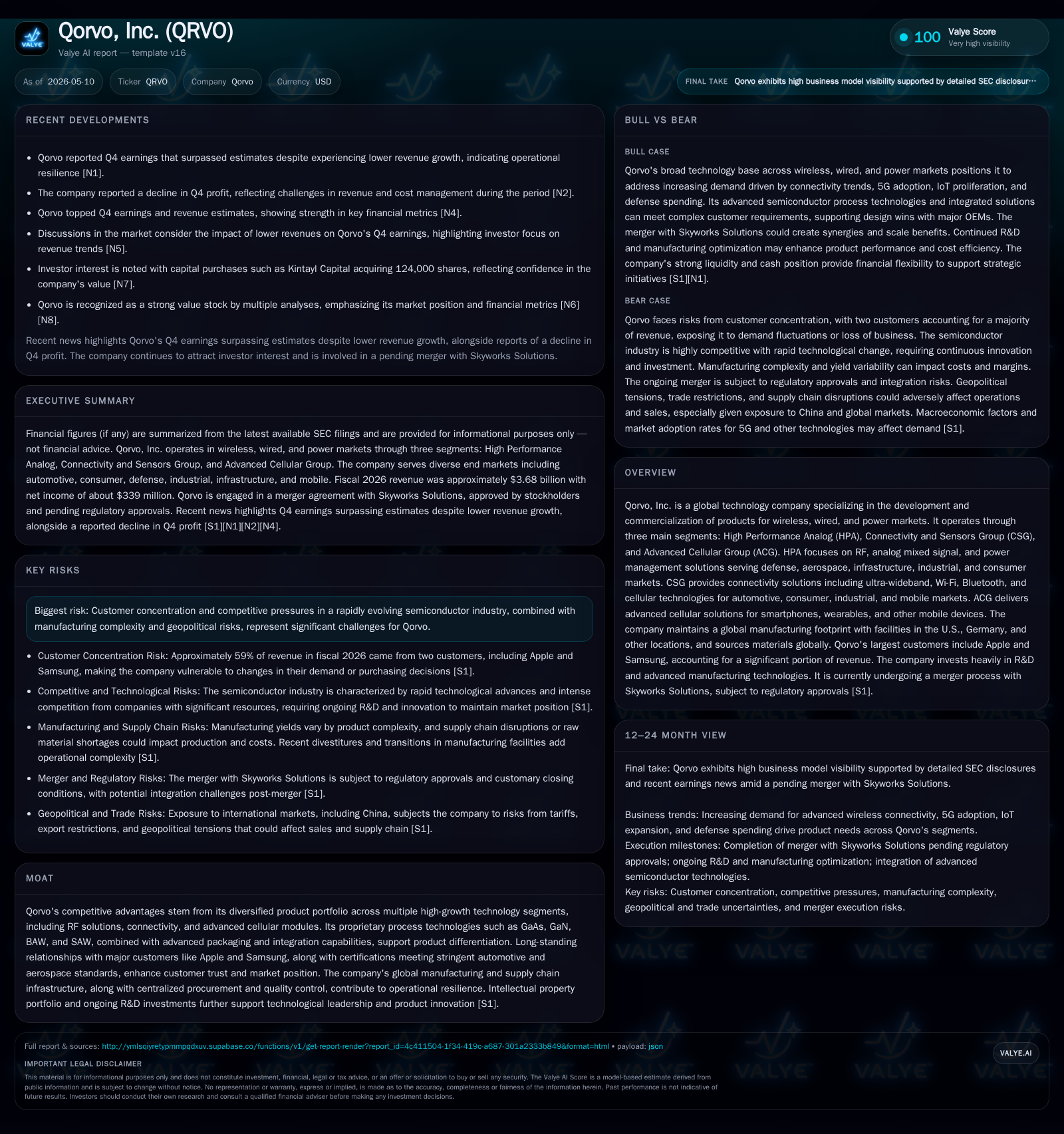
Qorvo reported fourth quarter fiscal 2026 revenue of $3.68 billion and operating income of $411 million, exceeding estimates despite slower top-line growth amid macroeconomic pressures [S2][N3]. The company is progressing toward a transformative merger with Skyworks expected in early 2027, contingent on regulatory approvals, which could expand scale and product breadth [S1][S14]. Its three main segments – High Performance Analog (HPA), Connectivity and Sensors Group (CSG), and Advanced Cellular Group (ACG) – leverage proprietary GaAs, GaN, BAW, and SAW technologies to serve major customers like Apple and Samsung across mobile, automotive, defense, and industrial markets [S1][S16]. Growth drivers include rising demand for wireless connectivity and defense electronics, complemented by ongoing R&D investment in integrated RF solutions. Risks remain around customer concentration, merger execution complexities, supply chain challenges, and geopolitical uncertainties [S7][S24]. Monitoring merger progress, regulatory decisions, and customer demand cycles will be critical near-term milestones.
Quarterly Operational Highlights and Their Implications
In Q4 fiscal 2026 ended March 28, Qorvo generated $3.68 billion in revenue alongside operating income of approximately $411 million and net income near $339 million, surpassing analyst expectations despite modest sequential deceleration in revenue growth [S2][N3][F1]. This resilience reflects the company's diverse product portfolio mitigating weakness in certain segments influenced by seasonality and macroeconomic headwinds impacting consumer device launches [S1][S2]. Management underscored that new product cycles at key smartphone OEM customers helped offset softness in some wireless infrastructure areas. Importantly, earnings outperformance was partly aided by operational efficiency gains even as volume growth remained subdued.
Concurrently, Qorvo advanced its strategic merger agreement with Skyworks Solutions following stockholder approval received in February 2026. Completion hinges on antitrust regulatory approvals — anticipated to clear by early calendar year 2027 — which represents a defining milestone shaping Qorvo’s medium-term trajectory by combining complementary technology portfolios and enhancing scale [S1][S3][S14]. The near-term outlook depends on smooth integration without distracting management focus or disrupting critical design wins.
Business Model Overview: Segment Dynamics and Product Value
Qorvo’s business is structured into three reportable segments that tightly align its RF semiconductor expertise with targeted end markets [S1]:
High Performance Analog (HPA): Focuses on radio frequency (RF), analog mixed signal, and power management semiconductors serving defense/aerospace customers alongside industrial enterprise and consumer markets. This segment benefits from growing demand for radar-enabled systems and electronic warfare as global defense budgets rise.
Connectivity & Sensors Group (CSG): Provides RF front-end solutions supporting ultra-wideband (UWB), Wi-Fi®, Bluetooth® Low Energy (BLE), Thread®, Zigbee®, Matter®, and cellular connectivity tailored for automotive electronics plus broad IoT device ecosystems.
Advanced Cellular Group (ACG): Delivers highly integrated modules incorporating gain blocks, filters (BAW/SAW), envelope trackers, antenna tuners optimized for complex mobile devices such as smartphones and wearables operating across multiple contemporaneous 5G bands.
The company leverages proprietary compound semiconductor technologies including gallium arsenide (GaAs), gallium nitride (GaN), bulk acoustic wave (BAW), surface acoustic wave (SAW), complemented by advanced packaging strategies to differentiate products in performance density and power efficiency [S16]. Underpinning these capabilities is significant R&D investment driving cycles of innovation that enable design wins with entrenched customers such as Apple — which accounts for 50% of sales — distributed mainly through contract manufacturers – as well as Samsung (10%) [S8][S9].
Qorvo follows a hybrid manufacturing model prioritizing in-house fabrication only for its most differentiated elements while outsourcing components to cost-effective partners globally [S12]. Recent divestitures include selling the North Carolina wafer fabrication facility while transferring surface acoustic wave filter production to Texas operations. Assembly facilities in Costa Rica were closed with subsequent reliance on external partners to consolidate capital expenditure obligations and align production footprints closer to regional demand centers.
Competitive Landscape: Positioning Within High-Performance Analog and Connectivity Markets
The semiconductor industry is fiercely competitive characterized by accelerating innovation demands, short product life cycles particularly in mobile sectors, pricing pressures from alternative suppliers plus increasing regulatory scrutiny around global supply chains [S1][S7]. Leading competitors across segments include Analog Devices and MACOM in high-performance analog; Broadcom/Skyworks as major peers in RF front-end modules; alongside emerging players focused on silicon-based alternatives.
Qorvo’s competitive moat stems from a broad IP portfolio covering multiple proprietary semiconductor processes including GaAs/GaN used extensively in high-power amplifiers (HPAs), alongside BAW/SAW filter expertise integral to signal filtering quality critical for complex multi-band cellular architectures [S27]. Long-standing relationships with Tier-1 OEMs like Apple enforce customer lock-in supported by custom design wins requiring significant upfront non-recurring engineering expenditures. Certification compliance — such as AS9100 for aerospace quality standards — expands defensibility in regulated defense platforms where trustworthiness over supply chain continuity is essential.
Furthermore, the firm maintains geographically diversified manufacturing reducing potential single points of failure while retaining trusted source accreditation for U.S. Department of Defense programs. However, inherent risks remain around patent disputes typical within semiconductors given extensive cross-licensing ecosystems plus ongoing challenges from hardware/software integration shifts enabling competitors’ silicon innovations at lower costs or higher integration levels.
Growth Catalysts: Technology Innovation and Market Expansion
Several structural tailwinds support Qorvo’s growth outlook:
Wireless Data Demand: Continued rollout of advanced cellular standards including evolving generations beyond initial 5G releases require more sophisticated front-end components supporting wider frequency ranges with stringent linearity/power requirements.
IoT Connectivity Proliferation: Expanding use cases for UWB enabling secure ranging/location tracking plus standardization efforts around Matter® protocol facilitate broader interoperability especially within smart home automation bolstering CSG revenue potential.
Defense Electronics Upside: Escalating geopolitical tensions globally drive increased procurement of radar systems using phased array technology reliant on GaN power amplifiers present predominantly within HPA segment offerings.
Investment focus intensifies on integration technologies like multi-chip packaging consolidating components to reduce system space/power consumption aiding adoption within compact mobile devices [S16]. Barclays recently upgraded Qorvo citing accelerating design wins tied to next-generation iPhone launches plus broader attach rate improvements attributable partly to upcoming merger scale synergies anticipated post-close enhancing R&D reach further [N6].
Risks and Constraints: Customer Concentration, Integration Challenges, and Geopolitical Exposure
Despite strengths there are material risk vectors warranting active monitoring:
Customer Concentration: Apple alone contributes half the revenue base amplifying exposure should consumer device demand slow or if product design cycles shift away from Qorvo’s technologies without compensating new client gains [S8][S9].
Merger Execution Risk: Integration complexity could divert management attention or disrupt new product introductions. Regulatory delays especially under Hart-Scott-Rodino antitrust provisions could postpone deal completion or impose conditions curbing expected synergies thereby impacting shareholder value [S1][S7][S28].
Supply Chain Complexity: Manufacturing yields vary greatly due to component intricacy affecting margins. Divestiture-related transitions especially moving production between sites pose short-term operational risks plus reliance on specialized third-party suppliers heightens vulnerability to disruptions or cost escalations.
Geopolitical & Regulatory Factors: Export restrictions increasingly constrain access to certain markets/customers affecting sales volumes. Ongoing trade policy shifts particularly involving China impose compliance burdens potentially reducing addressable markets. Tax legislation changes including U.S. minimum book tax regimes may alter effective tax rates materially influencing net profitability levels [S7][S24][S26].
Intellectual Property Litigation: Patent infringement claims could result in costly legal battles while independent technology development by rivals threatens ongoing competitive positions requiring sustained patent filings plus defensive measures preventing unauthorized use of core innovations.
Near-Term Milestones and Monitoring Points
Attention now centers on progress toward merger consummation anticipated early 2027 contingent upon:
- Closure of antitrust investigations under the HSR Act along with required foreign investment regulatory reviews which remain open regulatory risks
- Quarterly revenue booking trends reflecting adoption momentum at key OEM smartphone clients including pipeline updates on upcoming device launches
- Backlog levels signaling customer order visibility especially ahead of seasonal demand shifts
- Supply chain stability markers including wafer yield improvements post-facility transfers
- Management commentary regarding synergy realization benchmarks once merger completes [S3][N2][S14]
These factors cumulatively shape operational continuity assurance alongside prospective combined entity scale advantages poised to reinforce competitive positioning post-integration.
Financial Snapshot: Balance Sheet Strength and Profitability Metrics
Qorvo exhibits a solid financial foundation entering post-merger plans supported by $1.22 billion cash reserves offsetting $1.55 billion total debt resulting in moderate net indebtedness near $330 million [F1]. Operating margin performance exceeding 11% evidences capacity to extract efficiencies across complex manufacturing processes even amid competitive pricing pressures.
This analysis integrates Qorvo’s latest quarterly disclosures anchored by the January 2026 filing along with contextual annual reports framing its strategic transformation through an imminent merger while navigating sector-specific innovation demands and risk landscapes. It reflects a comprehensive assessment aimed at buy-side diligence emphasizing concrete operating realities over generalized narratives.
This document is solely intended for informational purposes providing detailed company analysis without constituting investment advice.
Disclaimer: This is research-only, informational analysis and not investment advice. It may include AI-generated interpretation and general industry context. Always verify important details using primary sources.

Comments