
Investar Holding Corp Strengthens Regional Banking Footprint with WFB Acquisition
The completion of the Wichita Falls Bancshares acquisition in Q1 2026 substantially increased Investar’s assets and branch network, reshaping its regional banking presence.
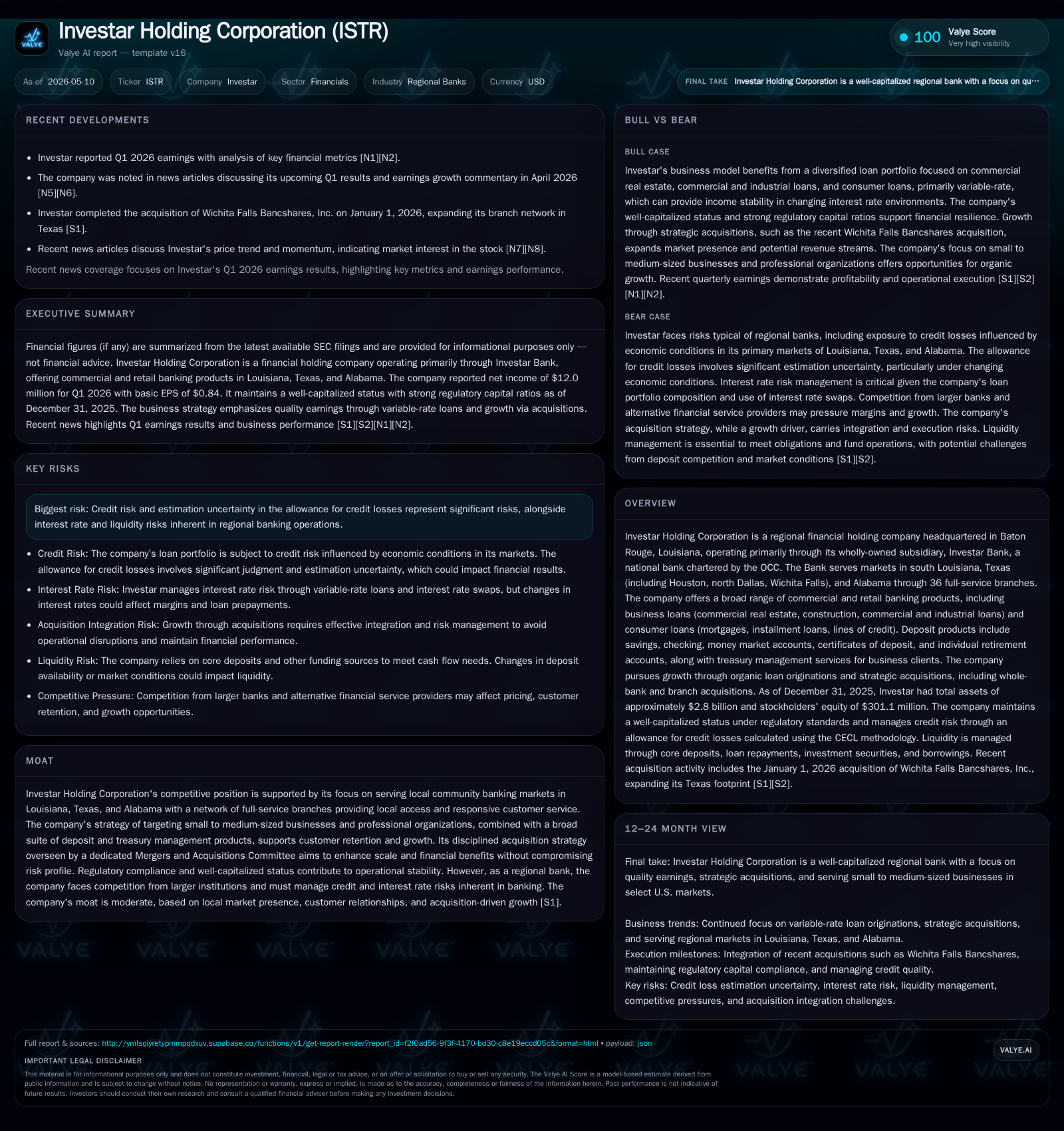
Investar Holding Corporation completed its acquisition of Wichita Falls Bancshares (WFB) on January 1, 2026, adding $1.15 billion in assets, nearly $950 million in loans, and over $1 billion in deposits, expanding its footprint notably in Texas. The integration of WFB remains a key operational focus as the company absorbs the acquired branches and loan portfolio without standalone financial disclosures. Investar’s business model centers on community banking with a diversified mix of commercial real estate, construction loans, and consumer products supported by personalized service across Louisiana, Texas, and Alabama. Growth is fueled by disciplined acquisitions and organic loan origination within stable deposit bases, while risks include credit quality volatility amidst integration and sensitivity to interest rate fluctuations. The holding company enters this phase with robust capital ratios and liquidity buffers that support ongoing expansion and regulatory compliance.
Q1 2026 Operational Update: WFB Acquisition Integration
Investar Holding Corporation's latest quarterly report (10-Q as of May 8, 2026) marks a significant operational inflection driven by its January 1 acquisition of Wichita Falls Bancshares (WFB), headquartered in Wichita Falls, Texas [S2]. The transaction consideration totaled approximately $112.9 million paid through a combination of $7.2 million cash and nearly four million shares of common stock issued to WFB shareholders.
This acquisition extended Investar's physical footprint by adding six full-service branches in the Texas market areas surrounding Wichita Falls. Importantly, this added scale came with an infusion of substantial balance sheet growth: $1.15 billion in total assets were acquired including $950.2 million in net loans alongside $1.02 billion in deposits.
Due to ongoing consolidation efforts aimed at streamlining operations during the first quarter of 2026 post-close integration activities, Investar deemed it impracticable to separately disclose standalone revenues or net income for legacy WFB operations or provide pro forma financial metrics associated with the deal [S2]. Thus, the initial impact on consolidated earnings reflects a combined entity without explicit segment-level breakdowns for this newly acquired portfolio.
Business Model and Product Offering Overview
Investar Holding is a regional financial services organization headquartered in Baton Rouge, Louisiana. Its primary banking operations are conducted through Investar Bank, N.A., a national bank chartered by the OCC [S1]. Serving communities throughout south Louisiana, Texas (Houston, north Dallas area including Wichita Falls), and Alabama via 36 full-service branches, the bank targets a community-oriented clientele centered on individuals, professional groups, and small to mid-sized businesses.
The product suite centers on diversified commercial loans including commercial real estate (CRE), construction financing, commercial & industrial (C&I) lending alongside consumer-focused products such as residential mortgages, installment loans, lines of credit for consumers. Deposit offerings encompass checking/savings accounts—including noninterest-bearing deposits—money market accounts, certificates of deposit (CDs), IRAs plus specialized treasury management services catering to business clients' operational cash flow needs [S1]. This mix fosters a resilient recurrent revenue base driven by interest income on loans coupled with fee-based income streams.
Crucially for competitive positioning within community banking markets, localized branch access supports personalized client relationships and responsive service delivery while treasury offerings build sticky relationships with small business customers who require sophisticated cash management solutions.
Competitive Landscape and Regional Banking Dynamics
Investar operates in a competitive regional banking environment marked by overlaps between larger national banks' scale advantages and smaller local banks' personalized service appeal. In markets such as Louisiana, Texas’s key urban clusters plus Alabama footholds where Investar plants branches, competition ranges from large-cap institutions with extensive digital platforms to boutique regional players focused on community banking nuances.
Investar leverages its entrenched local presence—as evidenced by its branch network—and nimble underwriting expertise geared towards both commercial establishments and individual borrowers [S1]. Regulatory compliance rigor combined with solid capitalization establishes operational stability amid sector volatility and elevates trust among stakeholders.
However, as a regional player investing heavily into new markets via acquisitions like WFB’s addition to its Texas footprint, Investar faces pressures integrating scale without diluting credit standards or customer experience. The challenge remains balancing growth ambitions against incumbents’ defenses and shifting macroeconomic variables impacting lending demand [S1].
Growth Initiatives Fuelling Expanding Loan Originations and Deposits
Growth at Investar is propelled by two distinct yet connected vectors: organic underwriting volume increases complemented by strategic M&A activity governed by a dedicated Mergers & Acquisitions Committee. The sizeable WFB transaction exemplifies this approach—adding over $950 million in loans while expanding deposit base meaningfully.
Within organic channels, Investar focuses on high-quality loan originations spanning CRE projects with predictable collateral values; construction loans linked to local development; alongside C&I lending to established businesses requiring revolving credit facilities or term debt lines [S1][S2]. Simultaneously fostering existing customer relationships drives retention of core deposits critical for funding asset growth while pricing disciplines aim to grow low-cost noninterest-bearing accounts despite recent declines caused by rising market rates [S5].
The company's loan loss allowance methodology—anchored by the CECL accounting standard—enables dynamic provisioning reflective of historical experience tempered by current economic outlooks; maintaining reserve adequacy even amid portfolio expansion reduces downside surprises [S1].
Risks and Challenges in Credit Quality, Interest Rate Sensitivity, and Regulatory Compliance
Notwithstanding growth opportunities, regional banking inherently carries concentrated credit risk proximate to geographic footprints—Investar is no exception given operating presence tightly clustered across three states [S1]. Estimation uncertainty related to allowances for credit losses remains material given economic cyclicality altering borrower repayment capacity unpredictably especially post-acquisition when portfolio heterogeneity rises [S1][S2].
Interest rate movements significantly influence net interest margin profiles; rising rates may improve loan yields but simultaneously elevate deposit cost structures needed to retain customers or attract funds reducing spread compression potential [S1][S5]. Investar’s usage of interest rate swaps hedges some exposures though derivative notional balance declined slightly from year-end reflecting tactical ALM adjustments [S2].
Regulatory expectations requiring well-capitalized status demand ongoing capital planning discipline particularly as asset balances swell post-WFB acquisition [S1][F1]. In addition technological transformation introduces heightened cybersecurity risks plus compliance cost increments challenging resilience [S1]. Maintaining balance between aggressive growth execution versus prudent risk controls will be pivotal.
Forward-looking Milestones and Indicators to Monitor
Key near-term milestones hinge around successful integration of WFB franchise: including consolidation timelines for six new branches under common systems; harmonizing underwriting standards; stabilizing credit quality metrics including watchlists/nurturing nonperforming loan flows under tighter scrutiny [S2][N1][N2].
Monitoring deposit base composition shifts—specifically share dynamics between noninterest-bearing versus higher-cost instruments will offer insights into funding cost trajectories amid evolving rate landscapes. Renewed issuance or pipeline visibility regarding future M&A activities provides clues on strategic appetite.
Credit metrics such as net charge-offs ratio trends near-term combined with allowance coverage analyses offer early warnings about asset deterioration risks heightened during portfolio amalgamation phases [S2]. Capital adequacy ratios tracking regulatory benchmarks quarterly remain core readouts for sustaining growth capacity without triggering corrective measures.
Financial Position and Capital Adequacy Snapshot
Investar enters post-acquisition phase with solid capital buffers supporting regulatory well-capitalized designations. As of December 31, 2025—the latest available snapshot prior to official inclusion of WFB balances—the Company reported Tier 1 leverage capital ratio exceeding 10%, Tier 1 common equity to risk-weighted assets above 11%, cumulatively indicating robust capitalization consonant with OCC standards [S1][F1].
Liquidity anchors include substantial core deposits augmented by sizable investment securities portfolios classified chiefly as available-for-sale providing accessible buffers against unexpected withdrawals or funding needs [S5]. Cash plus equivalents approximated healthy levels despite debt usage limited to $9.8 million total borrowings indicating restrained leverage relative to asset size supporting prudent financial flexibility [F1].[S2]
Absent indications from current disclosures are immediate refinancing concerns or covenant pressures underscoring ongoing capacity for balanced expansion aligned with regulatory oversight.
Disclaimer: This analysis is based solely on currently available SEC filings and verified news reports as referenced. No forward-looking statements herein constitute investment advice or recommendations. Readers should conduct further independent due diligence before forming conclusions regarding Investar Holding Corporation or its securities.
Disclaimer: This is research-only, informational analysis and not investment advice. It may include AI-generated interpretation and general industry context. Always verify important details using primary sources.

Comments