
Blackstone Real Estate Income Trust Shows Resilience with Strategic Debt Portfolio Management
Q1 updates reveal nuanced interest rate exposure and continued capital raising supports BREIT's income trust strategy.
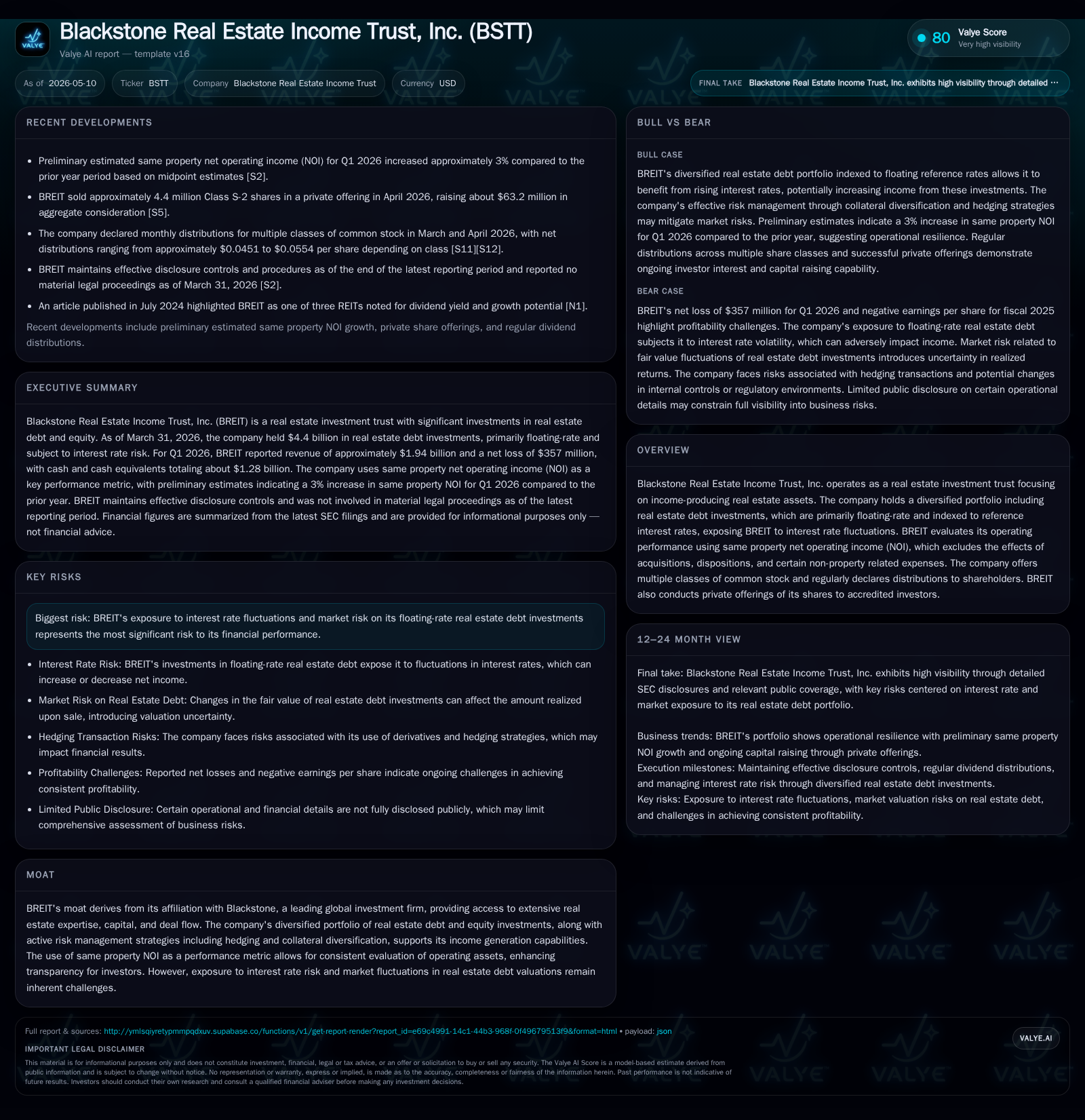
In Q1 2026, Blackstone Real Estate Income Trust (BREIT) held $4.4 billion in floating-rate real estate debt, with sensitivity analysis suggesting a 25 basis point rate decrease would reduce quarterly income by approximately $2.2 million. The company disclosed a 3% year-over-year increase in same property net operating income (NOI), highlighting operational stability. Continuing its private share offerings to accredited investors, BREIT raised over $32 million in May 2026 alone, reinforcing its capital formation approach. While the Blackstone affiliation offers unique competitive advantages in expertise and deal flow, BREIT remains exposed to interest rate volatility and fair value fluctuations on its real estate debt portfolio.
Q1 Operating Update: Real Estate Debt Portfolio and Interest Rate Impact
As of March 31, 2026, Blackstone Real Estate Income Trust held $4.4 billion in investments classified as real estate debt—down modestly from $4.8 billion reported at the end of 2025 [S2]. These holdings primarily consist of floating-rate instruments tied to Reference Rates typical for commercial real estate lending markets. The company explicitly quantifies sensitivity: a hypothetical decline of 25 basis points in these reference rates would reduce quarterly income from these investments by roughly $2.2 million [S2]. This exposure underpins the importance of rate fluctuations on BREIT’s net income.
Despite this vulnerability, preliminary estimates announced in April indicate a roughly 3% year-over-year increase in same property net operating income (NOI) for Q1 [S5][S7]. This metric excludes acquisition and disposition effects and reflects performance stability at core properties. Such NOI growth provides a buffer against fluctuating yields on variable-rate financial assets.
BREIT manages market risk on its debt portfolio through diversification across collateral types and credit ratings [S2][S29]. Although fair values can move materially, the broad backing by various asset types aims to mitigate concentration risk inherent to single segments.
Business Model Overview: Income Trust Structure and Investment Strategy
Operating as a non-traded real estate investment trust (REIT), BREIT generates income principally through cash yields on its diversified equity and real estate debt portfolios [S1]. The company issues multiple classes of common stock—distinguished by attributes such as servicing fees—that it offers primarily via continuous private placements targeted at accredited investors [S3][S8].
Share pricing is based on net asset value (NAV), with upfront commissions shared among broker-dealers providing distribution incentives during offerings [S3][S24]. This structure facilitates ongoing capital raises essential for asset acquisition and portfolio rebalancing without relying on public market liquidity.
Active hedging strategies involving derivatives are employed but carry inherent risks as outlined extensively [S1][S29]. The combination of floating-rate exposure and derivative use reflects a tactical approach to balancing yield capture with interest rate risk management.
Competitive Position: Blackstone Affiliation and Industry Dynamics
BREIT’s connection to Blackstone distinguishes it amid non-traded REITs by granting access to an extensive global real estate network and deep analytical expertise [S1][F1]. This relationship allows for superior deal flow sourcing and sophisticated asset selection strategies compared with standalone peers.
These factors reinforce BREIT’s ability to maintain steady income streams even as public REITs face volatility tied to equity market swings.
Growth Drivers: Demand from Accredited Investors and Asset Diversification
Recent unregistered sales documents show that on May 1, 2026, BREIT raised approximately $32.6 million through sales of Class S-2 shares as part of its continuous offering program [S3][S24]. Historical data reveal monthly equity raise pacing well into tens of millions each month since early 2026 [S8][S26][S27], demonstrating sustained investor demand.
Coupled with organic growth evidenced by same property NOI increases (+3% YoY) [S5], this fundraising supports further acquisitions and portfolio enhancements. Broker-dealer commissions tied to these offerings incentivize distribution channel engagement [S3], fueling incremental investor inflows.
The NAV-based share structure facilitates reinvestment programs aligning investor interests with asset growth while maintaining stable distribution capabilities.
Risks and Constraints: Interest Rate Exposure and Market Valuation Fluctuations
The primary operational constraint remains BREIT's sensitivity to floating-rate reference indices governing much of its real estate debt investment income [S1][S2]. Unlike fixed-rate instruments that provide more predictable returns, falling rates directly depress revenue streams; conversely, rising rates can improve yields but may pressure underlying asset valuations.
Fair value accounting introduces earnings volatility unrelated directly to cash flows; the difficulty lies in forecasting realizable values upon potential sales due to market price fluctuations [S1][S29]. While collateral diversification reduces risk concentration, it does not eliminate systemic vulnerabilities tied to broader economic shifts.
Derivative hedging activities designed to mitigate interest risk present additional complexity and residual risk exposure requiring vigilant management oversight [S1][S29].
Key Upcoming Milestones and Market Signals to Monitor
Investors should watch subsequent quarterly reports for confirmation that same property NOI growth trends continue as a reliable operational indicator distinct from valuation noise [S5][S6].
Further disclosures regarding the pace and size of private placement share issuances will serve as barometers for investor appetite within the accredited segment [S3][S24].
Upcoming events could also include pipeline announcements concerning new acquisitions or dispositions affecting portfolio composition. Adjustments or elaborations on BREIT’s derivative hedging strategies amid evolving interest rate environments will be informative regarding risk posture adjustments [S2][S6].
Debt refinancing or repricing moves outlined in future filings will additionally shed light on leverage management dynamics critical given the substantial roughly $54.8 billion outstanding total debt obligation recorded end-Q1 alongside about $1.28 billion cash reserves [F1].
Latest Financial Snapshot
Latest financial snapshot
| Metric | Value | Period |
|---|---|---|
| Cash & equivalents | $1276mm | |
| 2026-03-31 | ||
| Total debt | $54.8bn | |
| 2026-03-31 | ||
| Net debt | $53.5bn | |
| 2026-03-31 |
Source: SEC companyfacts cache [F1].
| Metric | Value (USD Billions) | Period Ending |
|---|---|---|
| Cash & Equivalents | 1.28 | Mar 31, 2026 |
| Total Debt | 54.77 | Mar 31, 2026 |
| Net Debt Approx. | 53.49 | Mar 31, 2026 |
This leverage profile highlights significant reliance on external financing typical for large-scale real estate investment trusts focused on income generation through asset yield capture rather than capital preservation alone [F1].
This analysis synthesizes publicly filed SEC disclosures as of May 10, 2026. It is intended exclusively for informational purposes without providing investment advice or recommendations.
Disclaimer: This is research-only, informational analysis and not investment advice. It may include AI-generated interpretation and general industry context. Always verify important details using primary sources.

Comments