
Katapult Holdings Advances Lease-to-Own Model While Facing Debt and Merger Execution Risks
Katapult reported 1Q26 operational progress anchored by growing gross originations but continues to face significant debt covenant challenges and merger uncertainties.
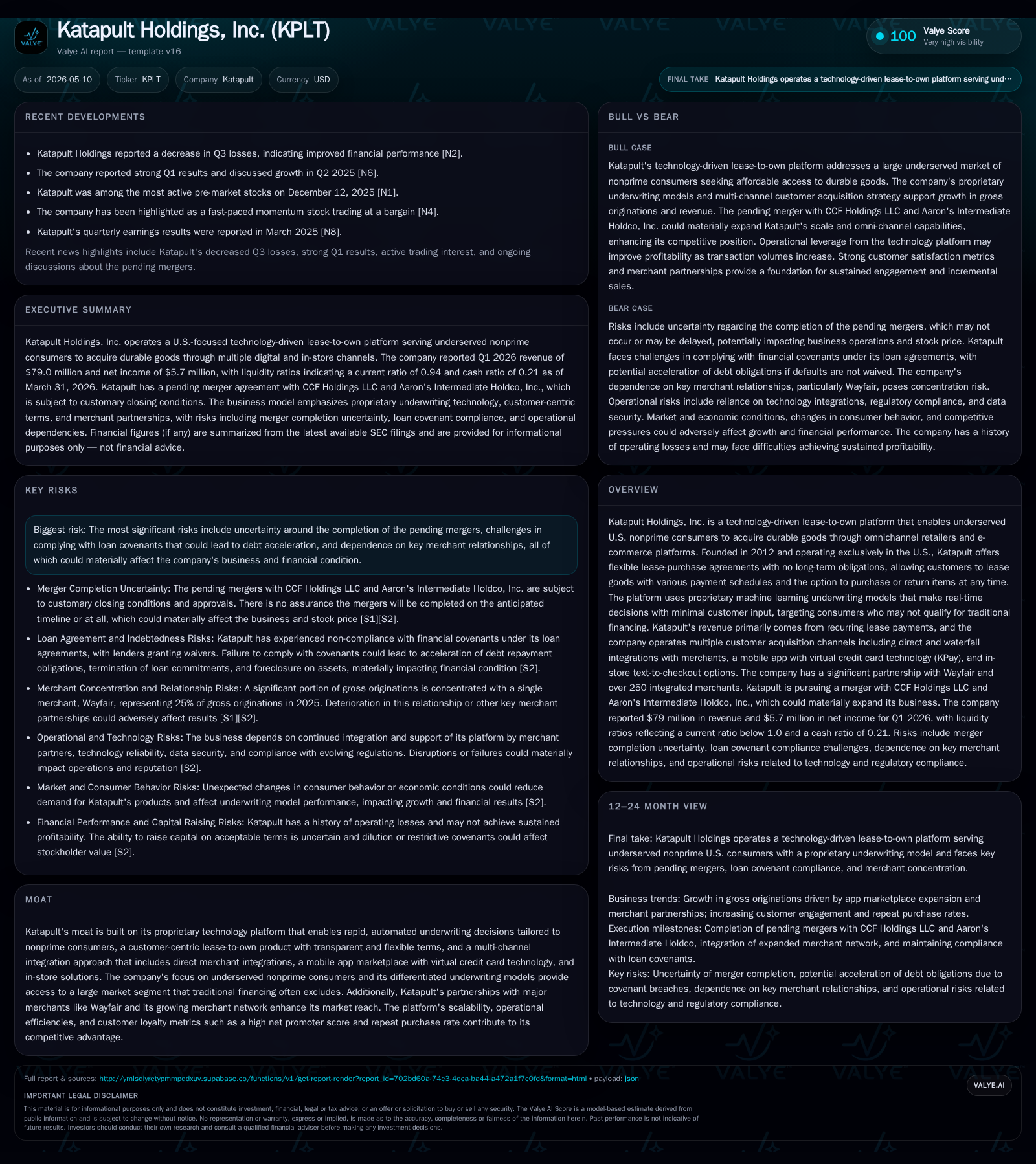
Katapult Holdings, Inc. operates a technology-driven lease-to-own platform targeting underserved nonprime U.S. consumers through omnichannel retail partnerships and proprietary underwriting technology. In its latest quarterly filing for Q1 2026, Katapult highlighted continued growth in gross originations enabled by expanding merchant integrations and its KPay platform, while simultaneously navigating substantial indebtedness with ongoing waivers of financial covenants as it prepares for a pending transformational merger with CCFI and Aaron's. The company’s model leverages flexible lease-purchase agreements with no long-term obligation, uniquely serving a large nonprime population underserved by traditional credit. Risks include execution uncertainty around the proposed mergers, dependence on key merchant relationships, substantial debt and covenant compliance pressures, and regulatory complexities inherent in its highly regulated industry segment.
Recent Operating Update
Katapult Holdings reported its latest quarterly results in the 10-Q filed May 8, 2026 [S2], underscoring steady progression in key operational metrics despite ongoing financial headwinds. The period ending March 31, 2026 coincides with a reflective phase as Katapult’s business contends concurrently with transformative merger activities involving CCFI and Aaron’s (expected Q2 2026 close).
The company continues to grow its lease portfolio through increased gross originations driven by both direct merchant integrations and the expansion of its proprietary mobile app payments system (KPay), which now contributes a significant portion of transaction volume. However, the firm remains cautious due to repeated waivers needed from lenders concerning loan covenants tied to minimum trailing three-month net originations thresholds — reflecting liquidity constraints despite $22.3 million cash on hand as of March-end [F1].
Management highlights the strategic intent behind the mergers is to construct an omni-channel platform dominating the nonprime consumer durable goods segment by leveraging complementary assets across Katapult, CCFI, and Aaron’s, creating scale advantages while enhancing product offerings. Still, execution risks abound given stringent regulatory landscapes and pending approvals [S1][S2][S3].
Business Model
Katapult operates as a technology-driven lease-to-own (LTO) platform focusing exclusively on U.S. nonprime consumers who often lack access to traditional financing avenues due to credit constraints [S1]. Its model revolves around providing flexible lease-purchase agreements that allow customers immediate possession of durable goods (home furnishings, appliances, electronics) upon transaction completion without long-term commitment or penalty if returned early.
Revenue generation primarily stems from recurring rental payments over the life of leases—typically around eight months—with recognition aligned under ASC 842 lease accounting standards [S1]. The company supplements rental revenue with ancillary streams including sales of leased assets to third parties.
A pivotal competitive asset is Katapult's proprietary machine learning underwriting engine embedded within both direct merchant POS platforms and its KPay virtual credit card marketplace. This enables real-time credit decisioning within seconds from minimal inputs tailored for underserved customers, vastly reducing friction compared to traditional installment or BNPL financing programs. Importantly, Katapult emphasizes transparent pricing structures without late fees, an uncommon feature aligned with their mission-driven ethos centered on fairness and dignity toward nonprime users [S1].
Merchant partnerships operate via multiple integration points: direct API connections enabling seamless checkout financing; waterfall arrangements where Katapult competes alongside other payment options; consumer-facing app-driven commerce through KPay; and in-store solutions designed for physical retail environments [S1]. This diversified approach broadens addressable market reach while mitigating single-channel dependency.
Industry Structure & Competitive Position
The LTO space targeting nonprime U.S. consumers comprises a fragmented set of players including specialized rent-to-own retailers (e.g., Aaron’s), digital-first fintech alternative lenders (Katapult itself), and broader BNPL providers adapting offerings for higher-risk segments. Katapult uniquely combines technology-enabled automated underwriting tailored for the subprime sector with multi-channel distribution capabilities.
Its moat resides chiefly in three pillars: advanced proprietary technology allowing swift predictive leasing decisions; customer-aligned product flexibility lowering churn risk; and strong merchant ecosystems providing acquisition scale. Notably, partnerships with major e-commerce merchants like Wayfair have historically driven large portions of gross originations (about 25% excluding KPay transactions) while KPay further diversifies access channels [S1][S19].
The company's steady increase in gross originations (up 17% YoY for full year 2025) illustrates growing traction amid rising acceptance among merchants and consumers alike [S1]. Operational efficiencies derived from cloud-based infrastructure investing in data analytics underpin cost control despite heightened servicing needs inherent to higher-risk customer bases.
Nonetheless, competitive threats loom from incumbent rent-to-own retailers with entrenched physical presences that benefit from brand familiarity among certain demographics alongside emerging fintech disruptors enhancing credit assessment algorithms or offering simpler BNPL alternatives without durability-focused merchandise consideration.
Growth Drivers
- Expanding Merchant Integrations: Broadening direct API partnerships enhances customer conversion efficiency by integrating lease offers seamlessly at checkout.
- KPay Platform Adoption: Mobile app featuring virtual credit cards enables customers access to leasing even where merchants lack direct integration; this channel’s contribution rose markedly (32% of gross originations in prior years up to 42%) showcasing scalability [S19].
- Nonprime Market Demand: A structurally large underserved nonprime consumer base (~$50-$60 billion TAM) drives sustained demand beyond cyclical variations.
- Flexible Product Features: No long-term obligation leases combined with transparent terms appeal strongly amid economic uncertainty increasing preference for lower commitment purchasing methods.
- Pending Mergers: Strategic consolidation via CCFI/Aaron's acquisitions promises cross-selling opportunities, cost synergies, wider footprint especially in brick-and-mortar segments complementing Katapult’s digital strength.
- Technology Enhancements: Continued investment in machine learning models improves loss mitigation capabilities supporting volume growth without degrading portfolio quality.
Risks & Watchpoints
- Merger Completion Uncertainty: Despite agreements signed late last year aiming for Q2 closing, regulatory approvals are not assured; delays or failure could stall strategic momentum [S1][S2].
- Debt Covenant Pressure: Significant indebtedness (~$71.6 million principal outstanding) carries restrictive covenants keyed to trailing three-month net originations and liquidity minimums; past quarters required lender waivers pointing to fragile compliance status risking acceleration or refinancing difficulties [S8].
- Merchant Concentration: Heavy reliance on key partners like Wayfair exposes Katapult to revenue volatility if these relationships weaken or competitor alternatives displace Katapult offerings [S1].
- Regulatory Complexity: Operating under diverse state-level lease-purchase statutes introduces ongoing compliance costs plus potential litigation exposures; evolving regulations may impose new constraints altering current business practices adversely [S21][S7].
- Consumer Behavior Shifts: Alterations in repayment behavior or creditworthiness among nonprime segments may reduce model effectiveness necessitating recalibration of underwriting criteria [S1].
- Operating Losses & Cash Flow Constraints: Despite top-line growth (+18% revenue YoY for FY25), operations remain unprofitable with operating loss (-$0.5M FY25); high interest expense limits free cash flow abilities affecting reinvestment capacity [F1][S16].
What To Watch Next
- Progress on merger closing process including receipt of shareholder votes and regulatory green lights expected mid-2026.
- Monitoring subsequent earnings releases for revenue growth sustainment post-merger announcements alongside margin trend changes amid integration costs.
- Trailing three-month net originations trends impacting covenant compliance status; closely tracking if further waivers occur or if more permanent resolution is reached.
- Expansion velocity of direct merchant integrations plus resulting share gain within large e-commerce ecosystems beyond Wayfair.
- Customer retention metrics such as net promoter scores and repeat purchase rates as indicators of product-market fit durability.
- Legal or regulatory developments introducing new restrictions within core states impacting marketing or collections operations.
Financial Profile Snapshot (As of Quarter Ended March 31, 2026)
Latest financial snapshot
FY ended 2025 |
Katapult continues grappling with moderate liquidity tightness reflected by a current ratio of 0.94 alongside elevated liabilities relative to current assets which underscores financial fragility exacerbated by high leverage levels totaling nearly $72 million principal under loan agreements subject to restrictive covenants demanding consistent origination volumes [F1][S13]. Despite this backdrop, modest positive net income reported for fiscal year-ending Dec 2025 slightly contrasts prior loss trends albeit powered largely by non-cash items including derivative revaluations rather than core earnings adequacy [S16]. Interest burdens remain material limiting near-term profitability improvements absent deleveraging or refinancing success.
This analysis draws exclusively upon publicly filed SEC documents contemporaneous as of May 8, 2026 ([S1]-[S21]), supplemented by company facts data extracted via standard XBRL tags ([F1]). It does not constitute investment advice but aims to provide a detailed operational overview structured through an industry-informed lens emphasizing fundamental drivers versus mere financial statement recitals. Readers should consider forward-looking risks inherent especially relating to corporate transactions underway and capital structure complexity inherent in digital nonprime finance sectors.
Disclaimer: This is research-only, informational analysis and not investment advice. It may include AI-generated interpretation and general industry context. Always verify important details using primary sources.

Comments