
Radian Group Broadens Risk Profile Through Inigo Acquisition with Promising Q1 Results
Radian’s integration of Inigo expands its market risk landscape while early Q1 results confirm resilient premium growth and operational stability.
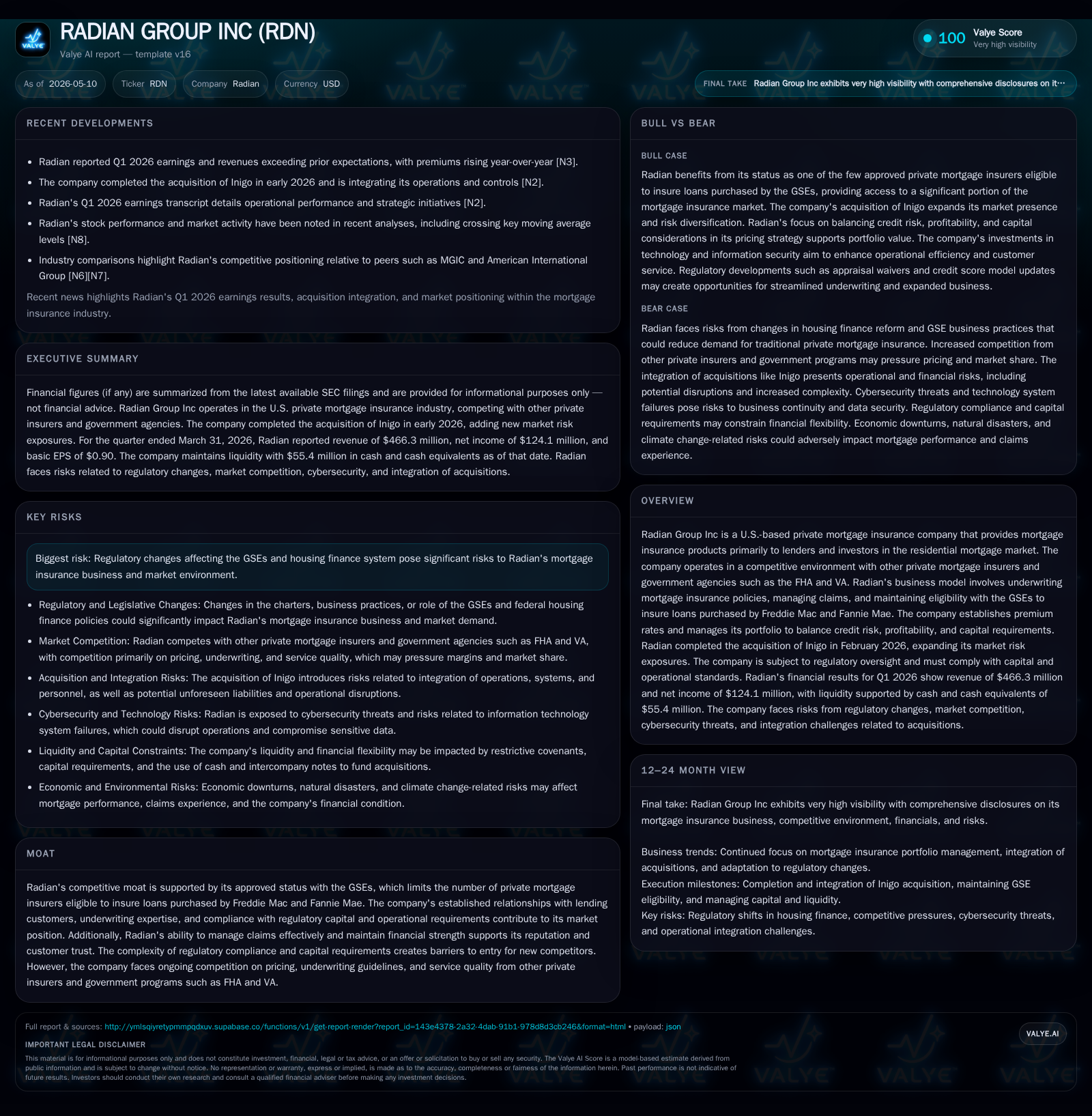
Radian Group’s 2026 Q1 filings reveal that the recent acquisition of Inigo introduced new foreign currency and reinsurer credit risks, although these are currently immaterial to the company’s overall risk profile. The acquisition enhances Radian’s geographic and product diversification within mortgage insurance and specialty insurance markets. Radian maintains a competitive edge through its approval status with the GSEs, underwriting rigor, and operational controls, despite ongoing regulatory uncertainties. Robust premium growth in Q1 alongside solid integration progress positions Radian for measured expansion while cautious monitoring of capital adequacy and regulatory developments is warranted.
Latest Quarterly Insights and Inigo Acquisition Impact
Radian Group Inc's latest quarterly report filed May 8, 2026, highlights the completion of its acquisition of Inigo Limited on February 2, 2026 [S2][S3]. This strategic move extends Radian’s footprint beyond the U.S. mortgage insurance market into international specialty insurance sectors, introducing new foreign currency exchange rate risk and reinsurer credit risk exposures. Management has assessed these additional risks as not material to the overall company risk profile as of March 31, 2026 [S2][S18]. The acquisition also increased existing interest rate and credit spread risk exposures inherent in Radian’s portfolio.
Operational integration is underway with management incorporating Inigo’s processes, systems, and controls into Radian’s internal control framework. While Inigo’s internal control over financial reporting will be excluded from the consolidated annual assessment for 2026 due to ongoing integration activities, no material adverse changes in internal controls were reported during Q1 [S2][S7]. This indicates stable governance during the transition period.
Financially, Radian experienced year-over-year premium growth in Q1 2026 consistent with continued demand for private mortgage insurance products amid stable housing market conditions [N1][N2][N3].
Business Model and Mortgage Insurance Operations
Radian primarily operates as a private mortgage insurer offering credit enhancement to lenders against borrower default on residential mortgages secured by real estate collateral. Its core revenue derives from mortgage insurance premiums paid by lenders whose loans are typically purchased or securitized by government-sponsored enterprises (GSEs) such as Freddie Mac and Fannie Mae [S1]. Premium volumes correlate closely with insured loan balances tied to home purchase activity exceeding minimum down payment thresholds.
The company emphasizes disciplined underwriting standards to mitigate credit risk within its portfolio. Claims management involves rigorous claim perfection protocols requiring comprehensive documentation before indemnity payments are made. Loss mitigation efforts include collaboration with servicers to reduce losses on delinquent loans. Radian holds contractual rights under its Master Policies to deny claims when servicers fail to timely provide necessary documentation, reinforcing strict coverage enforcement [S1].
Capital adequacy requirements are governed by the Private Mortgage Insurer Eligibility Requirements (PMIERs), which mandate minimum capital levels relative to unpaid principal balances of insured loans. Maintaining compliance is essential for continued GSE eligibility—a critical competitive advantage—and influences liquidity through restrictions on dividends and capital distributions [S1][S4][S5].
Competitive Landscape and Regulatory Environment
Radian competes in a concentrated private mortgage insurance industry where GSE approval serves as a high barrier to entry. Competitors include Arch Capital Group Ltd., Genworth Financial, Essent Group Ltd., MGIC Investment Corp., and National Mortgage Insurance Corporation among others [S1]. Competition centers on pricing discipline, underwriting standards, policy servicing quality, customer relationships, perceived financial strength including credit ratings, and reputation.
Government-backed programs like FHA and VA provide alternative credit enhancements primarily serving borrowers outside PMI eligibility criteria [S1][S24]. The regulatory environment remains fluid; legislative proposals for housing finance reform could redefine GSE roles impacting PMI business models. Administrative changes at agencies such as FHFA add further uncertainty regarding future policy directions [S1].
These factors necessitate vigilant capital planning since any modifications to PMIERs or GSE eligibility criteria could constrain underwriting capacity or alter financial flexibility [S24][S26]. Pricing competition continues within regulatory constraints.
Growth Drivers Supporting Expansion
Key growth catalysts include sustained housing demand supporting steady loan originations above PMI thresholds fueling premium inflows [N2][N3]. The acquisition of Inigo diversifies revenue streams internationally into specialty insurance markets broadening earnings sources beyond traditional mortgage insurance risks [S2].
Strong relationships with GSEs ensure access to eligible loan flow while consistent underwriting preserves portfolio quality [S1]. Enhanced claims management capabilities contribute to efficient loss mitigation maintaining favorable loss ratios.
Operational efficiencies stemming from technology platform harmonization post-Inigo integration will enable broader product offerings with controlled underwriting across jurisdictions [S2][S3]. These factors collectively underpin measured market share gains within regulated frameworks.
Risks and Watchpoints
Regulatory reform poses notable risks especially around potential changes to GSE charters or heightened capital requirements that could reduce insurable mortgage volumes or profitability [S24][S26]. Dependency on third-party servicers introduces operational risks affecting claim perfection timing which impacts loss recovery effectiveness [S1].
Integration challenges include potential IT system incompatibilities, navigating international regulatory regimes—especially Lloyd’s Funds at Lloyd’s (FAL) requirements applicable to Inigo—and managing cybersecurity/data privacy risks associated with geographic expansion. Employee retention amid organizational change remains an area of focus given recent acquisitions and divestitures [S2][S17][S24].
Capital adequacy pressures arise from funding part of the Inigo acquisition via an intercompany note that reduced liquidity buffers and imposed dividend restrictions on subsidiaries possibly limiting cash flow flexibility upstream [S17]. Adverse economic or investment performance could necessitate additional capital raises potentially dilutive or costly.
Near-Term Catalysts and Monitoring Points
Upcoming milestones include progressing full integration of Inigo's systems into Radian's control framework with clearer visibility expected after year-end assessments given current SEC guidance excluding these controls from consolidated annual evaluations until then [S7]. Monitoring quarterly claim trends post-acquisition will be key for assessing portfolio performance.
Regulatory developments from FHFA or federal authorities on housing finance reform remain pivotal external events capable of materially affecting business operations. Changes in PMIERs or GSE eligibility rules would directly impact underwriting capacity and capital allocation strategies. Financing activities could signal adjustments in liquidity management related to acquisition indebtedness or growth plans.
Latest Financial Snapshot (March 31, 2026)
Latest financial snapshot
| Metric | Value | Period |
|---|---|---|
| Cash & equivalents | $55mm | |
| 2026-03-31 | ||
| Total debt | $774mm | |
| 2026-03-31 | ||
| Net debt | $719mm | |
| 2026-03-31 |
Source: SEC companyfacts cache [F1].
| Metric | Value (USD millions) |
|---|---|
| Cash & Equivalents | 55.4 |
| Total Debt | 774.0 |
| Net Debt | ~719.0 |
As of March 31, 2026, Radian held approximately $55 million in cash against total debt near $774 million resulting in net debt around $719 million per SEC companyfacts data [F1].
Revenue exceeded expectations in Q1 evidencing robust demand continuity. Management affirms effective disclosure controls ensuring reliable information flow during transitional phases [S2][S18]. Overall financial positioning balances scale benefits post-acquisition against evolving risk exposures inherent in expanded operations.
This analysis is based exclusively on public SEC filings through May 8–9, 2026 combined with contemporaneous market commentary from reputable sources. Forward-looking statements contained within cited materials are presented cautiously without speculation. This report provides an operational overview rather than investment advice.
Disclaimer: This is research-only, informational analysis and not investment advice. It may include AI-generated interpretation and general industry context. Always verify important details using primary sources.

Comments