
Kirby Corp Expands Fleet Amid Jones Act Waiver Risks and Sector Demand Dynamics
Q1 2026 results show revenue growth and fleet investments under regulatory uncertainty driven by Jones Act waivers.
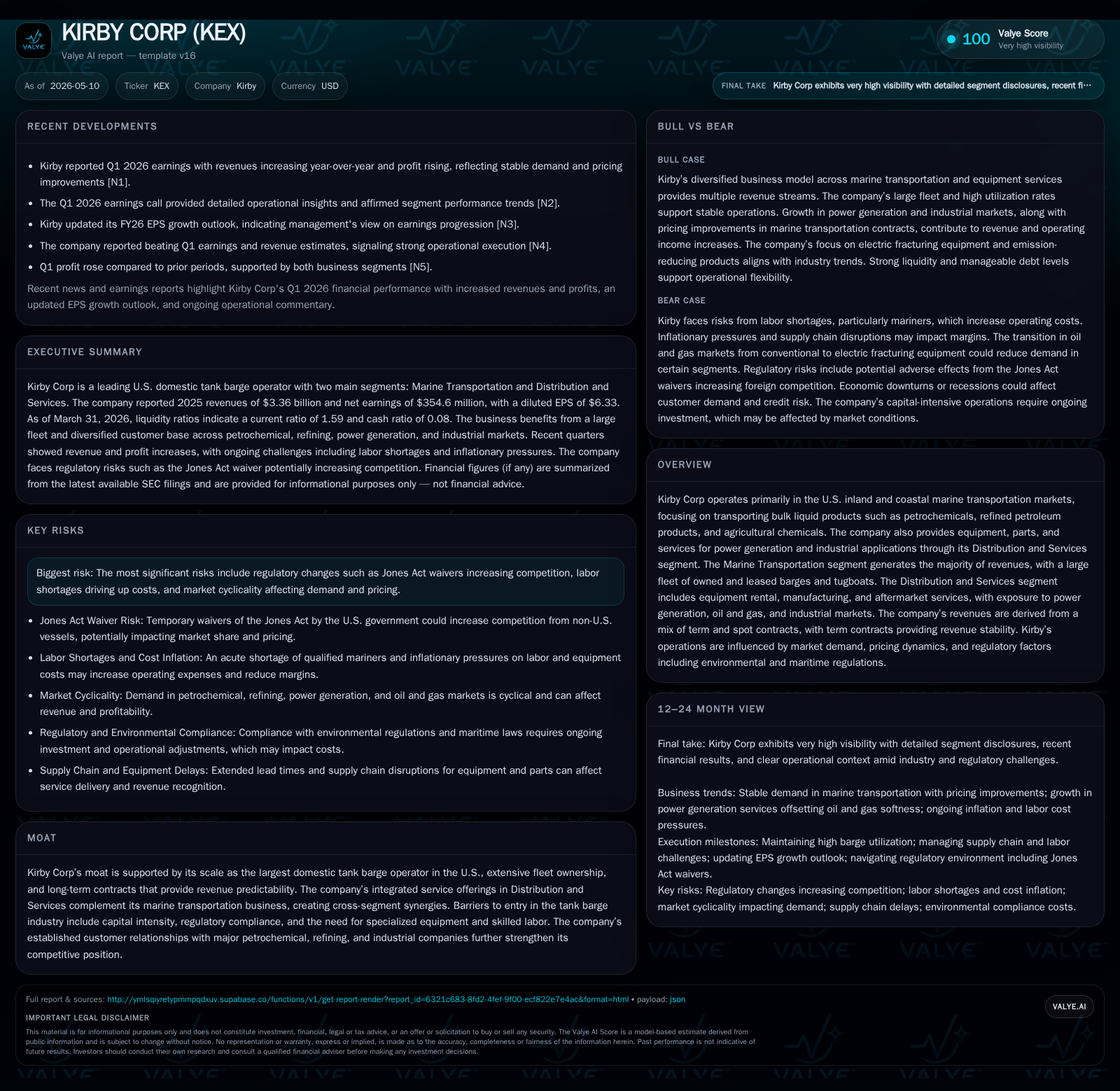
Kirby Corporation reported higher revenues in Q1 2026 supported by increased activity in its tank barge operations and service segments. The company continued to bolster its inland tank barge fleet through targeted acquisitions, sustaining its market leadership amid evolving regulatory pressures including temporary Jones Act waivers. Kirby’s business model leverages significant scale in U.S. domestic marine transportation combined with equipment distribution and services for industrial and power generation markets. The core moat rests on its substantial owned fleet, long-term contracts, and integrated service offerings. Growth drivers include term contract pricing improvements, expansion into specialty barges, and cross-selling power generation solutions; yet regulatory risks and labor cost inflation remain key constraints. Monitoring upcoming contract renewals, waiver extensions, and fleet utilization will be critical indicators of operational momentum.
Recent Operating Update
Kirby Corporation’s first quarter ended March 31, 2026 reflected a positive top-line trajectory supported by increased activity in both its Marine Transportation (KMT) segment and Distribution & Services (KDS) segment [S2][S3][N1][N3]. Revenues outperformed analyst estimates alongside an EBITDA presentation highlighting improved operating leverage [S3]. Importantly, the company continued its strategic fleet expansion by acquiring 14 inland tank barges (including four specialty barges) plus four high horsepower towboats for $97.3 million early in the year [S25]. This move boosted Kirby's operational capacity primarily along the Mississippi River System and Gulf Intracoastal Waterway.
At the same time, regulatory developments cast a shadow with the U.S. government issuing a Jones Act waiver on March 17, 2026 for an initial 60 days, subsequently extended for another 90 days starting May 18, 2026 [S2]. While Kirby has not yet faced material adverse effects from this policy flexibility allowing foreign-flagged vessels in domestic trade lanes, prolonged or expanded waivers could erode the company’s competitive moat.
Business Model
Kirby Corp operates principally as the nation’s largest domestic tank barge operator transporting bulk liquid cargoes such as petrochemicals, black oil, refined petroleum products, and agricultural chemicals via an extensive network of inland waterways plus coastal trade routes spanning all three U.S. coastlines [S1]. Owned and leased fleets of tank barges paired with tugboats enable control over capacity and service reliability.
Beyond transportation revenue — which represents the majority share — Kirby also runs Distribution & Services (KDS), delivering equipment rental, manufacturing specialized electric fracturing units (aligned with industry trends favoring electric over diesel fracturing), aftermarket parts servicing power generation systems, industrial compressors, refrigeration trailers, lift trucks among other equipment [S1]. This integrated model caters to power generation markets alongside oilfield services and heavy industrial applications.
Revenue streams are typically split between long-term contracts providing revenue stability and spot market elements offering upside but exposure to commodity price-driven volatility. Term contracts have gained importance across KMT coastal markets where pricing disciplines help maintain margin integrity [S1][S3].
Margins benefit from scale economies tied to being the largest operator controlling a sizable percentage of U.S. domestic tank barge capacity — a significant barrier to new entrants due to capital intensity and stringent regulations such as environmental standards and safety compliance [S1][S18].
Industry Structure and Competitive Position
The U.S. inland marine transportation industry is characterized by high fixed costs due to asset-intensive fleets requiring substantial capital expenditure for vessel maintenance and replacement. Regulatory compliance—especially adherence to the Jones Act mandating vessels transporting goods between U.S. ports be flagged domestically—creates significant entry barriers that favor incumbents like Kirby.
Competition primarily involves other smaller operators who tend to lease more vessels rather than own outright. Kirby’s strategy emphasizes ownership of newer barges averaging approximately 16 years old following recent acquisitions that replaced older units [S25], supporting enhanced reliability credentials valued by large petrochemical customers.
Industry demand drivers include crude oil production levels impacting refined product transport needs; agricultural chemical cycles; infrastructure development influencing inland waterway utilization; and broader economic activity affecting goods movement.
Additionally, ecosystem integration through KDS affords cross-selling advantages unavailable to pure-play barge companies—offering clients bundled marine transportation alongside equipment leasing and technical support reduces switching costs.
Growth Drivers
Fleet Modernization & Expansion
Kirby actively invests in fleet augmentations focused on specialty barges optimized for petrochemical transport or environmentally preferred cargoes [S25]. These investments position the company ahead of aging competitor fleets and allow pricing leverage due to differentiated service capability.
Term Contract Pricing Improvement
Long-term contracts within coastal markets have seen upward price revisions reflecting improved industry fundamentals post-pandemic supply chain normalization—providing predictable revenue streams despite spot market fluctuations [S1][N11].
Power Generation Market Exposure
Through KDS’s deeper penetration into power generation equipment rental/maintenance fueled by renewables integration trends and emission regulations favoring cleaner backup systems contributes additional growth potential less correlated with hydrocarbon volatility [S1].
Selective Acquisitions
Recent bolt-on deals adding inland tank barges indicate Kirby's disciplined capital deployment targeting capacity alignment with anticipated demand growth rather than broad diversification [S25]. Acquisitions also extend geographic coverage into Mexico, Central America via distributorship expansions enhancing aftermarket reach.
Risks / Watchpoints / Growth Constraints
Regulatory Uncertainty Around Jones Act Waivers
Temporary waivers allowing non-U.S.-flagged vessels pose a competitive risk undermining pricing power especially if extended or broadened beyond emergency relief scenarios currently articulated by the government [S2].
Labor Cost Inflation & Shortages
Labor market tightness impacts crew availability driving higher labor costs which can pressure operating margins if not fully passed through via contract escalators [S18].
Cyclicality in Oilfield Service Demand
KDS remains partially exposed to cyclicality within fracturing equipment markets where technology shifts (electric vs diesel) can create inventory valuation risks—as previously evidenced by impairments—but also open new growth avenues if adoption accelerates [S1].
Capital Intensity & Asset Utilization Challenges
High maintenance capital requirements on an aging fleet could constrain free cash flow generation when coupled with lower utilization periods or prolonged downtime due to regulatory inspections or weather disruptions.
What to Watch Next
- Contract renewal announcements for major term contracts across coastal markets which will inform future revenue visibility.
- Government stance on Jones Act waivers beyond current extensions; any indications of permanent policy shifts would materially affect competitive dynamics.
- Quarterly utilization rates of newly acquired barges indicating integration success.
- Pricing trends in spot marine freight tariffs relative to term contract adjustments.
- KDS backlog/order book updates particularly regarding electric fracturing units and power generation equipment demand signals.
- Cash flow performance versus capital expenditure guidance revealing balance sheet strength or liquidity stress points.
Financial Profile Overview (Latest Quarter)
Latest financial snapshot
| Metric | Value | Period |
|---|---|---|
| Cash & equivalents | $58mm | |
| 2026-03-31 | ||
| Total debt | $986mm | |
| 2026-03-31 | ||
| Net debt | $928mm | |
| 2026-03-31 | ||
| Current assets | $1142mm | |
| 2026-03-31 | ||
| Current liabilities | $717mm | |
| 2026-03-31 | ||
| Current ratio | 1.59x | |
| 2026-03-31 |
Source: SEC companyfacts cache [F1].
As of March 31, 2026 Kirby held approximately $58 million in cash with total debt near $986 million resulting in net debt roughly $928 million supported by a current ratio of about 1.59 indicating adequate short-term liquidity [F1][S2]. The company maintains $500 million senior notes maturing in 2028 plus $300 million notes due in 2033 along with revolving credit facilities providing financial flexibility compliant with covenants [S5][S6][S7].
Capital expenditures remain focused largely on marine transportation upkeep augmented by targeted growth spending estimated at around $37.9 million in recent periods [S14][S25]. The company continues active share repurchase programs funded primarily through operating cash flows demonstrating confidence in long-term free cash flow profile [S12].
The overall financial posture supports ongoing operational investments while cushioning against cyclical variability given prudent liquidity management.[F1]
This analysis summarizes Kirby Corporation’s strategic positioning based on latest SEC filings alongside sector-specific dynamics shaping performance trajectories. Readers should consider this report informational without implication for investment decisions.
Disclaimer: This is research-only, informational analysis and not investment advice. It may include AI-generated interpretation and general industry context. Always verify important details using primary sources.

Comments