
AerSale Advances Mid-Life Aircraft Solutions with Strong Q1 Momentum
Q1 2026 results affirm AerSale's integrated model leveraging mid-life aircraft aftermarket cycles supported by proprietary engineered products and robust liquidity.
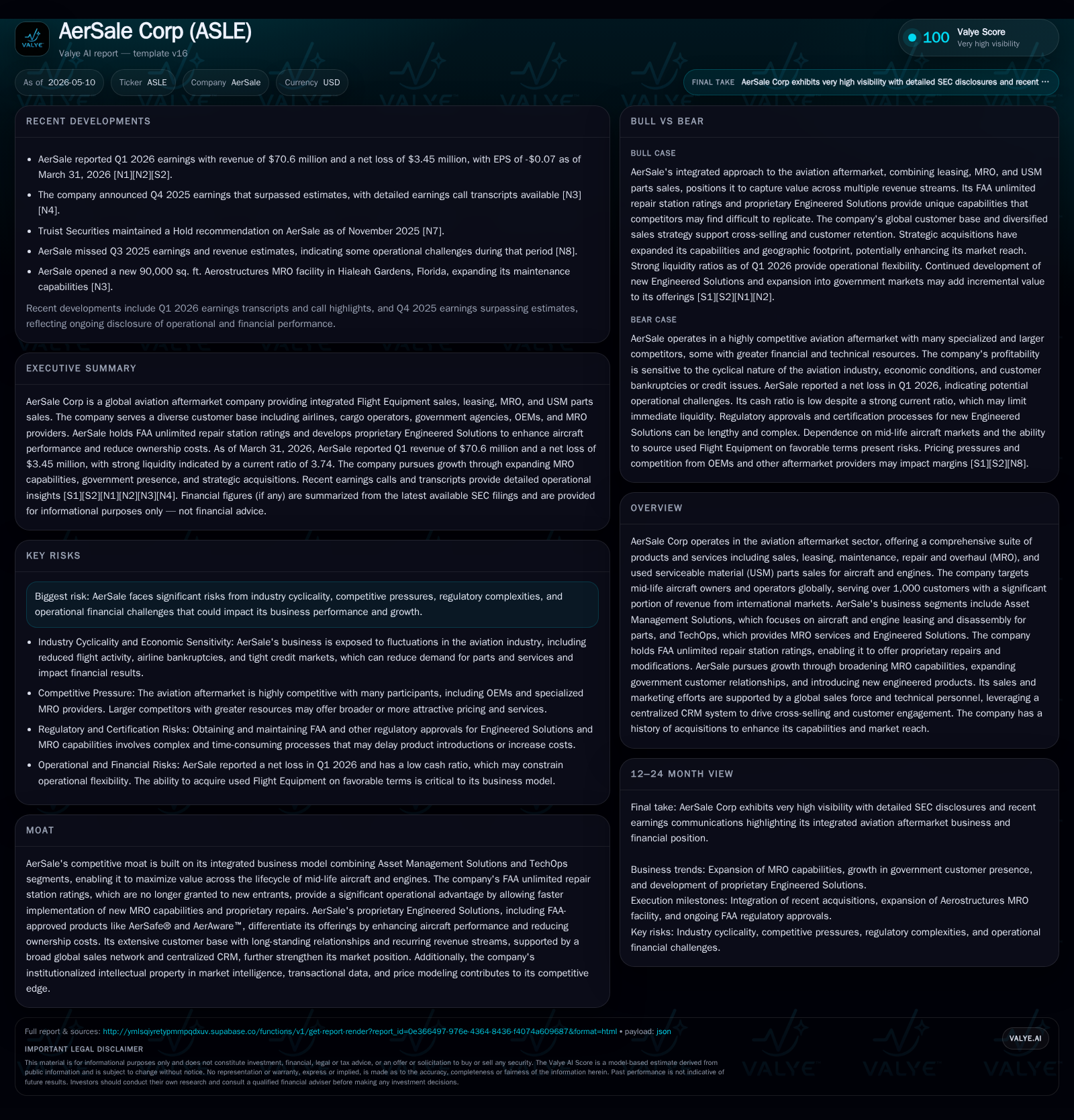
AerSale Corp reported solid operational progress in Q1 2026, anchored by growth in its Asset Management Solutions and TechOps segments. The company’s unique integration of leasing, disassembly, MRO services, and proprietary engineered solutions such as AerSafe® enhances its competitive moat, especially given its FAA unlimited repair station certification—a barrier new entrants cannot replicate. AerSale’s diverse international customer base and expanding government contracts underpin structural demand driven by mid-life aircraft lifecycle dynamics. However, industry cyclicality, environmental regulatory compliance costs, and elevated net debt remain key risks to monitor.
Q1 2026 Operating Update: Solid Performance Anchored by Core Segments
AerSale's latest quarterly filing dated May 8, 2026 [S2] documents consistent operating execution as the company advances its strategic agenda. The press release and earnings call on May 7 [S3][N1][N2] highlight revenue resilience across the integrated Asset Management Solutions and TechOps segments.
Though exact quarterly revenue was not explicitly disclosed in the filing beyond annual figures [F1], management commentary emphasizes steady demand for mid-life asset leasing and used serviceable material parts amidst prevailing industry dynamics. The company notes sustained contract renewals with government customers alongside incremental gains in proprietary engineered product sales. This progression suggests effective monetization of AerSale’s lifecycle integration approach.
AerSale Business Model: Integrated Asset Management and TechOps Services
AerSale operates primarily through two interconnected business pillars: Asset Management Solutions and TechOps [S1]. The former entails acquisition, leasing, sales, and disassembly of mid-life aircraft and engines. It targets operators seeking flexible short-term leases on fully serviced flight equipment — a value alternative to OEM new purchases. Asset disassembly maximizes residual asset value via used serviceable materials (USM), feeding inventory for parts resale or internal maintenance demands.
The TechOps segment provides comprehensive maintenance, repair, overhaul (MRO) services plus Engineered Solutions — FAA-approved technical modifications designed to improve aircraft reliability and cost-efficiency (e.g., AerSafe®, AerAware™). Leveraging FAA unlimited repair station certifications unique to AerSale allows development and accelerated implementation of proprietary repairs not broadly accessible in the marketplace. This creates cost advantages and notable switching barriers for customers reliant on durable spares and tailored maintenance.
By controlling asset lifecycle end-to-end — from leasing through MRO to parts harvesting — AerSale capitalizes on cross-segment synergies that lower total ownership costs for customers while optimizing margin profiles.
Competitive Position: FAA Certifications and Proprietary Engineered Solutions
AerSale’s FAA unlimited repair station status represents a significant moat because this accreditation is no longer granted to new entrants [S1]. It grants operational flexibility to develop novel repairs quickly without waiting for OEM mandates or lengthy certification delays. Proprietary Engineered Solutions like AerSafe® enhance safety metrics or reduce maintenance frequency, offered under PMA (Parts Manufacturer Approval) authority.
This combination grants AerSale defensible pricing power and helps maintain durable customer relationships through differentiated service quality. The company also benefits from its broad global footprint serving over 1,000 customers—including airlines, cargo operators, MRO providers, financial sponsors, and governments—cementing recurring revenue streams based on technically complex offerings.
Competitors often specialize narrowly in discrete aftermarket niches such as engine MRO or component leasing but lack the integrated platform combining full asset lifecycle management with engineering innovation [S25].
Industry Dynamics: Mid-Life Aircraft Aftermarket Trends and Customer Base
The global fleet is aging across regions; mid-life aircraft require increasing MRO attention while their owners look for cost-effective operation alternatives such as short-term leasing or USM consumption [S1]. Emerging markets expanding air traffic volumes intensify demand for aftermarket support where local OEM/MRO infrastructure remains limited.
AerSale's international revenue proportion of approximately 46% underscores how well positioned it is within these growing secondary markets [S14]. Mid-life aircraft present structural demand opportunities distinct from cyclical travel volume fluctuations owing to the intrinsic maintenance needs over prolonged operational lifespans.
Demand decision factors revolve around availability of high-quality USM at competitive pricing, trusted turnkey lease structures reducing downtime risks, proprietary technical upgrades lowering operating expenses, plus regulatory compliance assurances afforded by FAA oversight.
Growth Drivers: MRO Expansion, Government Contracts, & Product Innovation
Key growth vectors identified are:
- Expanding MRO capabilities: Broader repair offerings across composite structures to avionics enabling end-to-end component servicing within TechOps;
- Government customer deepening: Contracts offering stable revenue bases less sensitive to commercial market volatility;
- Engineered Solutions rollout: Introduction of additional FAA-certified products enhancing flight safety performance metrics;
- Geographic penetration into international markets tapping expanding secondary fleets lacking mature aftermarket ecosystems.
Growth is measurable via booked lease agreements’ renewal rates, backlog levels for TechOps projects noted in quarterly disclosures [S2], plus adoption rates of proprietary Engineered Solutions discussed on earnings calls [N2]. The recurring nature of sales from multi-offering clients further validates expansion within existing accounts.
Risks and Constraints: Cyclicality, Regulatory Challenges, and Financial Leverage
Industry cyclicality persists as a key risk impacting utilisation rates of leased assets—downturns in global air travel can depress fleet utilization thereby compressing lease rollovers or part sales volumes [S2]. Additionally, complex environmental laws impose costly remediation obligations related to hazardous materials handling across AerSale’s facilities despite indemnifications covering legacy contamination claims [S8]. Regulatory enforcement changes can translate into unplanned capital expenditures.
Financially the company holds approximately $139.8 million in total debt offset slightly by $2.08 million cash resulting in net debt near $137.7 million at quarter-end March 31, 2026 [F1]. The balance sheet shows a current ratio of 3.74, indicating solid short-term liquidity coverage over near-term liabilities [F1]. Still elevated leverage demands ongoing attention given industry volatility typically impacts cash flow generation margins especially during downturns [F1].[S2]
Competitive pressures exist from larger pure-play MRO firms or leasing operations with broader financial resources but often absent technical integration specializations that characterize AerSale’s full-service model [S25].
Near-Term Catalysts: Upcoming Guidance, Contract Awards, and Operational Initiatives
Investors should monitor upcoming quarterly guidance updates that may quantify momentum in booking activity or margin improvements stemming from recent operational expansions detailed in the latest Q1 filings and call transcripts [S3][N1][N2].
New governmental contract awards or renewals will serve as important structural revenue confirmation points given their relative stability amidst commercial market cyclicality. Similarly announcements regarding rollout timelines for new FAA-approved Engineered Solutions or geographic expansion initiatives should signal tangible execution progress against stated growth strategies.
Operational initiatives aiming at supply chain optimizations or vertical integration enhancements within TechOps could further improve cost efficiencies thus sustaining margin durability.
Consolidated Financial Snapshot and Balance Sheet Overview
Latest financial snapshot
| Metric | Value | Period |
|---|---|---|
| Cash & equivalents | $2mm | |
| 2026-03-31 | ||
| Total debt | $140mm | |
| 2026-03-31 | ||
| Net debt | $138mm | |
| 2026-03-31 | ||
| Current assets | $282mm | |
| 2026-03-31 | ||
| Current liabilities | $75mm | |
| 2026-03-31 | ||
| Current ratio | 3.74x | |
| 2026-03-31 |
Source: SEC companyfacts cache [F1].
| Metric | Value |
|---|---|
| Cash & Equivalents | $2.09M |
| Total Debt | $139.8M |
| Net Debt | $137.7M |
| Current Assets | $282.0M |
| Current Liabilities | $75.3M |
| Current Ratio | 3.74 |
As of March 31, 2026 balance sheet data reveals strong short-term liquidity positioning despite net leveraged status consistent with an asset-heavy aviation aftermarket business requiring capital outlays for inventory stocking and facility upkeep [F1]. Maintaining this balance will be crucial given potential industry cyclicality pressures on operating cash flows going forward.
This analysis reflects information available as of May 10, 2026 based on SEC filings including the March 10 annual report and May 7–8 quarterly/event disclosures along with recent earnings call transcripts. It synthesizes operational insights without providing investment advice.
Disclaimer: This is research-only, informational analysis and not investment advice. It may include AI-generated interpretation and general industry context. Always verify important details using primary sources.

Comments