
Essent Group’s Q1 Surge Highlights Mortgage Insurance Resilience
Essent’s robust Q1 performance underscores its disciplined underwriting and strategic positioning in mortgage insurance amid shifting residential credit dynamics.
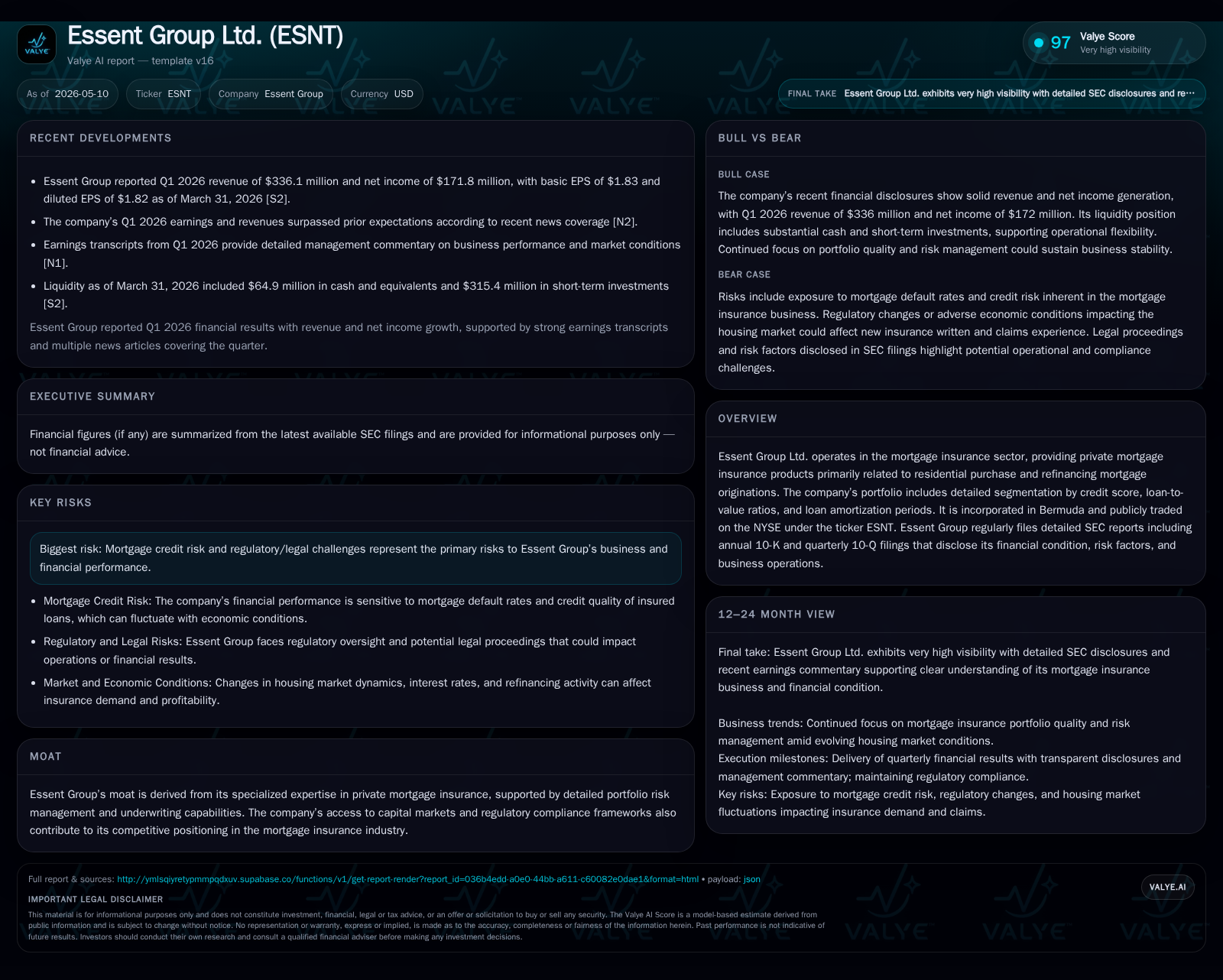
In Q1 2026, Essent Group Ltd. demonstrated operational strength through premium growth driven by purchase-originated mortgage insurance, surpassing earnings estimates and maintaining disciplined portfolio risk management. Its business model leverages detailed credit and loan-to-value segmentation to price and underwrite mortgage risks effectively. The company’s competitive advantage hinges on advanced analytics, regulatory compliance, and capital access supporting its underwriting rigor. Growth is underpinned by expanding purchase mortgage volumes post rate normalization and stable regulatory frameworks, while risks remain concentrated in credit cycles and regulatory/legal developments. Near-term milestones include monitoring refinance trends, default rates by vintage cohorts, and any shifts in regulatory environment that may affect capital or underwriting strategies.
Q1 2026 Operating Update: Key Takeaways and Market Implications
Essent Group Ltd.’s quarterly filing dated May 8, 2026, reveals a continuation of operational momentum with premium growth driven mainly by strong new insurance written (NIW) associated with residential purchase mortgages rather than refinancings [S2]. The earnings announcement simultaneously furnished via an 8-K confirms revenues and earnings outperformance relative to consensus estimates, signaling resilient demand amid nuanced interest rate environments [N2][S3][N9]. Portfolio composition subtleties appear as modest shifts in distribution metrics such as loan-to-value ratios and borrower credit scores—factors central to Essent's risk-based pricing model described in their annual disclosures [S1][S13]. This quarter's results underscore the durability of Essent’s underlying business model against a backdrop where refinancing volumes have diminished post prior rate increases.
Management commentary in the earnings transcript further highlights confidence in sustained premium flows from purchase originations as the primary growth vector going forward [N1]. The data disaggregated between purchase versus refinance originations clarifies that while refinance-driven premium income continues to wane structurally due to higher rates reducing refinancing activity, purchase-originated mortgage insurance remains a stable source of revenue reflecting ongoing housing market activity even in higher-rate regimes.
Essent’s Business Model: Private Mortgage Insurance amid Residential Origination Flows
Essent operates principally within the private mortgage insurance (PMI) sector providing coverage predominantly on loans where borrower down payments are below conventional thresholds, mitigating lender credit risk on residential home purchases or refinance transactions [S1]. Revenue is generated via premiums tied directly to the volume of insured mortgages — reflecting issuance activity — with pricing calibrated according to detailed borrower credit characteristics (credit scores), collateral quality (loan-to-value ratios), and amortization terms. This creates a multifaceted segmentation framework allowing tailored risk-adjusted pricing that supports margin stability.
The company's strategy includes emphasizing new insurance written on higher-quality credits within acceptable LTV bands to balance growth with underwriting discipline. Notably, the Bermuda incorporation offers regulatory efficiencies particularly around capital requirements and tax treatment which supports competitive positioning relative to US-headquartered peers operating under more burdensome constraints [S1]. Capital deployment focuses on maintaining sufficient reserves for expected claims while leveraging capital markets access for capacity expansion.
Essent’s premium income depends heavily on underlying residential mortgage origination flows—a demand profile subject to both cyclical interest rate shifts and structural housing market trends. Within this context, the delineation between purchase-driven versus refinance-driven premiums is critical since each follows distinct volume dynamics influenced by macroeconomic rates and consumer behavior patterns.
Industry Context: Competitive Positioning and Underwriting Expertise
Within the private mortgage insurance landscape, Essent distinguishes itself through advanced analytic capabilities underpinning its underwriting rigor and portfolio risk management. Its moat stems from an ability to price granular credit risk effectively while managing capital through Bermuda-based regulatory advantages [S1][N6]. Unlike some peers facing profitability pressure from lagging loss recognition or suboptimal pricing—illustrated recently by Heritage Insurance’s earnings miss contrasting Essent’s beat—Essent benefits from structural switching costs lending stickiness among lender clients that rely on consistent claim payment performance and financial stability [N3][N6].
The industry remains characterized by a small cluster of specialized insurers possessing significant barriers related to expertise, capital requirements, and regulatory licensing. Essent’s reputation for conservative underwriting paired with robust loss reserves enhances trust within lender ecosystems where PMI selection impacts loan approval pipelines. Furthermore, evolving regulation demands ongoing compliance investments; Essent’s history of managing these frameworks constitutes a competitive edge over less-capitalized participants.
Growth Drivers: Portfolio Quality, Market Demand, and Regulatory Factors
Primary growth fuel comes from sustained demand for mortgage insurance linked to home purchases as mortgage originations rebound following prior rate normalization phases [S2][N9]. Essent’s focus on prime credits within targeted LTV ranges supports favorable claims experience underpinning profitable premium generation. Quantifiable KPIs include upticks in NIW volumes specific to purchase loans—critical since these have higher frequency compared to refinancing MI flows which are more sensitive to interest rate volatility [S13].
Regulatory stability over PMI products facilitates continued lender adoption without disruption; no major policy upheavals reported recently ease execution uncertainties. The steady-state default rates by vintage loan cohorts suggest disciplined underwriting across macroeconomic cycles despite pockets of stress in challenged segments identified through portfolio analytics. This reinforces confidence in product relevance as customer appetite for PMI remains high given tight mortgage lending standards.
Overall demand drivers blend structural factors like housing affordability pressures with cyclical recovery post pandemic-related dislocations. Essent’s ability to capture increasing shares of private mortgage insurance among those qualifying borrowers leveraging its risk segmentation framework signals effective commercial execution aligned with broader market rhythms.
Risks and Constraints: Credit, Regulatory, and Legal Considerations
Essent explicitly highlights in its recent filings ongoing exposure to potential mortgage credit deterioration which could stress loss reserves disproportionately should macroeconomic conditions deteriorate unexpectedly or inflationary shocks compress borrower servicing ability [S18][S19]. Rising default rates—especially concentrated within certain loan vintages—represent a material factor requiring close surveillance given their direct impact on claims expense forecasts.
Legal proceedings or heightened regulatory scrutiny constitute additional uncertainty corridors potentially impacting capital allocation or return profiles. Evolving legislation around private mortgage insurers might impose tighter capital buffers or reporting mandates increasing operating costs while narrowing underwriting margins [S18][S19]. Compliance-related expenditures represent incremental constraints on scalability particularly if extensive adjustments become mandated.
Lastly, limited refinancing markets can constrain diversification of premium sources thereby heightening cyclicality linked solely to purchase-oriented originations. This concentration intensifies sensitivity to housing market fluctuations or policy shifts impacting homebuyer incentives.
Outlook and Upcoming Catalysts: What Investors Should Watch Next
Looking ahead, critical milestones include monitoring premium volume trends in upcoming quarters differentiating purchase versus refinance premiums to assess persistency gains or decelerations amid macro volatility [N1][S2]. Important metrics also encompass default rate evolution stratified by origination year cohorts informing actuarial assumptions guiding reserve adequacy.
Regulatory developments at federal or state levels bear watching for potential impacts on capitalization rules or permissible product structures influencing cost competitiveness or operational flexibility. Additionally, any announced expansions into new geographic markets or product extensions could signal avenues for incremental growth beyond current footprints [S3].
Capital markets engagement reflecting funding cost shifts or refinancing of existing debt levels will influence financial leverage ratios thus indirectly affecting future underwriting capacity thresholds acting as gating factors for scale momentum.
Condensed Financial Snapshot: Supporting Evidence of Operational Strength
Financially, Essent closed the most recent reported fiscal year with top-line revenue around $1.26 billion supporting net income attainment near $690 million—figures indicative of high operational leverage within its business segment driven by stable risk pricing frameworks [F1]. The latest quarter sustained this trajectory with earnings surpassing consensus while maintaining conservative leverage evidenced by net debt approximating $360 million based on the latest available data referencing early-2024 balance sheet figures [F1].
This analysis builds purely on publicly filed disclosures including Essent’s latest quarterly (10-Q), annual (10-K), and event filings alongside corroborating industry news reports; it does not feature investment recommendations but aims to elucidate company dynamics grounded in verifiable operating details.
Disclaimer: This is research-only, informational analysis and not investment advice. It may include AI-generated interpretation and general industry context. Always verify important details using primary sources.

Comments