
FS Bancorp Boosts Cybersecurity and Capital Management in Q1 2026 Update
Q1 2026 disclosures reveal FS Bancorp's enhanced liquidity management, stable loan portfolio quality, and leading cybersecurity initiatives.
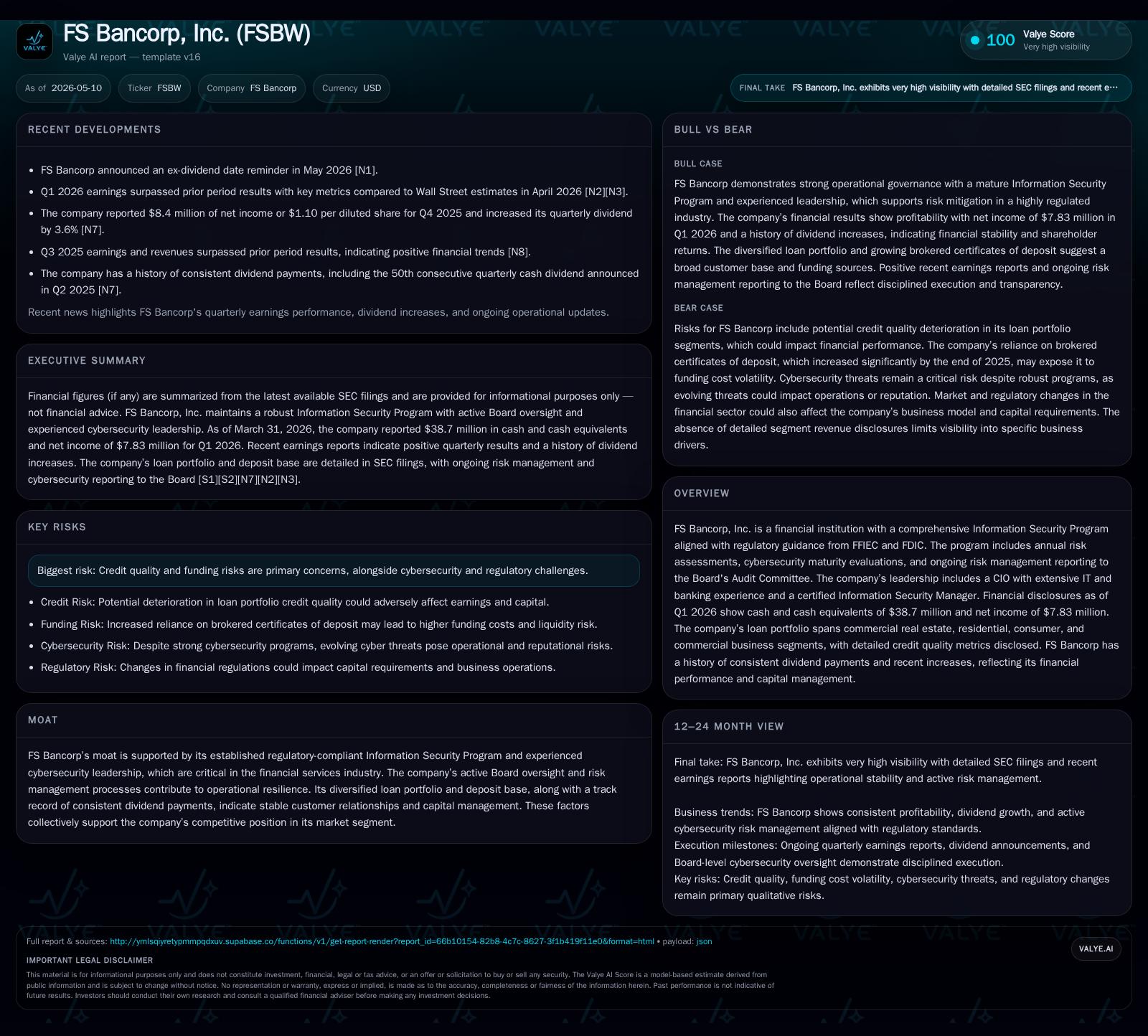
FS Bancorp’s latest quarterly filings highlight strategic liquidity shifts with increased brokered deposits and robust hedging portfolio management, underscoring refined interest rate risk controls. The company's diverse loan portfolio, spanning commercial real estate to consumer segments, is supported by a comprehensive information security program aligned with FFIEC and FDIC standards led by seasoned cybersecurity leadership. These operational pillars buttress its competitive stance in a tightly regulated and capital-sensitive regional banking sector. Key growth drivers include measured loan portfolio expansion and digital trust bolstered by cybersecurity compliance, while risks persist around credit quality concentration and funding costs.
Q1 2026 Operating Update: Key Developments and Implications
FS Bancorp’s Q1 2026 SEC Form 10-Q reveals an evolution in its liquidity profile with brokered deposits rising markedly to $20.3 million at year-end 2025 compared to negligible levels the prior year. Concurrently, brokered certificates of deposit expanded significantly to $202.1 million from $143.1 million at December 31, 2024 [S2]. This increase signals a tactical shift towards more active liquidity sourcing beyond core deposits, which can provide flexibility but introduces sensitivity to interest rate movements and funding cost volatility.
Moreover, FS Bancorp disclosed stable amortized cost bases for closed portfolios utilized within designated hedging relationships—approximately $178 million at March 31, 2026—alongside cumulative basis adjustments indicating gains ($2.4 million) versus slight losses in the prior quarter [S2]. These closed portfolios underpin disciplined interest rate risk management frameworks that mitigate earnings volatility against shifting yield curves.
Professional fees and marketing expenses remain controlled within other operating expenses categories; impairment recoveries on mortgage servicing rights (MSRs) modestly offset related costs [S2]. This holistic operating picture suggests calibrated expense governance alongside refining funding structures.
Business Model and Product Quality: Diverse Lending with Strong Cybersecurity Oversight
FS Bancorp’s business model centers on originating diversified loans across commercial real estate (CRE), residential mortgage, consumer credit, and commercial business sectors with revenue derived primarily from net interest margins complemented by service fees [S1]. The CRE portfolio includes owner-occupied properties as well as non-owner-occupied assets, construction loans, speculative development projects, and multifamily residential units [S1], ensuring varied exposure but requiring nuanced credit evaluation.
Underwriting quality is reinforced through detailed loan segment-level credit monitoring reflecting industry best practices. Consumer loans encompass home equity lines as well as specialty products such as marine loans—a niche segment requiring specific expertise [S1]. Stable deposit franchises fund lending activities supported by evolving brokered CD usage for liquidity optimization [S2].
A critical competitive differentiator resides in FS Bancorp’s mature Information Security Program aligned with regulatory guidance from FFIEC and FDIC [S1]. This program incorporates annual comprehensive risk assessments including targeted cybersecurity reviews using the FFIEC Cybersecurity Assessment Tool (FFIEC CAT). The program’s leadership structure spans a CIO with over 25 years of combined technology and banking experience holding CISSP certification alongside an Information Security Manager specialized in financial sector cybersecurity [S1].
Regular Board Audit Committee oversight ensures dynamic risk appetite calibration complemented by continuous reporting covering vulnerability assessments, penetration testing results, incident response preparedness, vendor management status, and patch update cycles [S1]. This enhances operational resilience amid evolving cyber threats prevalent in financial services.
Competitive Landscape and Industry Positioning
Operating primarily within regional bank markets subject to tight regulatory scrutiny around information security policies and capital adequacy norms, FS Bancorp faces competitor pressure both domestically from other midsize banks and non-bank fintech entrants targeting consumer lending niches.
Pricing power is constrained by the collective influence of Federal Reserve deposit rate benchmarks; however, FS Bancorp’s ability to access brokered certificates of deposit adds flexibility to its funding stack which partially offsets such constraints [S2]. Regulatory compliance demands notably elevate costs relative to less regulated competitors but simultaneously raise barriers to entry reinforcing FS Bancorp’s standing.
The company’s established Information Security Program mitigates operational risks disproportionate to peers lacking equivalent governance rigor—this serves as a distinct non-price moat particularly important for institutional client confidence in digital channels [S1],.
Growth Catalysts: Loan Portfolio Expansion and Regulatory Compliance
Areas promising incremental growth include measured loan origination upticks especially within commercial real estate segments showing stable credit conditions yet increased demand for owner-occupied and multifamily property financing [N1],[N2],[S2]. Consumer lending niches such as indirect home improvement loans also present opportunities given demographic tailwinds.
Continued capital redeployment evidenced by recent dividend increases reflects management’s confidence in sustained earnings power underlying shareholder returns — these payout trends are often indicative of prudent balance sheet utilization [N3],[F1].
Digital banking services enhanced through secured IT infrastructure anchored by the company’s cybersecurity program underpins client trust essential for customer acquisition and retention as branch dependency diminishes industry-wide [S1],. Regulatory compliance frameworks maintaining program maturity far exceed minimum standards further enable FS Bancorp to pursue tech-enabled initiatives without sacrificing safety or incurring penalties.
Risks and Constraints: Credit Quality, Funding Challenges, and Cybersecurity Vigilance
Credit quality remains the most salient risk vector given exposure concentrations within specific CRE sub-segments such as speculative construction projects which can be sensitive to economic shifts or local market downturns [S2],[S1]. Detailed overdue loan metrics underscore active monitoring but necessitate ongoing vigilance.
The rapid increase in brokered deposits introduces potential cost variability should market rates rise or liquidity preferences shift—brokered deposits typically command higher rates than core deposits impacting net interest margins if not balanced carefully [S2],.
Cybersecurity threats require persistent investment; while FS Bancorp maintains a robust stance presently including managed security services partnerships, the threat landscape evolves rapidly demanding adaptability lest operational disruptions occur with reputation ramifications [S1],.
Catalyst Watchlist: Forward Guidance and Execution Milestones
Investors should monitor upcoming Q2 quarterly filings expected later this year for further evolution of deposit mix dynamics—especially brokered versus core balances—and their associated funding costs which critically influence margin trajectories [S3],[N3].
Management’s appearances at major investor conferences such as the recent D.A. Davidson Financial Institutions Conference provide forums where incremental insights into loan portfolio strategy adjustments may be offered alongside comments on regulatory developments impacting the company's Information Security Program adherence track record [S3].
Ongoing quarterly disclosures related to hedging activities will be key markers assessing how interest rate environment expectations translate into balance sheet positioning given closed portfolios’ role in mitigating yield curve risks reported quarterly [S2],.
Financial Snapshot: Capital Management, Liquidity, and Profitability
FS Bancorp reported net income approximating $33.3 million annualized based on latest available data ending December 31, 2025 [F1], signaling profitable operations commensurate with moderate balance sheet scale.
As of March 31, 2026, cash & cash equivalents stood at $38.7 million providing a solid liquidity buffer for near-term obligations or opportunistic deployments [F1]. Estimated net debt positioning—derived conservatively based on reported total debt from prior periods less cash available—is around $148 million supporting efficient leverage ratios typical of community bank peer groups maintaining conservative capital postures [F1],.
Dividend consistency alongside modest growth reflects steady cash flow generation aligned with capital preservation priorities critical for banking operations exposed to cyclical macroeconomic influences.
This analysis is based exclusively on disclosed SEC filings and corroborated news reports available as of May 2026. It aims to provide an informed evaluation of FS Bancorp’s current operational dynamics without offering investment advice or recommendations.
Disclaimer: This is research-only, informational analysis and not investment advice. It may include AI-generated interpretation and general industry context. Always verify important details using primary sources.

Comments