
Future Prospects and Capital Structure Insights for Armada Acquisition Corp. III
Armada Acquisition Corp. III’s latest 10-Q details its ongoing SPAC progress, capital management, and path to a strategic business combination.
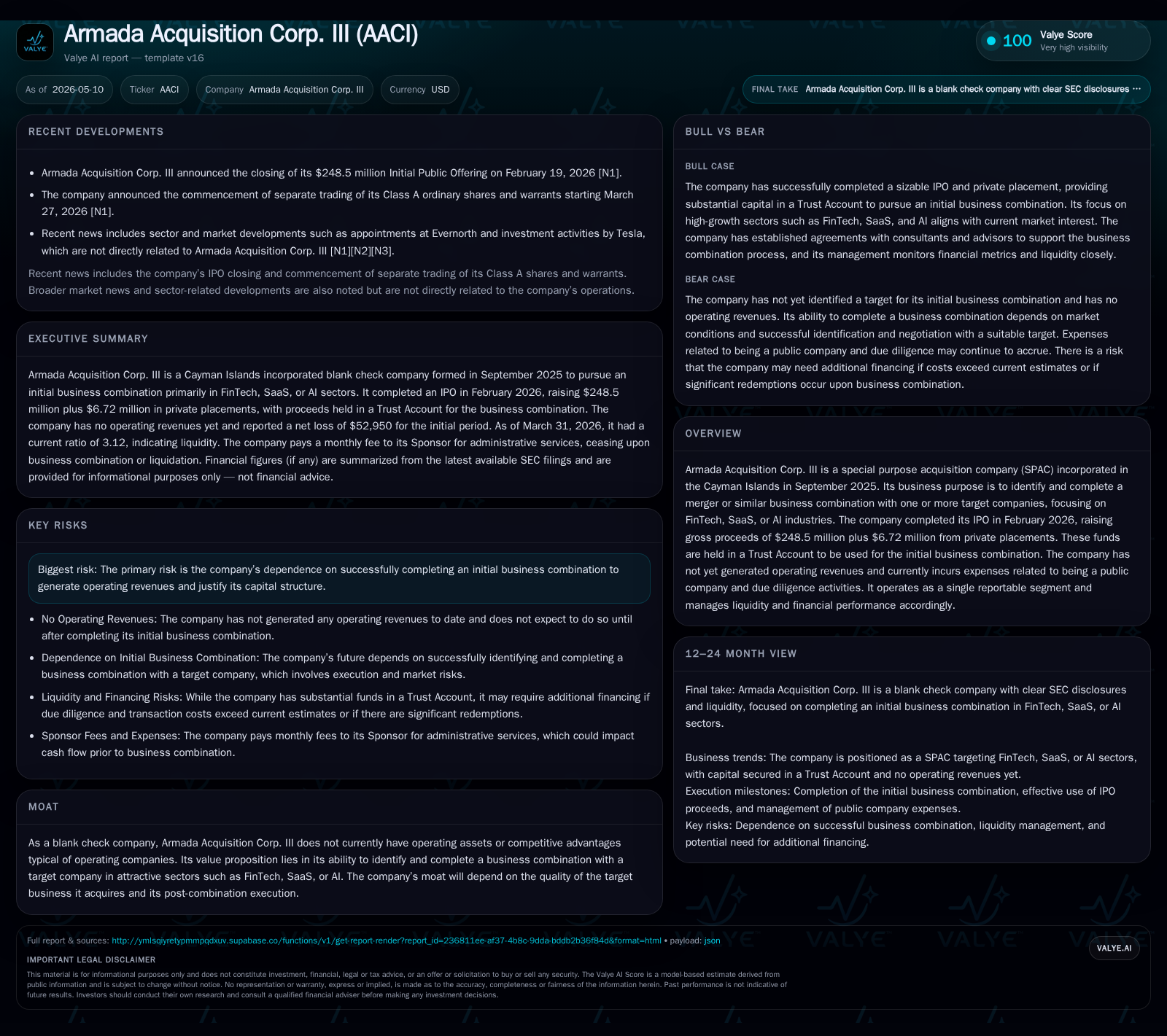
Armada Acquisition Corp. III remains a pre-revenue special purpose acquisition company (SPAC) focusing on FinTech, SaaS, and AI target sectors following its February 2026 IPO and subsequent private placements totaling approximately $255 million held in trust. The May 2026 quarterly filing underscores continued expenses related to public company operations and due diligence without revenue, highlighting the critical importance of securing an initial business combination to unlock operating value. Armada’s current capital structure is clean with no debt and a strong liquidity position, supporting its near-term ability to identify and transact with appropriate targets. The firm operates in a highly competitive SPAC environment where sponsor reputation, deal flow quality, and execution capability will dictate post-combination success.
Latest Quarterly Update Signals Progress in SPAC Lifecycle
Armada Acquisition Corp. III’s most recent quarterly filing dated May 8, 2026 (Form 10-Q) confirms its ongoing status as a special purpose acquisition company (SPAC) without active operations or revenue generation [S2]. The company raised gross proceeds of approximately $248.5 million via its February 2026 IPO together with an additional $6.72 million through concurrent private placements [S5][S8]. These funds remain segregated in a U.S.-based Trust Account designated for use expressly in completing one or more initial business combinations consistent with SEC rules governing SPACs.
Following the IPO close, Armada separated trading units—each initially composed of one Class A share plus half a warrant—into their components effective March 27, 2026; ordinary shares now trade under AACI and warrants under AACIW symbols on Nasdaq while non-separated units continue trading under AACIU [S3]. This development enhances liquidity mechanisms for investors by allowing separate market participation in shares and warrants.
Operating expenses continue to be driven by regulatory compliance costs typical for public companies alongside due diligence efforts required to evaluate acquisition prospects [S2][F1]. No revenues or operating profits have yet been generated due to the pre-transaction status—the measured net loss attributable to such activities totaled roughly $373K over the trailing twelve months as per latest available data [F1].
Overview of Business Model and Value Proposition
Armada Acquisition Corp. III functions as a blank check vehicle established September 19, 2025 in the Cayman Islands expressly to pursue mergers or similar business combinations aimed at entities within financial technology (FinTech), Software-as-a-Service (SaaS), or artificial intelligence (AI) verticals [S1][S8]. As a pure SPAC structure without own operating assets prior to merger, its economic value is entirely contingent upon identifying compelling target companies whose integration can produce scalable growth backed by the IPO capital.
The core revenue mechanics depend first on consummating an initial business combination using cash from the Trust Account supplemented potentially by equity or debt issuance made at or post-closing at negotiated terms [S1]. Post-combination operations would then generate revenues through license fees, subscriptions, service contracts or whatever models govern acquired entities primarily in technology-driven sectors.
Importantly, expenses incurred thus far relate exclusively to maintaining public reporting obligations alongside rigorous vetting including travel and due diligence review costs linked to acquisition opportunities—all funded through amounts outside the Trust Account [S8]. There is currently no operating margin or cash flow generation.
SPAC Industry Dynamics and Competitive Considerations
Within the expanding universe of SPACs focused on tech-centric sectors like FinTech, SaaS, and AI, Armada faces intensely competitive pressures arising from multiple contemporaneous sponsors pursuing limited high-quality targets. Sponsor reputation alongside established networks becomes decisive in sourcing promising candidates who meet growth criteria.
The latent moat is not inherent but dependent entirely on successful execution—post-merger economics will depend heavily on how well Armada transitions from capital allocator to operating entity optimizing acquired businesses’ growth trajectories. Regulatory environments have tightened around SPAC disclosures and shareholder protections increasing procedural complexity for deal completions.
Overall competitive differentiation will derive from sponsor ability to leverage experience-based insights into sector trends combined with efficient due diligence frameworks minimizing transaction execution risks.
Growth Drivers Centered on Strategic Target Selection
Pre-business combination growth is principally driven by Armada’s capability to allocate considerable IPO-derived funds prudently towards attractive FinTech/SaaS/AI companies demonstrating scalable recurring revenue models and strong unit economics [S1][F1]. Rigorous due diligence supported by dedicated deal teams backed by working capital enables comprehensive assessment enabling swift but informed engagement.
Post-merger growth vectors would materialize from commercial expansion initiatives by combined entities accessing new markets leveraging technological innovation embedded within acquired platforms. Increased enterprise subscription volumes or AI algorithm licensing enlargements represent plausible revenue levers.
Thus selecting a quality initial partner directly correlates with unlocking value creation opportunities important for sponsor credibility retention and shareholder confidence.
Risks and Challenges Facing Initial Business Combination
By operating as a pre-revenue blank check company reliant solely on successfully concluding an initial business combination within prescribed regulatory timelines (commonly up to 18 months from IPO), Armada faces several notable risks:
- Potential failure or delay in completing a qualified transaction threatens mandatory liquidation scenarios reducing investor returns substantially;
- Shareholder redemption rights create uncertainty on final funds available from the Trust Account after redemptions impacting deal financing plans;
- Additional financing through equity dilution or debt issuance might be necessary adding complexity to capital structure;
- The competitive market environment elevates pressure around finding appropriate targets given regulatory scrutiny;
- Sponsor operational cost commitments persist independent of transactional success increasing cash burn risk [S2][F1][S9].
Collectively these factors suggest that until an initial combination closes successfully some degree of investment uncertainty inherently persists.
Key Milestones and Upcoming Catalysts to Monitor
Investors should focus attentively on:
- Formal announcements detailing specific target companies identified for combination including financial terms;
- Reporting of signed definitive agreements which legally bind intended mergers;
- Scheduling of shareholder votes required for transaction approvals;
- Possible requests for extensions beyond original statutory deadlines if needed;
- Market reception measured via unit/separate share/warrant trading activity signaling investor sentiment;
- Updates regarding capital raises outside trust funds for supplemental transaction structuring or working capital needs [S2][S3].
These milestones collectively represent primary catalysts illuminating trajectory toward transition from blank-check entity to operating public company.
Current Financial Position and Liquidity Snapshot
As detailed by latest quarterly balance sheet data ending March 31, 2026:
| Metric | Value |
|---|---|
| Current Assets | $1,035,878 |
| Current Liabilities | $332,273 |
| Current Ratio | 3.12 |
| Total Debt | $0 |
| Operating Income (TTM) | -$373,484 |
This snapshot underscores that Armada holds no debt obligations leaving liquidity preserved principally via cash equivalents within its Trust Account plus minimal working capital outside trust supporting operations without meaningful leverage risk exposure [F1][S2]. Monthly administrative fees payable to sponsor amounting to approximately $19K cease upon business combination completion providing operational clarity over fixed expense commitments prior merger closure [S19][S29].
This analysis reflects publicly filed regulatory documents as of May 2026 combined with a sector-informed perspective specific to SPAC lifecycle characteristics emphasizing strategic operational milestones over historical financial metrics. It does not constitute investment advice but aims solely to offer an informed understanding of Armada Acquisition Corp. III’s current positioning based on disclosed facts.
Disclaimer: This is research-only, informational analysis and not investment advice. It may include AI-generated interpretation and general industry context. Always verify important details using primary sources.

Comments