
Southern Missouri Bancorp Strengthens Regional Footprint with Q1 2026 Loan Growth
Q1 2026 results highlight disciplined loan portfolio expansion and strategic liquidity repositioning, underscoring the bank’s continued regional growth trajectory.
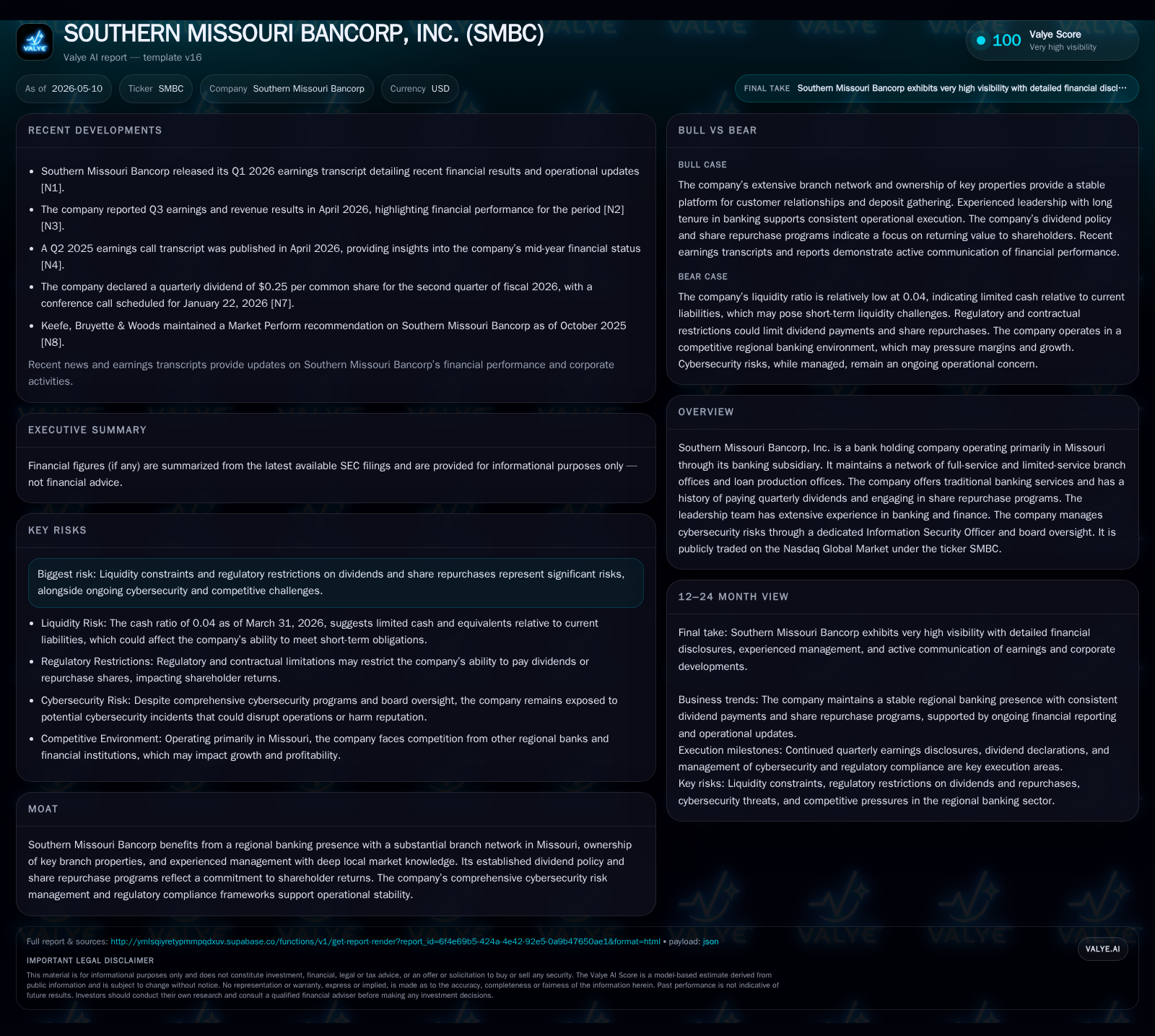
Southern Missouri Bancorp (SMBC) reported a measured rise in its loan portfolio to nearly $198 million in Q1 2026, reflecting sustained demand across its core Missouri market. The company’s liquidity position shifted with cash and cash equivalents declining to $93 million, signaling capital redeployment towards loan growth and securities. SMBC’s regional banking model is underpinned by an extensive branch network, most properties owned outright, which fosters customer retention and operational efficiency. The bank continues to balance shareholder returns through dividend payments and share repurchases while navigating regulatory and cybersecurity risks inherent to regional community banks.
As of March 31, 2026, total loans rose to $197.8 million from $187.5 million a year earlier [S2]. This approximately $10.3 million increase underscores persistent lending demand particularly across commercial real estate and agricultural sectors integral to the Missouri economy. Concurrently, cash and cash equivalents decreased sharply to $93 million from previous levels near $193 million [S2], suggesting a strategic reduction of low-yielding liquid assets in favor of deploying capital into income-generating loans and investment securities.
Available-for-sale securities totaled about $439.1 million at quarter-end compared with $460.8 million mid-2025 [S2], indicating modest portfolio rebalancing likely responsive to interest rate environments or liquidity needs. This nuanced asset allocation reflects a calibrated approach balancing earning asset growth with liquidity risk mitigation.
Business Model and Product Offering: A Regional Banking Service Portfolio
SMBC functions as a bank holding company anchored by Southern Bank’s retail banking subsidiary operating mainly within Missouri [S1]. Its revenue derives principally from net interest margin on diverse loan products including residential real estate mortgages, commercial real estate financing, agriculture-related loans—critical for serving local farming communities—and consumer credit [S1]. Deposit products span checking accounts, savings vehicles, certificates of deposits creating a stable funding base. Usage dynamics remain driven by relationships fostered via branch access points rather than digital-only channels.
The bank maintains both full-service branches and limited-service outlets combined with loan production offices (LPOs), allowing tailored customer engagement [S1]. Such physical footprint supports high customer retention through relationship banking—a key strength amid regional competition.
Branch Network and Property Ownership: Competitive Advantages in Local Markets
At June 30, 2025 Southern Bank operated from a network of 62 full-service branches complemented by two limited-service branches and two LPOs [S1]. Crucially, the company owns its headquarters property plus owns outright 59 of its branch locations with the remainder leased or partially owned. This ownership confers a durable moat by reducing occupancy costs and granting control over facility expansion or modification decisions.
Physical branch presence entrenches SMBC within local communities supporting cross-selling opportunities while erecting natural switching costs for customers accustomed to onsite services that digital-only competitors cannot replicate effectively.
Industry Dynamics: Competing in the Missouri Regional Banking Landscape
SMBC competes in a moderately concentrated banking market where regulatory oversight is rigorous and cybersecurity mandates are escalating [S1]. The company has established robust governance structures with an Information Security Officer leading cybersecurity strategy who reports regularly at the board level [S1]. This exemplifies attentive risk management vital given increasing cyber threats targeting financial institutions.
Dividend policies and share repurchase programs are subject to restraint under regulatory capital guidelines reflecting broader limitations community banks face when balancing growth allocations against capital distributions to shareholders [S1], [S3]. Competitive pressures stem from both larger regional banks offering scale advantages and emerging FinTech players encroaching on traditional deposit-taking or payment segments.
Growth Catalysts: Expanding Customer Base, Lending Focus, and Capital Return Initiatives
Loan portfolio growth serves as a tangible indicator of SMBC's expanding market penetration. Management commentary around Q1 earnings corroborates strong demand traction particularly among commercial real estate developers and local agribusinesses [N1], [N2]. Additionally, stable or growing deposit trends nourish funding capacity necessary for continued credit extension.
Capital deployment strategies include maintaining quarterly dividends ($0.25 per share per recent communications) alongside opportunistic share repurchases signaling commitment to shareholder value preservation despite regulatory headwinds [S3], [N2]. Optimizing this balance will remain central to sustaining investor confidence.
Risks and Constraints: Regulatory, Liquidity, and Cybersecurity Challenges
Liquidity positioning merits close attention given the significant drop in cash holdings from nearly $193 million to about $93 million as noted in the quarter-end balance sheet [S2], [F1]. While this likely reflects strategic asset reallocation towards higher-yield loans or securities portfolios, it introduces potential vulnerability if unexpected funding pressures arise.
Regulatory frameworks impose constraints on dividend payments and stock buybacks limiting financial flexibility during stress periods [S1]. Additionally, even though no material litigation or credit quality deterioration is reported currently, typical regional bank credit risk exposures require ongoing surveillance particularly in agricultural sectors sensitive to price fluctuations or environmental factors.
The company’s cybersecurity program benefits from seasoned leadership but remains exposed to evolving risks requiring sustained investment in controls alongside proactive monitoring given financial sector threat profiles [S1].
Near-Term Outlook: Upcoming Milestones and Market Indicators to Monitor
Investors should track subsequent quarterly earnings releases for margin development insights reflecting loan yield improvements or funding cost changes [S3], [N1]. Deposit composition shifts—especially core versus time deposits—will preview liquidity stability impacting lending capacity.
Additionally, disclosures concerning potential further branch expansions or technology investments will offer clues on strategic priorities amid competitive pressures. Updates regarding capital return program adjustments also merit focus as they signify management’s assessment of balance-sheet strength versus shareholder payout appetites.
Financial Snapshot: Key Metrics from Latest Quarter for Operational Validation
As of March 31, 2026 SMBC reported total loans at approximately $197.8 million compared to $187.5 million a year prior confirming notable credit book growth within its footprint [S2]. Cash and cash equivalents stood at roughly $93 million after decreasing materially from prior quarters reflecting active liquidity deployment [S2], supported by XBRL data confirmation [F1]. Securities classified as available-for-sale totaled about $439.1 million contributing positively to interest income streams.
While net income data referenced from mid-2025 was approximately $15.8 million [F1], detailed current-period profitability metrics were not emphasized but underpin the operational narrative of steady performance amid strategic execution.
This analysis synthesizes Southern Missouri Bancorp’s recent filings to profile its business model durability, competitive strengths rooted in branch ownership, evolving industry challenges including regulatory liquidity constraints and cybersecurity oversight, along with growth pathways tied primarily to loan book expansion within its regional Missouri franchise. Investors should weigh these factors without regard for specific investment recommendation directives.
Disclaimer: This is research-only, informational analysis and not investment advice. It may include AI-generated interpretation and general industry context. Always verify important details using primary sources.

Comments