
Rayonier Inc: Assessing Merger Integration and Timberland Asset Strengths After Q1 Surge
Rayonier’s Q1 2026 saw a pronounced revenue increase offset by merger-related costs, spotlighting its strategic timberland expansion and integration challenges.
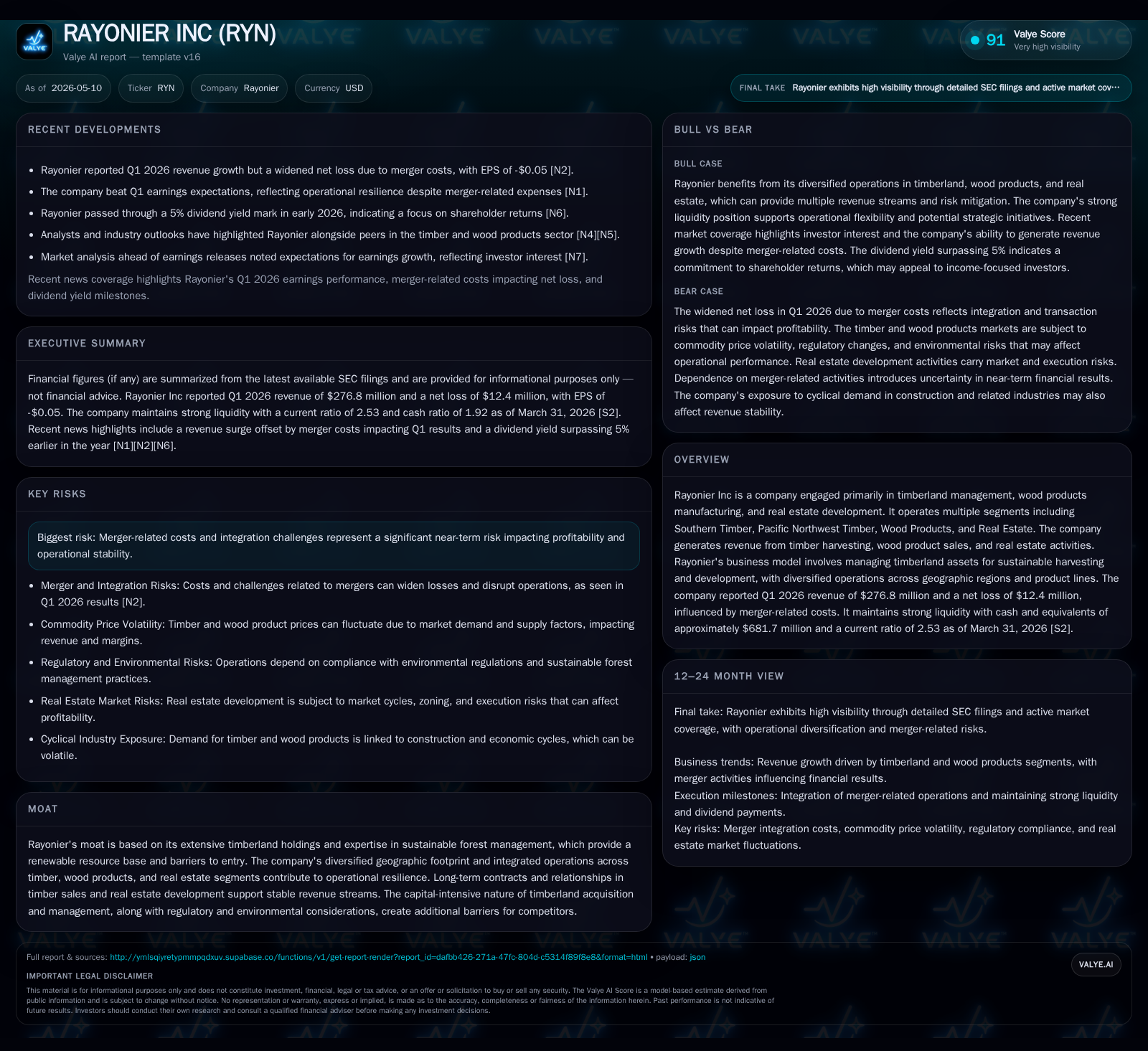
In the first quarter of 2026, Rayonier Inc. reported a significant revenue surge to $276.8 million, driven largely by its expanded timberland portfolio following the PotlatchDeltic merger completed in January. However, this growth was overshadowed by a net loss of $12.5 million, primarily due to elevated acquisition and integration expenses. Rayonier’s business remains anchored in sustainable timber management across diversified U.S. regions combined with real estate development activities. While merger costs present near-term margin pressure, the enlarged asset base and operational coverage suggest structural growth opportunities contingent on synergy realization and market stability.
Q1 2026 Operating Update: Revenue Surge and Merger Cost Dynamics
Rayonier's first-quarter results released on May 8, 2026, underscore a pivotal phase post-merger with PotlatchDeltic Corporation completed just months earlier on January 30, 2026 [S2][S3]. The company's top-line soared dramatically to $276.8 million from $82.9 million in Q1 2025—a direct consequence of consolidating PotlatchDeltic's operations and timber assets into its reporting scope [S2]. However, this volume-driven growth was offset by a net loss of $12.5 million compared to a smaller loss the prior year. The deepening loss owes primarily to merger-related expenses including acquisition costs charged in operating expenses as well as increased stock-based incentive compensation which rose from $2.3 million last year to $15.4 million this quarter [S2].
The substantial jump in cost of sales—from about $65 million previously to $230 million—reflects not only expanded volumes but also higher associated operational costs during integration [S2]. Other operating expense notably increased markedly by over $69 million tied mainly to merger activities impacting reported operating income which swung negative by $45.7 million versus breakeven before [S2]. In spite of these challenges, Rayonier generated positive cash flow from operating activities totaling roughly $34.6 million during the quarter indicating underlying earnings quality beyond accounting losses [S2][N1].
Furthermore, Rayonier's balance sheet remained robust with cash and equivalents at about $681.7 million as of March 31, supporting liquidity during this costly integration period [F1][S2]. The current ratio stands healthy at 2.53 with current assets at approximately $895.7 million dwarfing current liabilities near $354.1 million—a buffer that affords operational flexibility amid the transformative phase [F1].
Rayonier’s Business Model: Timberland Sustainability Meets Diversified Operations
As detailed in its February 23, 2026 annual report filing, Rayonier operates as a leading timberland Real Estate Investment Trust (REIT) primarily focused on owning and managing highly productive softwood timberlands across two major U.S. geographies: the South (1.69M acres) and the Pacific Northwest (307k acres), supplemented by real estate activities including land development for higher-value uses [S1][S8]. Its business model centers on balancing timber harvesting for recurring cash flows against maintaining biological growth for long-term asset value appreciation through sustainable forest management—an approach that underpins resilient, stable earnings profiles inclusive of cyclical volatility.
Revenue streams arise chiefly from stumpage sales (pay-as-cut or lump sum contracts), wood products manufacturing utilizing harvested logs from own lands for lumber and plywood production, and real estate segment transactions involving sale or improved development of non-core lands or portions thereof [S1][S11]. This integrated model allows Rayonier to capture multiple points along the forestry value chain while leveraging expertise in forest biology and land use planning.
Capital intensity is inherent due to land acquisition costs and continual capital expenditures required for silviculture practices to sustain timber growth cycles lasting decades—which simultaneously erect high barriers for new entrants given land scarcity in prime softwood regions as well as environmental permitting complexities [S1][S5]. Rayonier’s REIT status also benefits investors tax-efficiently provided compliance with qualifying income distribution tests is sustained.
Competitive Landscape: Barriers, Moats, and Regional Market Strengths
Rayonier's expansive scale places it among the largest private owners of productive U.S. softwood timberlands—a factor considered a considerable competitive moat given how size permits optimized operational logistics like harvesting rotation scheduling and transportation synergies essential in commodity markets where margins are thin yet volume-sensitive [S1]. The broad footprint covering both Southern U.S., which offers fast-growing pine species suited for pulpwood and structural lumber markets, and the Pacific Northwest with its premium Douglas-fir species provides geographic hedging against region-specific regulatory or weather disruptions.
Entry barriers are compounded by regulatory oversight encompassing environmental sustainability mandates along with forest certification protocols that require consistent stewardship actions—strengthening incumbents' positions who have long-standing expertise navigating these frameworks effectively [S1]. Long-standing customer relationships coupled with mix of lump-sum and pay-as-cut contract modalities partially insulate revenue streams from outright cyclical shocks allowing more predictable harvest scheduling aligned to inventory age-class profiles.
Real estate operations complement timber earnings by monetizing parcels better suited for development rather than timber production—as market conditions dictate—adding optionality but also complexity given zoning approvals and local market variations [S1][S11]. The recent acquisition from PotlatchDeltic adds further scale with combinatorial logistics benefits but raises scrutiny on seamless cultural integration.
Driving Growth: Integration Synergies and Strategic Timber Asset Management
The January merger with PotlatchDeltic marks a transformative milestone expanding Rayonier’s acreage significantly while consolidating milling operations under one umbrella—expected to unlock synergy potential via procurement efficiencies, consolidated overheads, optimized harvest schedules reducing cut-and-haul costs, and enhanced market reach within wood product channels [S3][S5]. The synergy pipeline remains under active development; however, initial quarters reflect elevated costs as full benefits are yet to materialize causing temporary margin compression visible in Q1 losses [N1][S2].
Timber asset management continues hinged on sustaining biologically optimal yields—maximizing compound growth rates of pine plantations balanced against harvest volumes ensuring long-term inventory stability vital for revenue durability [S1]. Timber prices have historically exhibited cyclicality influenced by housing starts variability but longer-term contracting trends via stumpage agreements mitigate volatility exposure partially.
Meanwhile, capital allocation prudently favors reinvestments into core timberland improvements while evaluating opportunistic higher-return avenues such as selective land sales or upgrades to land parcels transitioning toward real estate development—supported by disciplined governance around divestiture timing per economic landscapes [S5]. This flexibility aligns with Rayonier’s stated nimble approach aiming to unlock value without compromising sustainability principles.
Risks and Watchpoints: Merger Integration Challenges and Market Volatility
Near-term risks prominently arise from hefty merger-related costs encompassing transaction fees, advisory expenses, integration redundancy payments (notably reflected in material expense hike during Q1), as well as stock-based incentives tied to new management awards—all weighing on operating profitability despite underlying revenue expansion [N1][S2]. Execution risks remain relevant given cultural assimilation needs across merged entities potentially impacting operational cadence or workforce retention.
Regulatory compliance represents another watchpoint—stringent environmental laws governing logging practices necessitate vigilant adherence lest permitting issues impose delays or fines that could restrict harvest schedules temporarily affecting cash flows [S1][N1]. Moreover, cyclical demand shifts in housing construction significantly influence timber product pricing; although Rayonier partially offsets this via geographic diversification and contract structures binding customers over multi-year periods.
Capital markets volatility or rising interest rates could pressure refinancing options or elevate debt servicing burdens despite currently strong liquidity buffers displayed in Q1 metrics—in turn potentially constraining expansive growth moves if broader macroeconomic shocks emerge unexpectedly.
Upcoming Catalysts: Milestones and Indicators to Track Post-Merger Progress
Key developments worth monitoring include incremental quarterly disclosures elucidating realized synergy savings versus projected targets which will illuminate the pace at which cost rationalization translates into improved margins relative to pre-merger combined baseline levels [S3][N2]. Increased volatility mitigation may be evidenced through stable or narrowing operating losses alongside consistent cash flow generation improvements.
Real estate segment milestones encompassing commencement or completion of notable development projects could materially influence earnings stability given their episodic nature requiring clear visibility into pipeline timing for shareholder assessments [S3]. Additionally, tracking aligned harvest schedules optimized post-merger will yield insights into inventory balance trends highlighting sustainable yield realization underpinning recurrent income streams.
Management commentary during upcoming earnings calls about capital deployment priorities —whether toward selective acquisitions augmenting high-growth acreage zones or accelerated deleveraging strategies—will provide signals on strategic trajectory adapting post-merger market dynamics.
Financial Snapshot: Key Metrics from Latest Quarter Filing
Latest financial snapshot
| Metric | Value | Period |
|---|---|---|
| Cash & equivalents | $682mm | |
| 2026-03-31 | ||
| Current assets | $896mm | |
| 2026-03-31 | ||
| Current liabilities | $354mm | |
| 2026-03-31 | ||
| Current ratio | 2.53x | |
| 2026-03-31 |
Source: SEC companyfacts cache [F1].
These metrics reflect Rayonier’s strong liquidity position critical during capital-intensive integration phases while highlighting earnings impacted by non-recurring merger expenses accompanying important strategic expansion steps [F1][S2]. Ongoing focus will be on translating asset scale into operational margin gains consistent with long-term business model sustainability.
This analysis is grounded exclusively on official SEC filings and public news reports dated through early May 2026 without investment recommendations or price forecasts.
Disclaimer: This is research-only, informational analysis and not investment advice. It may include AI-generated interpretation and general industry context. Always verify important details using primary sources.

Comments