
Freeport-McMoRan Faces Grasberg Recovery and Regulatory Scrutiny While Leveraging Scale for Growth
Q1 2026 highlights production ramp-up after 2025 Grasberg mud rush amid ongoing legal and geopolitical risks.
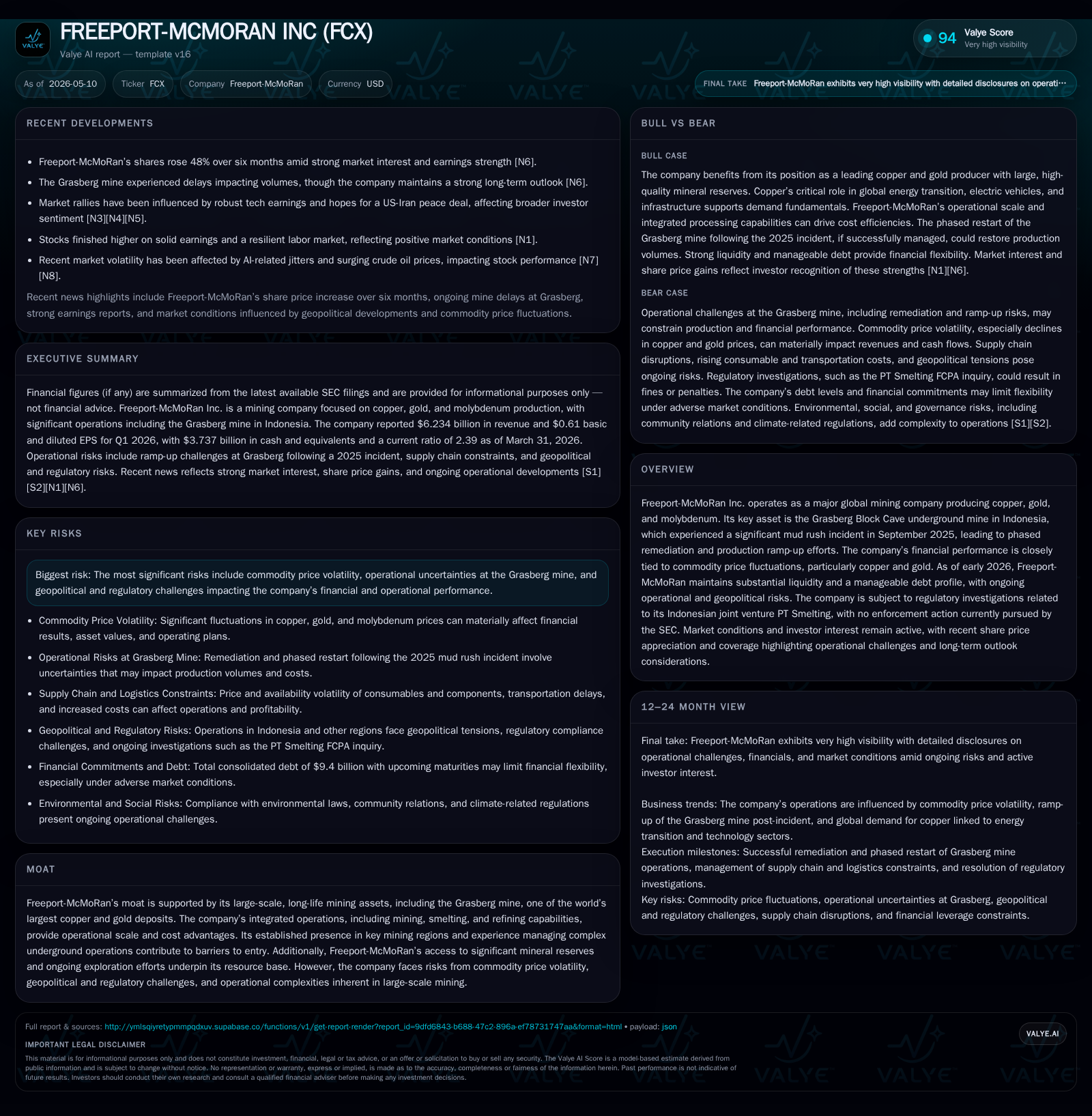
Freeport-McMoRan's latest quarterly filings reveal a cautious operational recovery from the September 2025 mud rush at its critical Grasberg underground mine, with phased remediation progressing and production gradually restoring. The company maintains robust liquidity and manageable leverage, while contending with regulatory investigations connected to its Indonesian joint venture PT Smelting. Its business model benefits from large-scale, integrated copper, gold, and molybdenum operations with durable competitive moats anchored in resource size and vertical integration. However, commodity price volatility, operational complexity, geopolitical uncertainty, and evolving environmental and legal risks constrain visibility and growth execution in the near term.
Recent Operating Update
The first quarter of 2026 marked a significant phase for Freeport-McMoRan (FCX) as it pursued remediation activities and a phased restart of the Grasberg Block Cave underground mine in Indonesia following the severe mud rush incident that occurred in September 2025 at the site operated by its subsidiary PT Freeport Indonesia (PTFI) [S2]. This incident dramatically disrupted PTFI’s production profile—one of Freeport’s cornerstone assets—and prompted a reassessment of operating plans including production ramp-up schedules.
In Q1 2026, the company disclosed incremental progress in restoring operations with a conservative staged approach to ensure safety and operational stability. While no exact volumes or timelines were specified beyond this staged restart, management highlighted this as pivotal to near-term operational continuity [S2]. Concurrently, Freeport continues navigating an ongoing investigation pertaining to activities under PT Smelting—a joint venture involving PTFI and Mitsubishi Materials Corporation (MMC). The company voluntarily notified the SEC and U.S. Department of Justice regarding potential Foreign Corrupt Practices Act (FCPA) violations related to PT Smelting's conduct; however, as of March 17, 2026, the SEC indicated no intention to pursue enforcement action [S4]. This investigation embodies a key regulatory overhang that bears watching.
The company issued pre-announcement press releases on April 23 confirmed Q1 results reporting consistent financial performance despite operational headwinds [S3][S7]. Liquidity metrics remain solid with $3.7 billion cash balances at quarter-end against current liabilities approximating $5.9 billion resulting in a sound current ratio of approximately 2.39 [F1]. However, net debt remains elevated at an estimated $15.2 billion based on the balance sheet snapshot [F1], reflecting capital-intensive growth projects plus legacy financing structures.
Business Model
Freeport-McMoRan operates as a vertically integrated global mining enterprise primarily focused on copper but also producing gold and molybdenum as key products [S1]. Revenue generation flows from selling mined concentrates and refined metals predominantly through long-term contracts supplemented by spot market sales. The concentration on copper aligns it closely to global industrial metal demand cycles tied to construction, electronics manufacturing, electric vehicle penetration, renewable energy infrastructure deployment, and broader urbanization trends.
Revenue mechanics are driven by volume mined/extracted (subject to ore grades and plant throughput), commodity price realizations adjusted for off-take terms (contract versus spot), cost management around consumables like diesel, explosives, reagents such as sulfuric acid used in leaching processes, freight logistics for concentrate shipping, and metallurgical recovery rates within proprietary smelting/refining facilities. Margins are highly sensitive to copper prices but are also affected by operational efficiencies spanning underground mining complexity—particularly at Grasberg’s block cave operation —and broader macro supply-chain inflation impacting consumables pricing [S24].
Customers primarily include global metal traders, industrial consumers such as electronics firms or automakers seeking refined copper inputs, commodity exchanges intermediating derivatives exposure, and regional governments benefiting from tax take. Freeport’s integrated downstream assets including smelting operations enable capture of additional value beyond concentrate sales conferring competitive cost advantages while helping mitigate concentrate market volatility.
Switching costs for customers are moderate but the company's ability to provide stable volumes over time backed by their long-life mineral reserves supports durable relationships. Pricing power is tethered to prevailing market prices rather than being contractually fixed long term due to commodities nature.
Industry Structure & Competitive Position
The copper mining industry is oligopolistic with substantial barriers to entry including the need for large-scale capital investment upfront, extensive permitting hurdles often complicated by geopolitical issues especially pertinent in developing nations such as Indonesia where FCX has significant exposure [S14][S18]. Freeport-McMoRan holds one of the world’s largest copper-gold deposits—Grasberg—providing strategic scale unmatched except by a handful of other major miners globally (e.g., Codelco-Chile, BHP-Billiton).
The structural moat is underpinned by:
- The sheer size of mineral reserves granting decades-long mine life.
- Vertical integration through smelting/refining assets reducing dependency on third-party processors.
- Geopolitical tenure established via special mining business license (IUPK) potentially extendable beyond original expiration in 2041 subject to government agreements [S9][S10].
- Operational expertise managing complex underground block cave mining technology providing cost control benefits compared to conventional methods.
However, this competitive position is not without vulnerabilities: ongoing regulatory scrutiny both domestically in the U.S. (SEC investigations over disclosure accuracy) and internationally (licensing/remediation compliance in Indonesia); market price cyclicality exposing Freeport’s cash flows; supply disruptions linked to safety incidents like the recent mud rush; labor relations challenges; environmental obligations; plus reputational risks related to community engagement all pose tangible headwinds [S13][S19][S20].
Growth Drivers
Key growth vectors include:
- Grasberg Production Ramp-Up: Smoothly returning to pre-incident output levels post-mud rush will restore one of FCX’s largest volume contributors bolstering top-line growth.
- Life-of-Mine Extension: Securing definitive long-term extension agreements for mining rights beyond current permits allows capital allocation confidence toward greenfield expansions or brownfield improvements at Grasberg mineral district [S10].
- Commodity Demand Environmental Tailwinds: Increasing electrification globally fuels copper demand structurally due to richer wiring requirements per unit consumed (e.g., EV batteries contain several times more copper than traditional vehicles) along with investments driven by renewables—solar/wind projects requiring extensive copper wiring infrastructure.
- Exploration & Project Development: Continued exploration success enhancing resource base provides optionality for incremental feedstock supply sustaining operational longevity.
- Operational Improvements & Cost Control: Efficiency initiatives leveraging technology innovations targeting reduced unit costs amid inflationary pressures improve margins when commodity prices allow.
Risks / Watchpoints / Growth Constraints
Several constraints linger that could limit growth or exacerbate risk exposure:
- Geopolitical & Regulatory Risks: Uncertainty around Indonesian regulatory environment including environmental permitting timelines adds execution risk; anti-corruption probes into PT Smelting may surface latent liabilities or fines despite no current SEC enforcement action [S4].
- Operational Incidents & Mining Complexity: Large-scale block cave operations have inherent hazards as evidenced by prior mud rush disrupting steady-state output; future incidents could trigger costly delays or impair volumes.
- Commodity Price Volatility: Copper prices notoriously volatile influenced by macroeconomic trends including China demand shifts; sustained downtrends could necessitate scaled-back capex or force asset impairments restricting expansion ability.
- Environmental & Reclamation Obligations: Rising costs related to mine closure bonds or remediation requirements could pressure free cash flow; evolving governmental expectations raise compliance burdens [S11][S25].
- Supply Chain Constraints: Inflationary pressures on consumables such as diesel fuel or ammonium nitrate coupled with logistical disruptions can inflate operating costs above budgeted levels affecting margin resilience.
- Legal Proceedings: Multiple ongoing lawsuits relating to environmental claims or securities class actions stemming from previous incidents may create contingent liabilities affecting financials [S26][S29].
What To Watch Next
Investors should focus on several forthcoming developments:
- Communication from management regarding progress milestones on Grasberg ramp-up detailing throughput recovery timelines and safety performance metrics.
- Updates concerning the Indonesian government’s stance on mining license renewal validity under IUPK regime beyond 2041 which could materially impact reserve life assumptions.
- Final outcomes or settlements associated with FCPA investigation into PT Smelting and other outstanding litigation potentially yielding financial penalties or operational restrictions.
- Commodity price trajectory given global economic signals especially developments in EV markets and Chinese infrastructure spending regimes influencing copper demand.
- Quarterly earnings calls providing revised guidance reflecting actual operating metrics post-grasberg incident recovery phase adjustment.
Financial Profile Overview
Latest financial snapshot
| Metric | Value | Period |
|---|---|---|
| Cash & equivalents | $3.7bn | |
| 2026-03-31 | ||
| Current assets | $14.1bn | |
| 2026-03-31 | ||
| Current liabilities | $5.9bn | |
| 2026-03-31 | ||
| Current ratio | 2.39x | |
| 2026-03-31 |
Source: SEC companyfacts cache [F1].
Freeport's cash position remained robust at $3.7 billion as of March 31, 2026 while total debt stood near $18.98 billion with net debt around $15.25 billion reflecting considerable leverage but manageable within its BBB rating category framework [F1].[S11][S15]
The current ratio reported at approximately 2.39 favors short-term liquidity comfort mitigating risks related to immediate obligations financing amidst fluctuating revenues dependent on commodity prices. Operating income in recent periods has been healthy but adjustments linked to Grasberg disruption have introduced margin pressure requiring close monitoring moving forward [F1].
Capital expenditures related primarily to mine remediation work alongside sustaining investments will continue drawing down free cash flow until full production restoration occurs thereby influencing near-term free cash generation capabilities.
This analysis synthesizes publicly filed information through May 8th, 2026 filings covering operational updates post-Grasberg mud rush incident alongside known regulatory proceedings impacting Freeport-McMoRan Inc., contextualizing industry positioning within a volatile commodity environment without providing investment advice.
Disclaimer: This is research-only, informational analysis and not investment advice. It may include AI-generated interpretation and general industry context. Always verify important details using primary sources.

Comments