
Brookfield Asset Management’s Incremental Fee-Bearing Capital Growth Strengthens Multi-Sector Footprint
Brookfield Asset Management posted a 2% increase in fee-bearing capital in Q1 2026, driven by fundraising across key asset classes, supporting durable recurring revenues and reinforcing its global diversified platform.
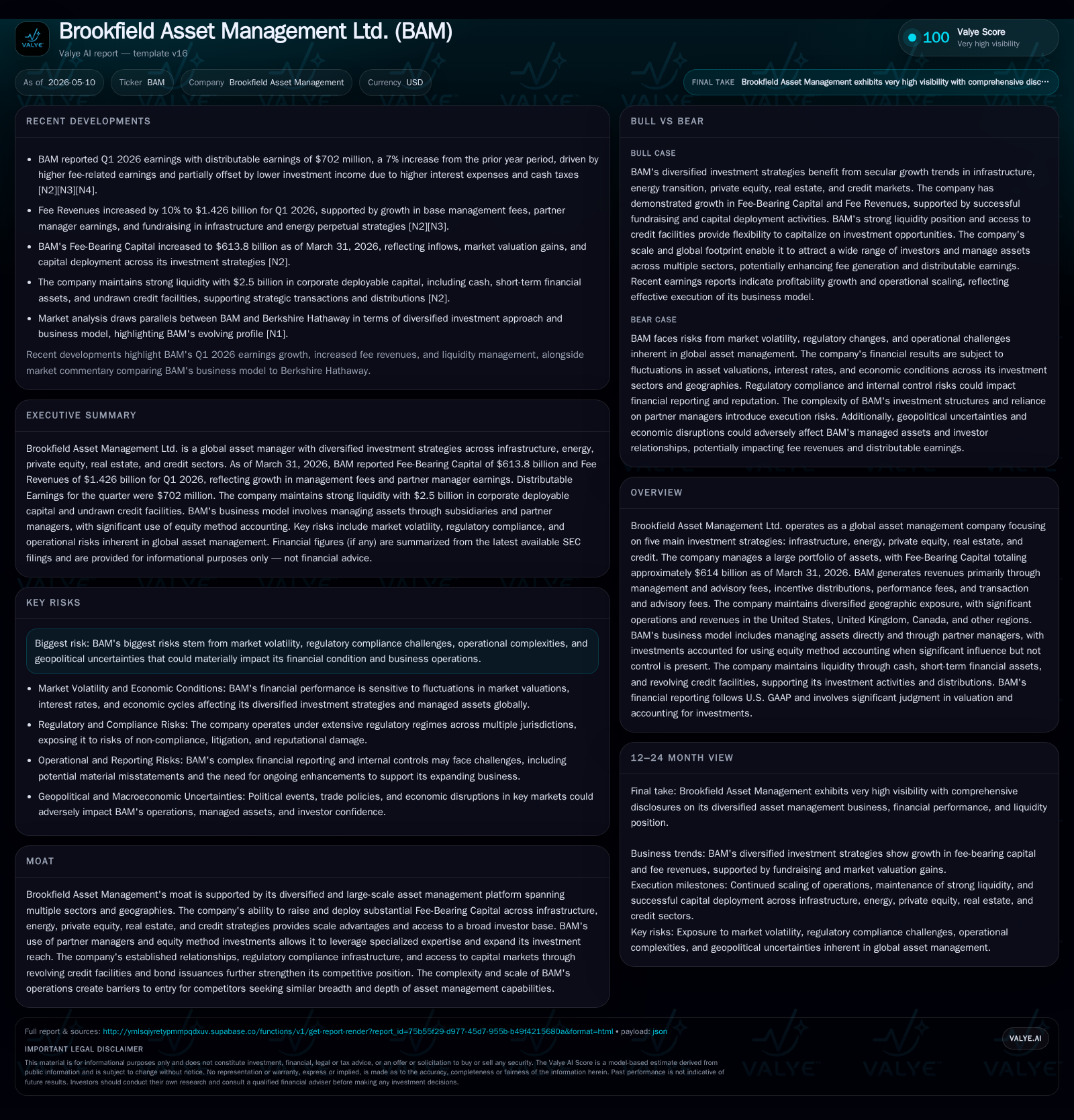
In Q1 2026, Brookfield Asset Management advanced its fee-bearing capital to approximately $614 billion, boosted by $19.1 billion of inflows across infrastructure, energy, private equity, real estate, and credit. This incremental growth underscores persistent investor appetite for its diversified strategies and reinforces the company's competitive scale in alternative asset management. The latest quarterly filing highlights strong fee revenue expansion alongside steady liquidity and manageable leverage, positioning BAM for ongoing capital deployment and fee income growth amid evolving market dynamics.
Q1 2026 Operating Update: Fee-Bearing Capital Insights
Brookfield Asset Management (BAM) reported a net increase in Fee-Bearing Capital of approximately $11.1 billion (+2%) during the first quarter of 2026, bringing total fee-bearing capital under management to about $613.8 billion as of March 31, 2026 [S2]. This increment was driven by gross inflows of nearly $19.1 billion across BAM's diversified investment strategies compared with outflows totaling $6.4 billion and distributions approximating $6.5 billion.
Breaking down inflows by sector reveals that the credit segment contributed the largest share with $11.4 billion — fueled largely by insurance capital from Brookfield’s insurance platform (BWS), alongside fundraising efforts across liquid strategies, private funds, and partner managers [S2]. Infrastructure attracted about $3.8 billion in inflows dominated by co-investment fundraising activities and contributions into BAM's perpetual strategies.
Energy and real estate also posted meaningful inflows of $2.1 billion and $1.4 billion respectively; energy inflows were notably supported by debt issuances from Brookfield Energy Partners (BEP) along with fundraising into long-term private funds [S2]. Despite some market rotations leading to real estate debt repayments within permanent vehicles causing outflows, new capital deployments helped mitigate net declines.
Market valuations added roughly $4.2 billion to fee-bearing capital during the quarter due mostly to the appreciation in BEP equity prices (+$2.9B) and rising valuations across liquid credit strategies [S2]. These valuation uplifts partly offset lower fair values seen in certain listed affiliates such as Brookfield Infrastructure Partners (BIP).
Overall changes reflect both cyclical portfolio realignments common in large-scale asset managers as well as structural growth supported by sustained investor demand for alternatives exposure.
Brookfield's Asset Management Model: Diverse Revenue Streams and Strategic Deployment
BAM operates an integrated global asset management platform centered around five core strategies: infrastructure, energy, private equity, real estate, and credit [S1]. It generates revenues primarily through multiple complementary channels — including management/advisory fees on committed/ invested capital; incentive distributions; performance fees notably from listed entities such as BBU; transaction and advisory fees; plus carried interest allocations.
The company's business model benefits from a mixture of directly managed consolidated assets where BAM retains control and equity-method investments via partner managers where it exerts significant influence without direct control [S1][S2]. This hybrid approach extends strategic reach while leveraging specialized sector expertise embedded within partner organizations.
Fee revenues totaled $1.426 billion for the quarter ended March 31, up 10% from the prior year period [S21]. The uplift was predominantly driven by infrastructure (+16%), energy (+26%), private equity (+18%), and credit (+17%) — illustrating strong underlying volume/mix expansion — albeit somewhat tempered by an 18% decrease in real estate fees following asset sales activity [S21].[F1]
Perpetual affiliates also play a critical role providing stable recurring fee income including incentive distributions which grew alongside higher dividends from listed affiliates like BEP [S1],[S21]. Fee-related earnings benefit from operational leverage but face pressure from scaling costs tied to employee compensation and technology investments needed to support expanded platform complexities [S11].
This multi-source revenue base combined with fee-bearing capital breadth facilitates durability in cash flow generation even with periodic shifts in asset allocations or market cycles.
Competitive Moat Analysis in Global Asset Management
At over $610 billion in Fee-Bearing Capital, BAM stands among the largest global alternative asset managers offering broad diversification across sectors like infrastructure—which often require localized knowledge and long-term commitments—and credit—where distribution networks matter greatly [S1],[S2].
The company's moat is reinforced by scale advantages that allow more efficient fundraising access worldwide coupled with an extensive regulatory compliance framework suitable for multi-jurisdiction operations [S1]. BAM's ability to collaborate with partner managers expands investment reach while maintaining control over performance standards without diluting focus on core asset verticals.
Switching costs are elevated given BAM’s integrated stewardship capabilities spanning physical assets ownership alongside fund management structures which collectively foster stickiness among institutional clients seeking comprehensive investment solutions rather than point exposures.
Operational complexity might pose an entry barrier for smaller competitors aiming to replicate this ecosystem quickly without incurring prohibitive costs or regulatory risk exposure.
Drivers of Growth: Fundraising, Capital Deployment, and Segment Expansion
Q1 trends reinforce robust fundraising momentum with notable commitment growth especially within credit products that address insurance-linked capital needs as well as traditional fixed income alternatives led by BWS [S2]. Infrastructure continues to benefit from strategic co-investment vehicles drawing institutional interest amid accelerating infrastructure demand globally.[N2]
Energy segment benefits not only from equity injections but also from expanded debt financings supporting renewable transitions embedded within BEP’s balance sheet structure—a factor enhancing overall fee-base scalability beyond direct equity commitments [S2],[N5].
Private equity inflows remain steady reflecting continued investor embrace of diversified buyout strategies spread geographically. Real estate funneling exhibits opportunistic deployment primarily through flagship funds underscored by active portfolio recycling enhancing return profiles.[N5]
Underlying all sectors is structural demand for yield-enhanced alternatives driven by macro economic uncertainties including low interest environments prompting institutional shifts toward real assets allocation.
Risk Factors and Operational Constraints
Despite strengths, BAM faces inherent risks that merit vigilance. Market volatility can impair asset valuations impacting incentive/performance fees leading to periodic earnings fluctuations [S1],[N9]. Regulatory complexities multiply as BAM integrates new acquisitions requiring sophisticated internal controls; any deficiencies could damage reputation or induce financial restatements impacting investor confidence.
Geopolitical tensions disproportionately affect energy/infrastructure verticals where political risk or regulatory changes may alter project economics or delay development timelines [S1]. Operationally scaling governance frameworks across partner managers increases managerial burden with lag risks on timely compliance enforcement potentially leading to penalties or lost licenses.
Liquidity management amidst growing debt issuance requires close monitoring given maturities concentrated into mid-to-long term horizons; disruptions could constrain capital deployment flexibility limiting BAM’s agility to capitalize on market opportunities [S5],[S14].
Milestones to Watch: Guidance and Key KPIs Ahead
Market participants should closely track quarterly Fee Revenues trends segmented by product line for early signals on fund raising success or waning investor enthusiasm impacting distributable earnings sustainability [N1],[S21]. New fund launches or expansions of existing funds partnering with specialist managers will indicate capacity build-out readiness complementing BAM’s internal talent pool.
Maintaining balanced net inflow/outflow ratios at the fund level is crucial as redemption spikes might pressure liquidity buffers despite corporate cash availability standing near $1.2 billion at quarter-end complemented by undrawn credit facilities totaling about $1.35 billion [F1],[S5].
Monitoring announced capital deployments vs uncalled commitments conversion pace will provide forward visibility on future Fee-Bearing Capital growth potential that translates directly into management fee accruals.[S24]
Latest Financial Snapshot
Latest financial snapshot
| Metric | Value | Period |
|---|---|---|
| Cash & equivalents | $1045mm | |
| 2026-03-31 | ||
| Total debt | $3.0bn | |
| 2026-03-31 | ||
| Net debt | $1906mm | |
| 2026-03-31 |
Source: SEC companyfacts cache [F1].
| Metric | Value (USD billions) | Date |
|---|---|---|
| Cash & equivalents | 1.045 | |
| 2026-03-31 | ||
| Total debt | 2.951 | |
| 2026-03-31 | ||
| Net debt | 1.906 | |
| 2026-03-31 |
As of March 31, 2026, Brookfield maintains substantial liquidity with over $1 billion in cash plus an additional ~$1.35 billion undrawn revolver capacity supplementing financial flexibility for opportunistic investments or liability servicing [F1],[S5]. Total debt stands near $3 billion translating into a manageable net leverage profile considering large-scale distributed cash flows generated across its diverse holdings.
This analysis is based strictly on publicly available SEC filings as of May 2026 combined with recent disclosed company communications without any speculative projections or investment advice.
Disclaimer: This is research-only, informational analysis and not investment advice. It may include AI-generated interpretation and general industry context. Always verify important details using primary sources.

Comments