
How abrdn Gold ETF Trust Balances Cost and Counterparty Risk in 2026
The latest quarterly filing confirms SGOL's operational stability and highlights its structural advantages as a physically-backed gold ETF.
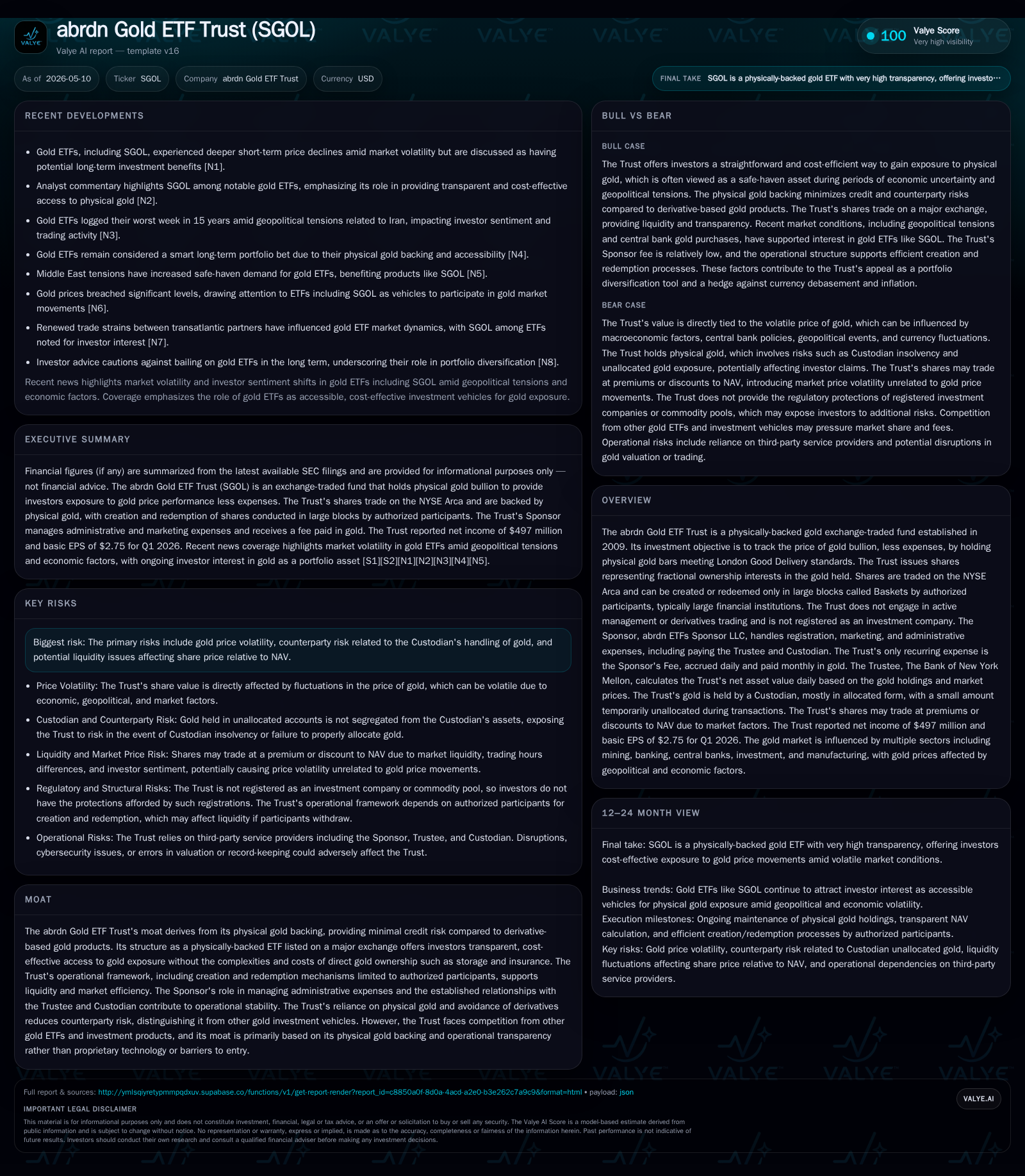
In its May 2026 quarterly report, abrdn Gold ETF Trust (SGOL) reaffirmed its business continuity without material risk changes, underscoring a stable framework centered on physical gold holdings. The Trust’s business model offers investors transparent, cost-effective exposure to gold via fractional ownership in London Good Delivery bars, avoiding derivatives and active management. Competition in the physical gold ETF space remains robust, but SGOL’s minimal credit risk profile and efficient creation/redemption process maintain its relevance. Growth is driven by structural investor demand for precious metals as a hedge amid macroeconomic uncertainty, while risks mainly stem from gold price volatility and liquidity factors tied to Authorized Participants’ market roles.
Latest Quarterly Operating Snapshot
The abrdn Gold ETF Trust’s most recent quarterly report filed on May 8, 2026, reconfirms business continuity with no material changes to previously disclosed risk factors or operational practices [S2][S3]. This stability is critical given the nature of SGOL as a passive investment vehicle strictly tracking physical gold ownership. The filing underscores consistent reliance on the established creation/redemption process managed by Authorized Participants—financial institutions that transact only in large share blocks called Baskets (each comprising 100,000 shares). No new contingencies or regulatory risks have emerged this quarter, maintaining investor confidence in SGOL’s transparent structure.
Understanding SGOL’s Business Model: Physical Gold Ownership Simplified
SGOL offers investors an accessible method to gain exposure to physical gold bullion without engaging in direct storage or insurance logistics. Each Share represents a fractional undivided beneficial interest in the Trust’s holdings of physical gold bars that satisfy London Bullion Market Association (LBMA) Good Delivery standards [S1][S8]. These high-quality bars are securely held by custodian institutions such as The Bank of New York Mellon.
Unlike actively managed funds or derivative instruments, SGOL holds solely physical metal and does not use futures, options, or swaps. This approach minimizes counterparty credit risks inherent in synthetic gold products. Creation of new shares occurs when Authorized Participants transfer physical gold to the Trust in exchange for Baskets; conversely, redemptions involve delivery of equivalent physical gold against redeemed Baskets [S1][S26]. By keeping issuance and redemption limited to large blocks via authorized participants rather than retail investors individually, SGOL manages liquidity efficiently.
Operationally, the Trust has no employees or active management—it solely delivers returns mirroring the price movements of gold bullion less expenses primarily represented by the Sponsor's Fee. Importantly, this fee is accrued daily and paid monthly in kind (gold), which preserves a lean expense profile favorable to investors compared with direct ownership costs involving storage and insurance overheads [S1][S23].
Competitive Environment and Industry Positioning of Gold ETFs
In the broader landscape of gold investment vehicles, SGOL sits firmly within the physically-backed ETF cohort competing against both synthetic ETFs and direct bullion purchases. The key moat comes from its tangible backing by allocated gold bars held under stringent custody protocols. Unlike derivative-based funds exposed to counterparty default risks—especially during times of market stress—SGOL's asset composition limits such vulnerabilities [S8].
Authorized Participants bolster secondary market liquidity by engaging in seamless creation/redemption activities that realign prices close to net asset value (NAV). However, trading spreads and premiums/discounts can widen during off-hours due to time-zone mismatches among global exchanges [S20]. Regulatory distinctions further differentiate SGOL: it is not registered under the Investment Company Act of 1940 nor regulated as a commodity pool under the Commodity Exchange Act (CEA), meaning it lacks protections typical for mutual funds but simplifies compliance costs [S7][S12].
While numerous competitors exist—some offering lower fees or different custody arrangements—SGOL leverages abrdn’s established operational platform and reputation for fiduciary stability. Its focus on minimal derivative usage appeals to risk-averse clients seeking straightforward exposure aligned closely with bullion prices [S8].
Growth Drivers: Demand Trends and Structural Advantages
Macro environment trends underpinning demand for physically-backed ETFs like SGOL are rooted in continued investor appetite for safe-haven assets amid inflation concerns, currency volatility, and geopolitical tensions. Institutional players have been progressively incorporating precious metals into diversified portfolios to hedge real interest rates and systemic financial risks [S1][S16].
Additionally, trading convenience supported by SGOL’s NYSE Arca listing enhances accessibility across retail and institutional channels alike. Compared with direct bullion ownership—which entails complex logistics—SGOL provides a liquid proxy with daily valuation transparency updated post-market close based on LBMA Gold Price benchmarks [S8][S21].
Market data show fluctuating but generally growing inflows into exchange-traded products backed by physical metals over recent years driven by these structural forces [S24]. The ability to transact through standard brokerage accounts lowers behavioral frictions enhancing adoption among cost-conscious investors.
Risks and Constraints: Price Volatility and Liquidity Considerations
Despite structural strengths, investment risks persist principally associated with the underlying asset—gold—which exhibits notable price volatility driven by supply-demand imbalances, speculative activity, interest rate differentials, currency shifts, and geopolitical events [S12][S19]. Movements in spot gold directly translate into proportional fluctuations in Share value since SGOL passively tracks bullion prices less expenses.
Liquidity risk arises if major Authorized Participants reduce their market engagement or withdraw participation. Such scenarios could adversely impact trading volumes causing wider bid-ask spreads or share prices deviating from NAV, introducing potential short-term mispricing or "short squeezes" if Shares are hard to redeem promptly [S12]. This dynamic places emphasis on monitoring participant activity continuously.
Counterparty risk also resides with custodian arrangements for physical metal storage; although mitigated by segregation practices and rigorous LBMA Good Delivery standards compliance—including responsible sourcing verification—the possibility of insolvency or operational failure cannot be entirely excluded [S28]. Furthermore, regulatory status exempting SGOL from some investor protections under federal securities laws means shareholders do not enjoy features like voting rights or dividend distributions typical of corporate securities [S9][S17].
Key Milestones and Market Indicators to Monitor Next
Future scrutiny should focus on upcoming quarterly results reporting any fluctuations in creation/redemption volumes signaling investor demand shifts [S2]. Changes in Sponsor fee policies impacting operating expenses could affect net returns especially if scaled materially over time [S23]. Macroeconomic indicators such as central bank monetary policy decisions, inflation data releases, currency valuations like USD strength/weakness trajectories will continue shaping the path of underlying gold prices thus influencing SGOL performance indirectly.
Moreover, regulatory developments affecting custodial standards or trading rules for exchange-traded products may alter competitive positioning or operational complexity over time. Lastly, any changes affecting Authorized Participants’ willingness or ability to facilitate efficient creation/redemption flows merit close attention as liquidity anchors.
Financial Commentary (Supporting Context)
The Trust notably does not carry debt nor maintain cash balances beyond minimal amounts for expense payments; thus conventional leverage measures are not applicable [F1]. Net income figures are largely non-representative given the Pass-Through nature of asset gains/losses attributed directly to Shareholders rather than retained earnings. Expense management centers on controlling Sponsor fees which are paid monthly in-kind using Trust-held gold rather than cash outlays contributing to a lean operating profile supporting cost-effective benchmarking against competing instruments.
Disclaimer: This analysis is based solely on publicly available filings up to May 2026 without investment recommendations. All numeric metrics are sourced explicitly from SEC disclosures referenced.
Disclaimer: This is research-only, informational analysis and not investment advice. It may include AI-generated interpretation and general industry context. Always verify important details using primary sources.

Comments