
Janel Corporation’s Latest Results Highlight Logistics and Acquisition Hurdles
The latest quarterly filing underlines liquidity pressures and integration challenges within Janel's multi-segment portfolio, tempering growth aspirations.
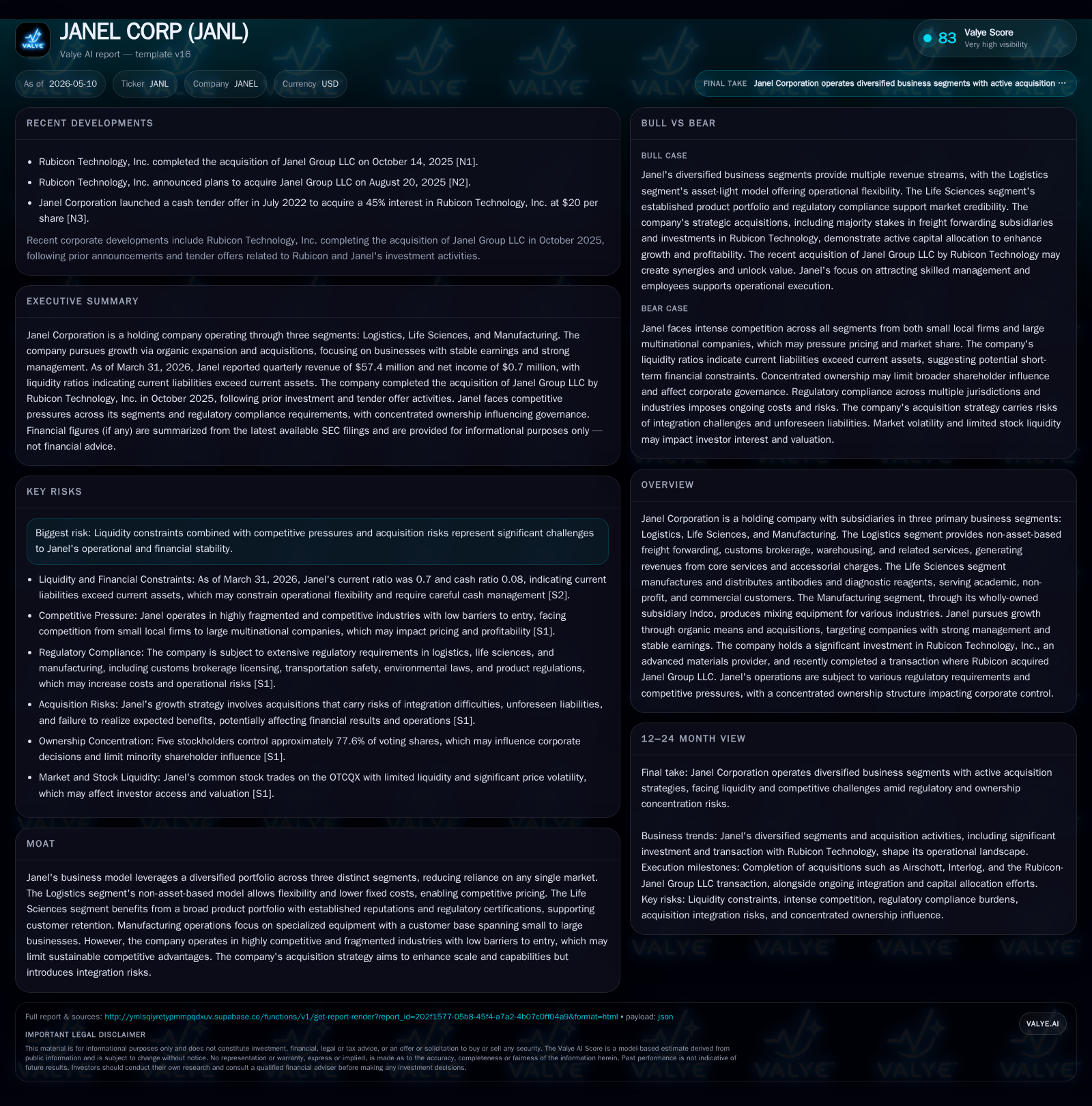
Janel Corporation’s May 2026 10-Q report reveals steady operational performance across its Logistics, Life Sciences, and Manufacturing segments but underscores persistent liquidity constraints signaled by a weak current ratio. The company’s non-asset-based logistics model provides competitive pricing flexibility, while its acquisition-driven growth strategy faces integration risks and capital allocation hurdles amid a fragmented competitive landscape. Key near-term focus includes working capital management and successful execution of recent acquisitions to stabilize financial metrics and advance organic growth initiatives.
Key Takeaways from the Latest Quarterly Results
Janel Corporation’s most recent quarterly filing dated May 8, 2026 ([S2]) confirms continuity in disclosed risk factors from the prior annual report ([S1]). There were no material revisions or surprises identified in this update. However, working capital metrics warrant attention: the company reported a current ratio of approximately 0.7 ([F1]), indicating liabilities exceeding current assets—a structural liquidity strain despite low absolute indebtedness. Cash & equivalents stood at $8.78 million alongside a minimal total debt of $100,000 ([F1]). This disproportion signals potential pressures in meeting short-term obligations and underlines management’s ongoing emphasis on acquisition discipline and cash flow optimization.
Segment reporting remains stable with no explicit changes in revenue recognition or concentration patterns disclosed. The persistence of these conditions suggests constrained financial flexibility that could impinge on capital deployment priorities over the near term.
Business Model Overview: Segment Diversification and Revenue Streams
Janel operates through three distinct business divisions—Logistics, Life Sciences, and Manufacturing—each contributing complementary yet discrete revenue streams as outlined in the 2025 annual filing ([S1], [S7], [S8]).
Logistics: This segment functions primarily as a non-asset-based freight forwarder with subsidiaries offering freight forwarding (air, ocean, ground), customs brokerage, warehousing, cargo insurance procurement, logistics planning, repackaging, and tracking services. Revenues are derived both from core service fees like customs entry filing and brokerage margins and from accessorial charges including fuel surcharges, labor fees, hazardous cargo handling fees among others ([S1], [S27]). The asset-light nature results in lower fixed costs enabling competitive pricing agility.
Life Sciences: Dedicated to manufacturing antibodies and diagnostic reagents distributed to academic institutions, nonprofits, and commercial labs ([S7]). This segment benefits from regulatory certifications supporting product quality standards which underpin customer loyalty. However, it competes in markets marked by consolidation trends that concentrate purchasing decisions ([S7], [S25]). Product innovation is critical to maintaining relevance amid heightened competition.
Manufacturing: Executed through wholly owned Indco subsidiary focusing on specialized mixing equipment catering predominantly to small- and mid-sized enterprises plus larger customers with recurring orders ([S8], [S18]). The business faces raw material sourcing uncertainties including motors, steel components which can impact production timing and cost base ([S7], [S24]).
Management at the holding-company level prioritizes capital allocation toward units with stable returns while supporting organic growth initiatives supplemented by acquisitions.
Competitive Dynamics and Industry Positioning
Across all segments, Janel contends in highly fragmented markets characterized by low barriers to entry:
Logistics: The freight forwarding industry hosts myriad competitors spanning small “mom-and-pop” operators to global multinationals. Low capital requirements foster continual emergence of new entrants which pressure pricing; however, Janel’s non-asset-based approach grants flexibility not available to asset-heavy players ([S1], [S27]). Customer multiplicity reduces dependence but market sensitivity to freight volumes poses cyclical risks.
Life Sciences: Competition is intense with large-pharma consolidated purchasing increasingly limiting account counts. Maintaining product quality certifications helps fend off substitutes; yet pricing power depends on continuous product innovation which remains essential for market share retention ([S7], analysis).
Manufacturing: Indco’s industry sector encounters competition from vendors leveraging online marketing channels aggressively. Supply chain fragility around raw materials sourced internationally adds unpredictability. The single Indiana manufacturing site introduces operational concentration risk exacerbating potential disruption consequences ([S13], [S24]).
Janel occupies a modest scale relative to dominant players hindering concessions on contracts but balances this via decentralized offices responsible for localized growth enabling nimble tactical responses.
Growth Drivers: Organic Expansion Versus Acquisition Strategy
Janel's growth blueprint combines organic development within existing subsidiaries coupled with targeted acquisitions that complement its portfolio profile ([S1]). The acquisition strategy seeks companies with "strong management teams," predictable earnings streams, and reasonably priced valuation disciplines.
A concrete expression of this approach was the majority ownership acquired in June 2024 over Airschott—a non-asset-based freight forwarder expanding logistics capabilities ([S1], ). Organic growth initiatives emphasize product portfolio enhancements especially within Life Sciences where research budgets influence demand trajectories.
However, Janel confronts challenges identifying attractive targets amid competitive bidding pressures from larger entities with superior financial firepower ([S1]). Integration efforts consume managerial bandwidth potentially diluting focus on core operations during transition phases.
Risks and Constraints: Liquidity, Integration, and Competitive Factors
Liquidity risks loom prominently:
- A current ratio below 1 signals working capital deficits implying reliance on credit lines or capital raises that carry execution risk ([F1], [S3], [S6]).
- Despite low nominal debt levels (~$100k), operational cash flow volatility tied to highly variable expenses—particularly within Logistics—and receivable collections impacted by trade tariffs constrain borrowing capacity ([S3], [S26]).
Acquisition-related challenges include assimilation difficulties spanning culture alignment, systems integration complexities (notably disparate IT platforms), employee retention risks post-acquisition all affecting synergy realization timelines ([S1]).
Product liability exposures exist notably in Life Sciences and Manufacturing where defects or safety issues could generate claims exceeding insurance coverage limits threatening liquidity cushions ([S5], [S14], [S16]). Raw material price volatility adds margin pressure especially for Indco where contractual protections may be limited or delayed ([S7], [S24]).
Competitive intensity across fragmented sectors requires sustained investment in technology upgrades and client engagement to maintain position notwithstanding size disadvantages vis-à-vis larger competitors (9[S25]9).
Monitoring Points: Upcoming Guidance and Operational Milestones
Key forward-looking indicators include:
- Quarterly updates on improvements or deterioration of working capital ratios signaling progress or worsening liquidity constraints.
- Metrics related to Airschott’s operational integration such as revenue contribution growth rates or margin expansion evidencing accretive acquisition impact.
- Profitability trends segmented by division reflecting whether organic investments in innovation particularly in Life Sciences translate into enhanced sales.
- Customer retention statistics plus any shifts in concentration levels which may alter exposure profiles.
- Disclosures around further acquisitions either expanding footprint or diversification indicating continuation or acceleration of capital allocation strategy.
- Regulatory developments affecting product compliance costs.
Visibility into these milestones will help assess management execution efficacy in balancing expansion ambitions against operational stability imperatives.
Snapshot of Current Financial Health
Latest financial snapshot
| Metric | Value | Period |
|---|---|---|
| Cash & equivalents | $9mm | |
| 2026-03-31 | ||
| Current assets | $74mm | |
| 2026-03-31 | ||
| Current liabilities | $107mm | |
| 2026-03-31 | ||
| Current ratio | 0.7x | |
| 2026-03-31 |
Source: SEC companyfacts cache [F1].
The table below summarizes Janel’s most recent balance sheet snapshot based on March 31, 2026 data from companyfacts [F1]:
| Metric | Value |
|---|---|
| Cash & Equivalents | $8.78 million |
| Total Debt | $0.10 million |
| Current Assets | $74.4 million |
| Current Liabilities | $106.8 million |
| Current Ratio | 0.7 |
Despite negligible debt burden supporting low interest expense obligations, the suboptimal current ratio reflects liquidity tensions predominantly driven by outsized current liabilities relative to available assets.
Disclaimer: This analysis is based exclusively on publicly available SEC filings as of May 2026 without reliance on any non-public information. It aims solely to provide an informed overview of Janel Corporation’s business environment and operating context without recommending investment action or expressing assurance about future outcomes.
Disclaimer: This is research-only, informational analysis and not investment advice. It may include AI-generated interpretation and general industry context. Always verify important details using primary sources.

Comments