
Ares Management’s Multi-Stream Fee Model Underpinning Q1 Stability
Q1 2026 results reveal nuanced fee dynamics alongside complex fund consolidation effects shaping Ares’ revenue streams and growth outlook.
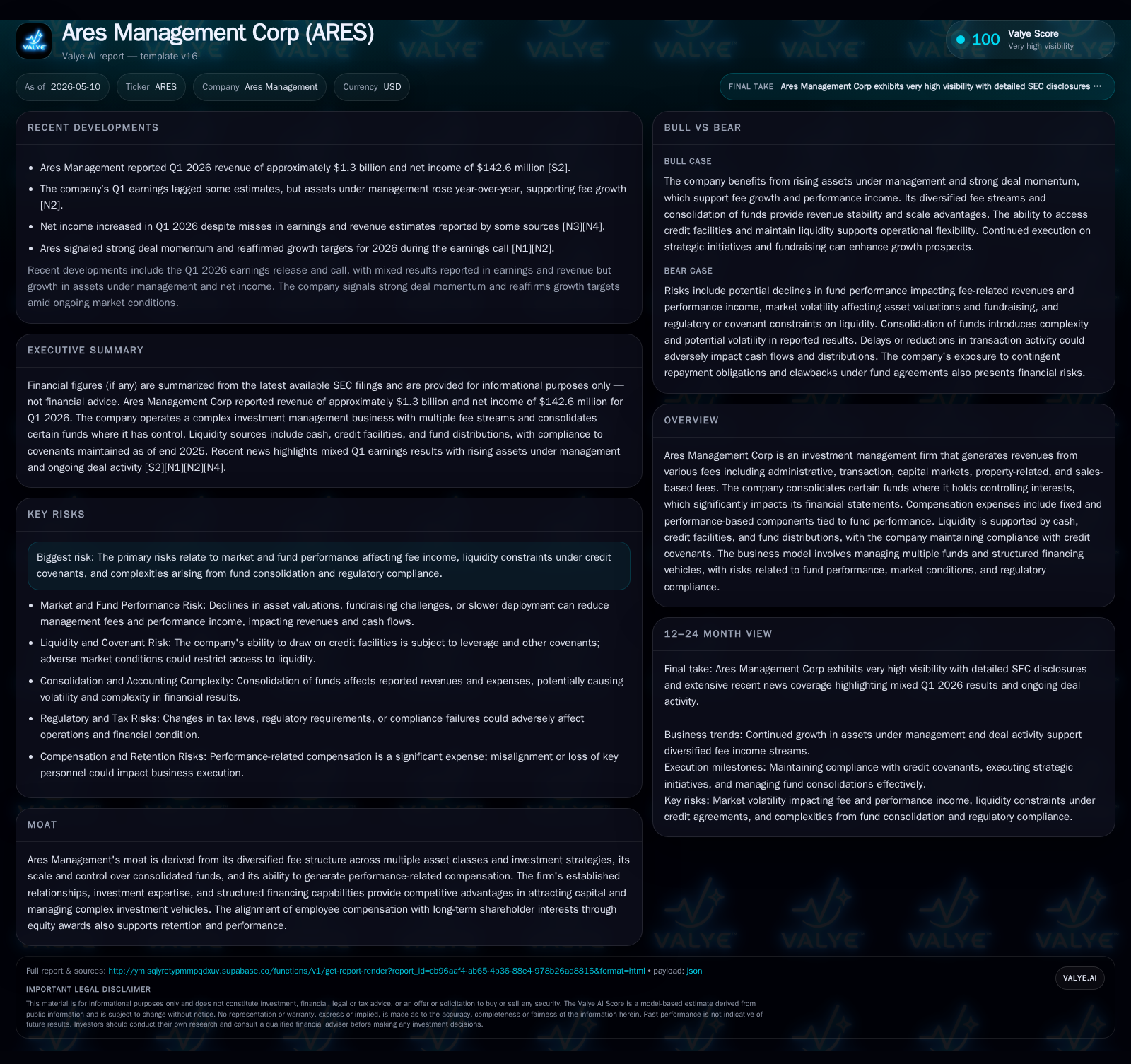
Ares Management’s first quarter 2026 disclosure highlights a stable revenue profile supported by diversified fees across multiple asset classes with notable impacts from consolidated funds on financial reporting. The firm’s business model leverages administrative, transaction, capital markets, and property-related fees, complemented by performance-based compensation closely tied to fund success. Competitive positioning benefits from scale, fund control, and fee diversification amid evolving industry dynamics. Growth is driven by capital deployment in real assets and direct lending, while risks cluster around fund performance volatility, liquidity timing from consolidated vehicles, and regulatory costs. Forward monitoring of fundraising progress and performance fee realization will be crucial.
Q1 2026 Operating Update: Revenue Mix and Fund Consolidation Impact
In the most recent quarterly filing dated May 8, 2026 [S2], Ares Management reported a revenue profile that continues to reflect its diversified fee base across alternative investment strategies. The firm notably underscores how consolidation of certain funds—where it holds controlling interests—impacts the timing and recognition of income streams. These consolidated vehicles introduce complexities in cash flow visibility due primarily to delayed distributions or reinvestment dynamics within such entities.
Specifically, administrative fees remain a reliable component tied to invested capital levels across funds. Transaction fees from direct lending show steady origination activity but remain subject to market-driven volume variability. Capital markets advisory fees continue to contribute modestly alongside property-related fees from real estate and digital infrastructure segments. Performance fees exhibit some volatility driven by the marking of underlying assets but remain an essential profit lever once crystallized.
The recent May 1 event filing [S3] provided supplementary color on strategic initiatives including selective expansions in digital infrastructure platform capabilities following the prior year’s acquisition of GCP International. This acquisition broadens geographic reach especially in Asia-Pacific logistics and enhances development fee income potential over time.
Overall, the Q1 disclosures reaffirm a stable baseline in management fees with nuanced shifts influenced by consolidated fund behavior—reflecting both a strength in diversified revenues and operational challenges in managing complex financial disclosures.
Dissecting Ares’ Business Model: Revenue Streams and Product Quality
Anchoring on the detailed annual descriptions in the February 25, 2026 Form 10-K [S1], Ares derives revenue primarily through multiple intertwined fee categories: administrative fees for fund management services; transaction fees for origination activities chiefly within direct lending; capital markets transaction fees accrued through underwriting or advisory roles; property-related fees encompassing acquisition, development, leasing, and property management; as well as sales- or asset-based fees linked to perpetual wealth offerings.
This multi-stream model creates a layered revenue mechanism where investors pay based on committed or invested capital (administrative), deal origination activities (transaction), asset performance (performance fees), or asset sales (sales-based). The impact is a blend of relatively predictable recurring fees buttressed by variable performance-linked compensation.
Importantly, compensation arrangements align staff incentives with investor outcomes via carry interest mechanisms as well as equity awards disclosed in filings [S1], underpinning retention of key personnel and reinforcing investment quality. The inclusion of digital infrastructure property management signifies product innovation responding to evolving institutional investor preferences for real assets with attractive yield profiles.
Competitive Sets and Industry Dynamics in Alternative Asset Management
Within the crowded alternative asset management space, Ares stakes competitive claims through scale advantages accrued from its large consolidated funds structure—a feature not universally shared by peers. This structure generates economies in fee administration but also creates complexity in balance sheet presentation.
Diverse asset class coverage—from credit to real assets to private equity—grants pricing power against more specialized boutique managers who may lack multi-sector diversification. However, regulatory compliance demands escalate proportionally with complexity, increasing fixed overhead expenses.
Capacity constraints particularly manifest in direct lending strategies where loan origination pipelines face competition for high-quality credits amid rising interest rates [N11]. Customer retention remains strong due to entrenched relationships and embedded switching costs linked to fund governance structures. Nevertheless, cyclicality in fundraising tied to capital market sentiment exerts periodic pressure on expansion initiatives.
Growth Catalysts: Scaling Fee Income and Expanding Fund Offerings
Ares' growth prospects hinge heavily on augmenting its fee-paying assets under management through strategic fundraising campaigns highlighted in the annual report [S1] that raised $113 billion in gross new capital during 2025. Notably, $78.8 billion represents undeployed capital providing runway for future fee ramp through disciplined investment deployment.
The firm places emphasis on real estate digital infrastructure as a fertile area benefiting from secular trends favoring logistics hubs and data center properties globally—the GCP Acquisition being instrumental here [S27]. Direct lending expansion continues as another vector by increasing volume of originated loans yielding transaction fees while improving fixed-income product diversity.
Operational leverage arising from scale permits margin improvement as fixed expenses spread over growing assets while performance fee realizations during market appreciation periods inject episodic incremental profits [N12]. Additionally, innovation around managed accounts tailored for wealth clients boosts sales-based revenues underpinned by dedicated distribution pathways [N3].
Key Risks and Operational Constraints: Fund Performance, Liquidity, and Regulatory Landscape
A primary risk identified lies in "clawback" or contingent repayment obligations triggered if fund performance reverses after incentive compensation has been paid out [S1]. Such provisions create potential liabilities that can depress net income unexpectedly.
Moreover, liquidity constraints emerge from the timing disconnect between earnings recognition on consolidated funds versus cash distributions received by Ares—a phenomenon accentuated by portfolio rebalancing or reinvestment cycles [S14].
Regulatory compliance spans cross-border investment vehicles increasing complexity and cost burdens while exposing the firm to legal proceedings or investigations referenced periodically [S25]. Heightened scrutiny of fee transparency or valuation methodologies among alternative managers serves as ongoing operational vigilance points.
Forward Indicators: Pipeline, Guidance, and Market Signals
Looking ahead into upcoming quarters per earnings call commentary [N1,N2,N4] and event filing disclosures [S3], critical milestones include fundraising trajectory updates particularly for new vehicles targeting emerging digital infrastructure sectors. Monitoring incremental deployment rates of dry powder will yield insights into upcoming transactional fee volumes.
Management guidance underscores cautious optimism dependent upon sustained recovery in capital markets coupled with steady net inflows from institutional investors [N7]. Performance fee accrual assumptions represent a key determinant of near-term earnings variability warranting close observation given their impact on distributable cash flow projections.
Execution risks related to integration efficiencies post-GCP Acquisition also feature prominently affecting synergy realization timelines [S27]. Overall market acceptance of newer strategies including tailored managed accounts constitutes an informative demand gauge going forward.
Financial Context: Recent Liquidity, Compensation Structure, and Capital Allocation
Though no explicit fresh debt figures appear in the latest filings beyond historical context [F1], Ares maintains cash and equivalents of approximately $152 million as of September 30, 2019 [F1]. Compensation expenses combine a base salary component with variable performance-linked incentives aligned tightly with fund outcomes promoting long-term shareholder value creation [S1]. Dividend policy targets payout ratios anchored primarily to core management fee earnings thereby dampening volatility while allowing retention of net realized performance income for reinvestment or share repurchase usage [S6,S11].
Capital allocation discipline remains central amidst balancing growth investments against shareholder returns amid evolving macroeconomic variables influencing fundraising environments.
This analysis is based exclusively on verifiable SEC filings up to Q1 2026 and relevant financial disclosures without speculation or unverified assumptions regarding Ares Management Corp's operations or financial condition. It is intended as an informed industry overview rather than investment advice.
Disclaimer: This is research-only, informational analysis and not investment advice. It may include AI-generated interpretation and general industry context. Always verify important details using primary sources.

Comments