
Matinas BioPharma’s Strategic Crossroads: Evaluating MAT2203’s Future After Development Pause
Recent SEC disclosures reveal Matinas BioPharma's halted Phase 3 trial and listing challenges amid urgent capital and partnership needs.
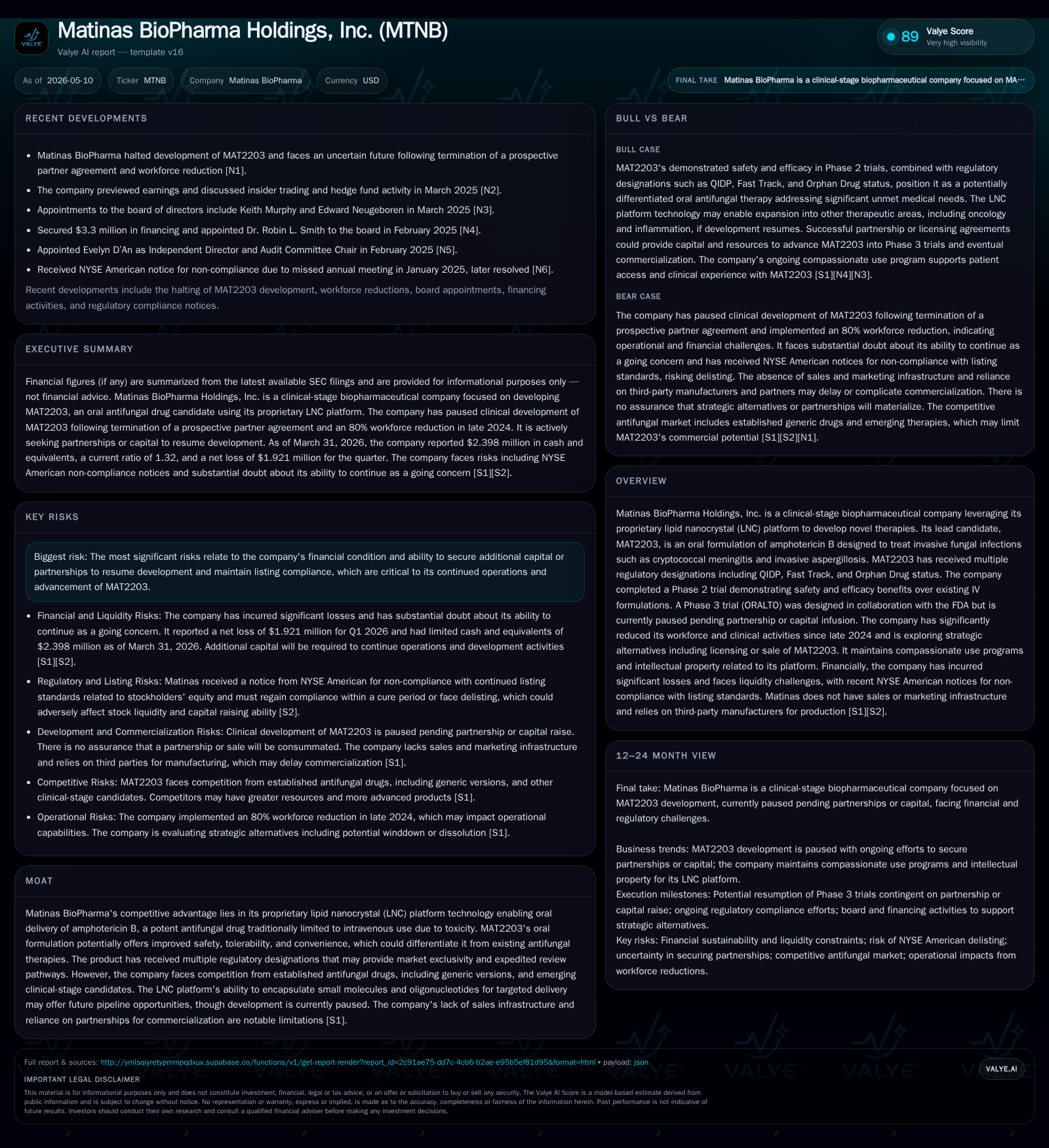
Matinas BioPharma Holdings, Inc. reported in its May 2026 quarterly filing that it has paused the Phase 3 ORALTO trial for its lead candidate MAT2203 and faces potential delisting risks due to shareholder equity shortfalls. The company is focused on securing partnerships or capital before resuming development, while maintaining regulatory milestones and compassionate use programs. Its proprietary lipid nanocrystal platform underpins the oral amphotericin B formulation, targeting significant antifungal treatment gaps, but financial pressures and operational downsizing constrain near-term growth.
Latest Quarterly Developments and Regulatory Status
In its latest quarterly filing dated May 8, 2026 [S2], Matinas BioPharma disclosed a critical operational update highlighting the pause of its Phase 3 ORALTO trial for MAT2203, an oral amphotericin B formulation for invasive fungal infections. This development follows the company's ongoing financial constraints and inability to self-fund pivotal trial progression absent new capital or strategic partnerships. Concurrently, Matinas received a formal notice from NYSE American on April 2, 2026 notifying non-compliance with continued listing requirements tied primarily to stockholders' equity thresholds after multiple years of net losses [S3]. The company submitted a remedial Plan by the May 2, 2026 deadline intended to outline actions to regain compliance during an up-to-18-month cure period extending through late 2027. While ongoing trading on NYSE American continues without immediate suspension, this delisting risk underscores urgent liquidity challenges.
Additionally, since late October 2024, Matinas reduced its workforce by approximately 80%, implemented cost containment measures, and suspended internal development activities outside of maintaining regulatory obligations and compassionate use access programs [S1][S4]. These moves reflect a focused pivot to conserving limited resources while maximizing asset value through partner engagement.
Matinas BioPharma’s Business Model and Pipeline Overview
Matinas operates as a clinical-stage biopharmaceutical firm centered on its proprietary lipid nanocrystal (LNC) platform designed for the targeted delivery of therapeutics. Its lead asset, MAT2203, reformulates amphotericin B—a historically effective yet intravenously administered antifungal plagued by systemic toxicity—into an oral treatment via LNC technology that potentially mitigates adverse effects while improving patient convenience [S1]. This formulation has achieved significant regulatory recognitions including Qualified Infectious Disease Product (QIDP), Fast Track designation by the FDA for invasive candidiasis and aspergillosis indications, as well as Orphan Drug Designation in both U.S. and EU markets for cryptococcosis treatment [S4][S16]. These designations offer incentive exclusivities like extended marketing protections and accelerated review pathways.
Revenue prospects derive principally from out-licensing or partnering deals given Matinas' lack of an internal commercialization infrastructure and paused clinical-stage development since late 2024. The company’s monetization strategy hinges on securing one or more collaborators to finance advancement into Phase 3 trials and eventual NDA submission. Without such partnerships or capital raises, operational capabilities remain curtailed with minimal personnel engagement focusing on IP maintenance, regulatory compliance, and compassionate use initiatives [S1][S4]. Earlier plans for broadening the pipeline leveraging LNC technology in oncology and inflammatory indications have been placed on indefinite hold pending strategic redeployment of resources.
Industry Context: Oral Antifungals and Competitive Dynamics
The antifungal therapeutics market remains dominated by intravenous formulations like amphotericin B deoxycholate and liposomal versions that are standard of care but limited by parenteral administration complexities and notable toxicities. Generics saturate segments with established drugs such as voriconazole and posaconazole competing across invasive fungal infection types. MAT2203's primary competitive differentiation lies in its oral bioavailability coupled with improved safety profile enabled through LNC encapsulation technology that reduces nephrotoxicity risks associated with IV amphotericin B [S1].
Regulatory designations such as QIDP facilitate accelerated clinical timelines but do not mitigate broader reimbursement uncertainties faced in pharmaceutical antifungal markets where cost-effectiveness studies (pharmacoeconomics) can be decisive in payer coverage decisions [S6]. Establishing premium pricing requires demonstration not only of efficacy but also superior tolerability or ease of use versus entrenched therapies—barriers that often prolong commercial adoption curves. Additionally, complex manufacturing processes inherent in novel nanocrystal lipid formulations may constrain large-scale supply chain ramp-up until commercial viability is proven.
Emerging oral antifungal candidates from other biotech firms underscore a competitive pipeline environment where demonstrating clear clinical advantages could dictate market penetration potential.
Growth Drivers Amid Development Pause: Partnerships and Strategic Alternatives
With clinical development paused since late 2024 pending funding events [S1], Matinas’ near-term growth proposition centers heavily on concluding partnership agreements or executing licensing transactions to fund resumption of the ORALTO Phase 3 study. Prior attempts including non-binding term sheets have faltered due to external reasons unrelated directly to MAT2203’s profile; however, active management commentary emphasizes continued dialogue with potential global collaborators aiming for rapid advancement post-deal closure [N1][S4].
Such partnerships would not only provide necessary capital infusion but likely bring commercial expertise required given Matinas’ lack of sales infrastructure while potentially revising clinical strategies according to partner input. The company also preserves value through ongoing intellectual property prosecution around the LNC platform encompassing encapsulations beyond amphotericin B[S4][N1].
Should partnering efforts stall further, business alternatives might include asset sale or corporate merger considerations although no definitive plans are announced. Maintaining compassionate use access programs signals commitment to patient impact despite stalled broader development.
Risks and Constraints: Financing, Regulatory, and Operational Challenges
Foremost risks stem from Matinas’ precarious financial condition manifested by the receiving of NYSE delisting notification due to failing minimum equity levels after sustained losses across five fiscal years [S2]. Subject to an extended cure period contingent upon meeting set milestones via submitted plans—and periodic NYSE reviews—the company faces ongoing risk that failure to regain compliance may force delisting, which could reduce stock liquidity and complicate capital raises.
Operationally significant is reliance on third-party technologies licensed from Rutgers University underpinning the LNC platform; loss or disputes here could materially impact product development timelines [S9][S13]. Additionally, any future clinical trial resumption faces typical risks including patient enrollment hurdles exacerbated by prolonged pauses, evolving regulatory landscapes notwithstanding prior Fast Track or Orphan Drug designations which are non-guarantees of approval [S10][S12].
Legal distractions emerge from ongoing landlord dispute concerning premises lockout allegations adding minor operational noise although currently managed through settlement talks [S9]. Market risks include uncertain reimbursement environments requiring costly pharmacoeconomic studies to justify pricing post-launch limiting revenue sustainability if unmet.
Collectively these factors compound challenges creating substantial execution risk around timely completion of pivotal registrational milestones or achieving commercial readiness.
Upcoming Milestones and Key Events to Monitor
Key near-term events include monitoring adherence progress under NYSE American’s plan submitted by the May 2, 2026 deadline aimed at curing continued listing concerns with quarterly reporting updates expected through mid-2027 at minimum [S2][S3]. Progress or breakthroughs in licensing discussions represent critical catalysts potentially unlocking clinical trial restarts.
Operational decisions surrounding possible modifications or redesigns of ORALTO protocol driven by partner preferences may alter timeline forecasts considerably—investors should observe related communications carefully. Consideration for revised fundraising activities or alternative strategic transactions such as asset sales additionally warrant attention given current cash constraints.
Maintaining regulatory IND status with FDA also remains essential allowing re-initiation without procedural setbacks. Continuous support of compassionate use programs demonstrates commitment but does not generate revenue streams providing runway extensions.
Financial Position Snapshot: Cash, Liquidity, and Capital Adequacy
Latest financial snapshot
| Metric | Value | Period |
|---|---|---|
| Cash & equivalents | $2.4mm | |
| 2026-03-31 | ||
| Current assets | $2.8mm | |
| 2026-03-31 | ||
| Current liabilities | $2.13mm | |
| 2026-03-31 | ||
| Current ratio | 1.32x | |
| 2026-03-31 |
Source: SEC companyfacts cache [F1].
As of March 31, 2026 per quarterly filings [F1][S2], Matinas reported cash & equivalents totaling approximately $2.4 million alongside current assets near $2.8 million against current liabilities around $2.13 million yielding a current ratio of roughly 1.32—a modest buffer indicative of tight liquidity amidst ongoing operating expenses.
Total debt stands negligible at about $79 thousand dating back several years without significant leverage pressures [F1]. Operating losses continue accumulating with net income deep in negative territory per latest filings [F1]. This tight financial profile substantiates dependency on external capital inflows or deal consummations critical to sustaining operations beyond the cure period horizon.
This analysis is based exclusively on publicly filed SEC documents up to May 8, 2026, company disclosures including recent earnings reports and event filings referenced herein. It does not constitute investment advice but aims to provide an informed industry perspective grounded in verified data.
Disclaimer: This is research-only, informational analysis and not investment advice. It may include AI-generated interpretation and general industry context. Always verify important details using primary sources.

Comments