
CKX Lands Pursues Strategic Alternatives to Enhance Shareholder Value
CKX Lands advances its strategic alternatives process amid active portfolio management and co-ownership partition efforts.
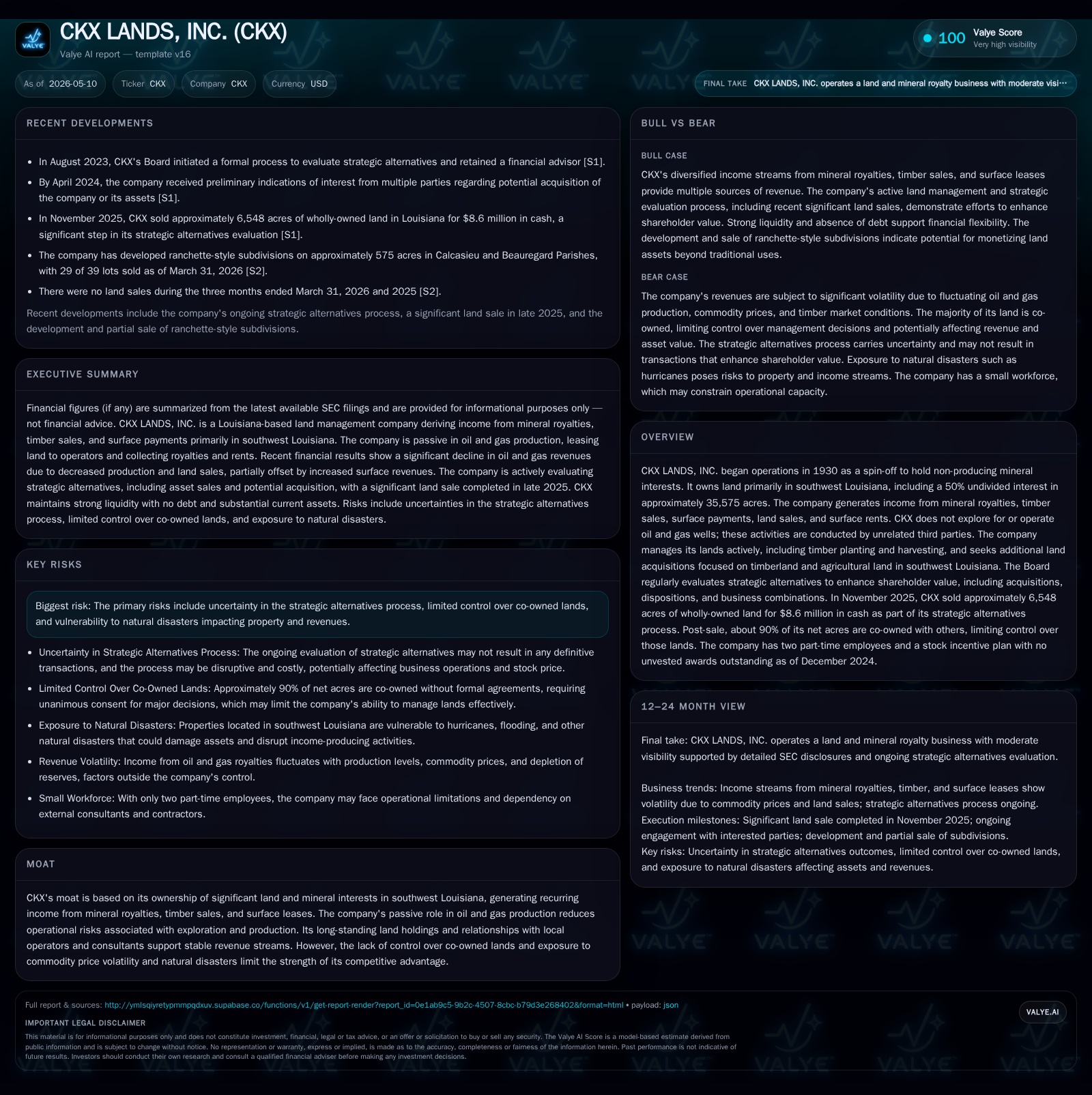
In its latest quarter, CKX Lands intensified efforts to identify strategic alternatives including land acquisitions, dispositions, and potential partitions of co-owned acreage to optimize shareholder value. The company’s diversified income streams from mineral royalties, timber sales, and surface rents underpin stable cash flows despite commodity price volatility. Growth hinges on successful execution of the Board’s strategic review and disciplined land acquisitions targeted at timber and agricultural assets in southwest Louisiana. Key risks involve uncertainty in partition negotiations and operational exposure to commodity cycles and natural events.
Latest Quarterly Developments and Strategic Review
CKX Lands reported in its Q1 2026 Form 10-Q that the Board continues an active evaluation of strategic alternatives intended to enhance shareholder value [S2]. This ongoing process includes exploring opportunities for growth through acquisitions or business combinations as well as asset dispositions and reinvestments. Critically, management disclosed plans to pursue partitions—either by sale or in kind—of undivided interests in acreage co-owned with others. Given CKX's substantial stake of approximately 35,575 acres (half undivided interest), separation of these interests could materially affect control and cash flow dynamics. However, no assurance exists that partitions will be negotiated amicably; court-ordered partitions remain possible [S2,S6].
Recent event filings such as the May 7, 2026 stockholder meeting update confirmed continued governance oversight aligned with this strategic momentum but included no new definitive agreements [S3]. The November 2025 sale of over 6,500 wholly owned acres for $8.6 million marked a key milestone in this strategic pathway [S1,S6].
This quarterly disclosure underscores a corporate posture increasingly dynamic compared to decades-long stable land holdings. The emphasis on unlocking intrinsic value through portfolio reshaping defines the near-term operating landscape.
Business Model and Revenue Streams
CKX’s earnings emanate chiefly from mineral royalties generated by non-operated oil and gas production on owned lands alongside revenues from timber sales and surface-related leases or rights-of-way [S1,S2]. As a non-operator with no exploration or well control responsibilities, CKX mitigates many operational risks typical of upstream producers but remains exposed to commodity price swings impacting royalty levels.
The company holds small royalty interests spread over approximately 20 producing fields with royalty percentages ranging from fractions of a percent up to over seven percent per unit. This fragmented royalty portfolio implies relatively modest but steady oil & gas cash inflows that naturally deplete as reserves exhaust or wells become uneconomical [S1,S7].
Timber represents a renewable revenue source managed actively through forestry practices—planting and harvesting cycles—subject to market stumpage price variability and stand age factors. Timber sales improved recently after flat prior-year comparatives indicating responsive operational management [S13].
Surface income encompasses recurring leases for agriculture or recreation plus occasional non-recurring revenues such as pipeline right of ways or temporary site rentals. Notably, surface revenues nearly doubled in Q1 2026 led by increased oil/gas delay rentals and surface lease activity evidencing leveraging of ancillary land uses beyond core mineral exploitation [S13].
Combined revenue streams produce a diversified though interlinked cash flow profile sensitive primarily to external commodity prices governing oil/gas royalties and timber markets impacting stumpage values.
Industry Structure and Competitive Positioning
CKX operates within a niche segment of southwestern Louisiana landholders with concentrated ownership in mineral rights coupled with timberland holdings. The company's largest single land interest dates back to a significant multi-party acquisition securing about half of a contiguous 35,575-acre bundle [S1]. However, the co-ownership nature complicates operational control since any strategic moves on acreage require negotiation with other owners.
This fractional ownership model restricts unilateral action but benefits from stable long-term income sources anchored by longstanding industry relationships among local operators leasing minerals or timber purchasers bidding competitively for quality stands. Pricing power for timber relies on regional market demand shaped by pulp/paper industries while mineral lease attractiveness depends on basins’ geology plus prevailing energy economics.
Regulatory environment presents noteworthy risk mostly through potential judicial involvement if amicable partitions fail—a rare but material contingency disrupting ownership rights.
Despite these constraints, CKX’s historical land base grants it enduring competitive moat rooted in size scale amidst highly fragmented private land parcels common in the region.
Growth Drivers and Expansion Opportunities
The key growth vectors are anchored on augmenting the company’s acreage footprint focused selectively on timberland or agricultural properties within its southwestern Louisiana geography where expertise resides [S2]. Management’s stated search parameters emphasize unimproved real estate exhibiting favorable timber/agriculture characteristics or improved tracts generating reliable revenues.
Operationally tighter harvest scheduling combined with better stumpage contract terms may incrementally increase timber income.
Surface rental optimization has also shown recent revenue upticks enabling enhanced returns from existing holdings without substantial capital outlay.
In addition to organic growth elements, ongoing partitions of co-owned lands could unlock liquidity via outright sales or confer greater operational autonomy if partitioned holdings become wholly controlled. Meanwhile, further divestitures akin to the recent large-scale sale could generate capital redeployable into higher-return assets or business combinations featuring synergistic portfolios [S2,S6].
These pathways rely heavily on maintaining financial flexibility and executing disciplined acquisition criteria amid volatile external commodity cycles.
Risks, Constraints, and Operational Challenges
The most conspicuous risk arises from the unresolved nature of planned partitions involving undivided interests; failure to reach consensual arrangements could result in costly court proceedings damaging cash flows or asset values [S1,S14].
Volatility in oil & gas commodity prices materially influences the royalty income stream despite diversification advantages. The inevitable depletion of mineral reserves under current holdings further enforces a finite horizon beyond which these revenues decline materially.
Timber revenues depend on market stumpage prices sensitive to cyclical demand for wood products regionally.
Natural disasters such as hurricanes pose tangible threats given Louisiana’s exposure that can damage standing timber assets or disrupt operations temporarily.
Lastly, management notes that the strategic alternatives process demands significant professional fees and diverting management attention potentially distracting from day-to-day asset management effectiveness [S1,S14].
Outlook: Key Milestones and What to Watch Next
Investors should focus upcoming months on progress reports from the Board regarding the negotiation status of land partitions which could significantly alter ownership structure or trigger asset monetizations [S2,S3].
Monitoring quarterly revenue decompositions will reveal whether surface rental growth sustains momentum offsetting anticipated declines in oil & gas royalties amid reserve erosion.
Land acquisition announcements particularly targeting timber/agriculture niches will signal confidence in growth strategy execution.
Further disclosure around professional expenses related to strategic advisory engagements could provide insight into process duration.
Overall stewardship decisions including any shareholder votes precipitated by transactions formed out of this process merit close attention given their transformational potential for the company’s trajectory.
Financial Position Snapshot
Latest financial snapshot
| Metric | Value | Period |
|---|---|---|
| Current assets | $18mm | |
| 2026-03-31 | ||
| Current liabilities | $705188 | |
| 2026-03-31 | ||
| Current ratio | 25.65x | |
| 2026-03-31 |
Source: SEC companyfacts cache [F1].
CKX maintains a robust liquidity position with current assets exceeding liabilities by over twenty-five times at quarter-end March 31, 2026 reflecting ample cushion for operating needs plus growth investments [F1,S2]. Operating cash flow was slightly negative $(52K) in Q1 reflecting timing effects relative to prior year but aligns with normal fluctuations given low cash operating intensity in passive royalty models. Significant investing outflows mainly reflect purchases of certificates of deposit bolstering short-term financial reserves [S2]. The absence of any debt affords substantial optionality enabling flexible capital deployment toward acquisitions or partnership ventures as contemplated in ongoing strategic reviews.
This healthy balance sheet underpins CKX's pursuit of maximizing shareholder value via carefully considered portfolio realignments without fiscal constraint pressure at present.
The analysis herein is based solely on publicly available SEC filings dated through May 8, 2026 and company-disclosed metrics without projections or forward-looking guidance beyond those explicitly stated by management. This report does not constitute investment advice but aims to provide an informed assessment of CKX Lands' current operating context within its stated strategy phase.
Disclaimer: This is research-only, informational analysis and not investment advice. It may include AI-generated interpretation and general industry context. Always verify important details using primary sources.

Comments