
HMH Holding Inc’s IPO Establishes Complex Governance Amid Early Operational Disclosure
The company’s first quarterly filing post-IPO sheds light on its governance structure and operational stance while financial transparency remains limited.
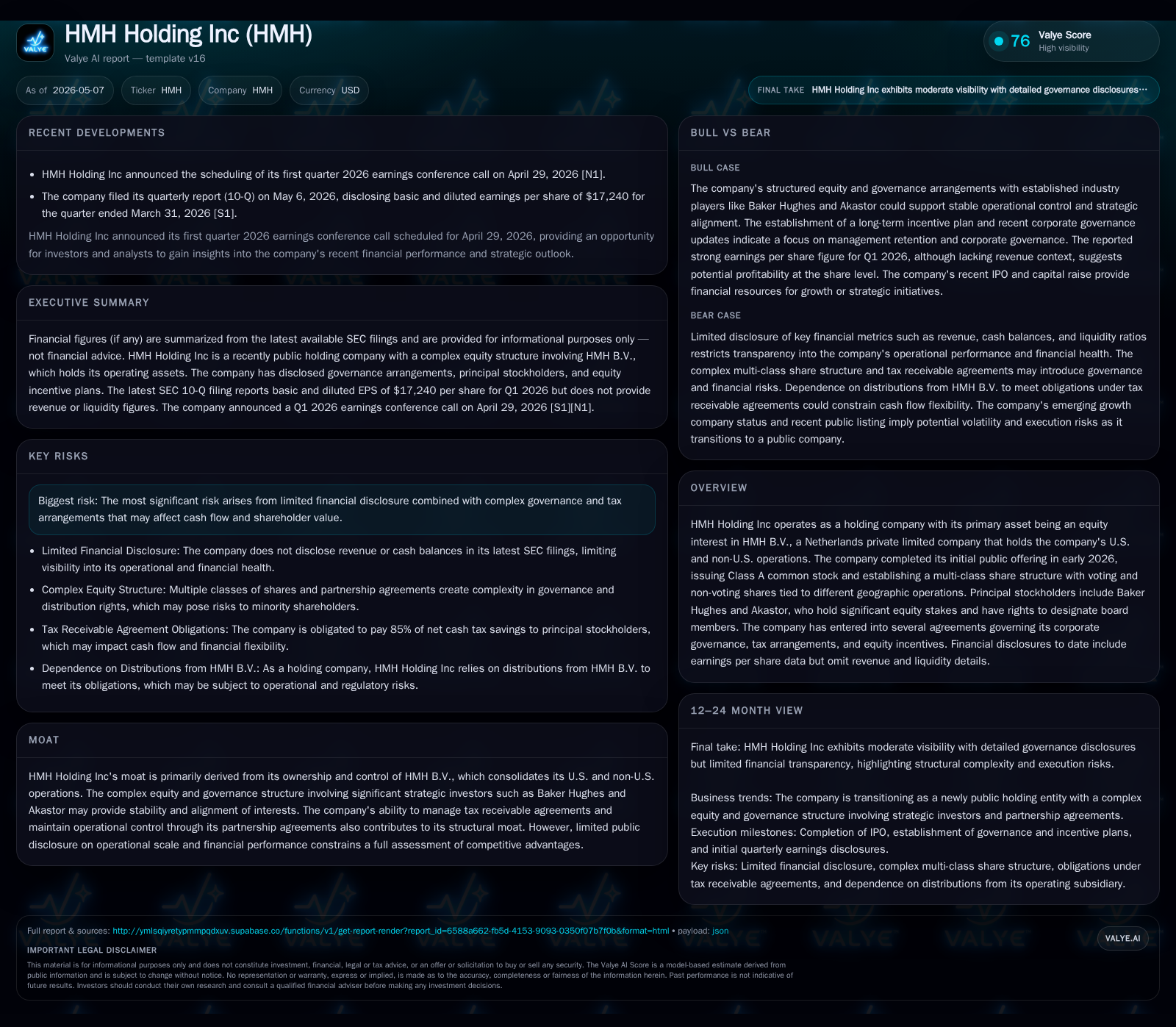
HMH Holding Inc, newly public in early 2026, released its first-quarter 10-Q filing providing key insights into its evolving governance and operational framework. The company operates primarily as a holding entity for HMH B.V., consolidating U.S. and international operations through a multi-class stock structure entwined with major strategic investors Baker Hughes and Akastor. While earnings per share data was disclosed, revenue and liquidity details remain undisclosed, limiting comprehensive financial evaluation. Governance complexities tied to tax receivable agreements and board appointment rights dominate the structural moat discussions, indicating a stabilization phase post-IPO.
Latest Operating Update: First Quarter 2026 Disclosures
HMH Holding Inc's inaugural quarterly report as a publicly traded entity was filed on May 6, 2026, presenting preliminary operational data nearly three months after its IPO close [S2][N1]. The filing notably disclosed earnings per share results but withheld granular revenue figures and liquidity conditions—a pattern reflecting early-stage transparency typical for new public holdings with indirect operating exposure. Risk factors remain unchanged from the final prospectus, suggesting no immediate material shifts in the company's external or operational environment [S2][S22].
Additionally, concurrent filings reinforce that corporate governance complexities remain salient topics. No significant changes in risk disclosure highlight the company’s focus on steady compliance amidst evolving public scrutiny [S2]. The absence of comprehensive financial detail underscores ongoing challenges analysts may face when assessing underlying business performance in near real-time.
Business Model Overview and Product/Service Context
Fundamentally, HMH Holding Inc operates not through direct provision of products or services but primarily as a holding entity owning an equity stake in HMH B.V., a Netherlands private limited company encompassing U.S. and international operations consolidated under one umbrella [S2]. This arrangement means all strategic decisions, value creation initiatives, and operational execution are channelled through HMH B.V., which issues four classes of shares segmented by voting rights and geographic focus.
Class A common stock issued by HMH tracks both U.S. (Voting Class A Shares) and non-U.S. (Voting Class B Shares) operations transparently through its one-to-one equity ownership in corresponding B.V. shares. Meanwhile, significant non-voting interest is held by principal investors via Non-Voting Class A and B shares related respectively to geographic segments. This multi-class share system aims to maintain operational control centralized within the holding company while allowing investors differentiated economic exposure.
Revenue mechanics thus revolve around value generation within HMH B.V.’s core businesses rather than direct transactional relationships with end customers by the parent holding company. Cash flow largely depends on distributions declared by HMH B.V., which in turn derive from its operational profitability across U.S. and international markets.
Governance Structure and Strategic Investor Influence
HMH Holding Inc’s governance structure is complex but deliberate, designed to balance control between the newly public entity and legacy strategic shareholders Baker Hughes and Akastor [S11][S24]. Both investors hold meaningful economic interests comprising large tranches of Class B common stock plus extensive holdings of non-voting shares in HMH B.V., enabling them to influence corporate directions despite reduced voting power in some cases.
This setup includes bespoke agreements such as:
- Board member designation rights: Baker Hughes can appoint up to two directors if it maintains certain ownership thresholds; Akastor holds equivalent rights tied to their stakes [S24].
- Tax Receivable Agreement: Obligates the company to pay 85% of realized net cash tax savings back to principal shareholders based on step-up basis increases following the IPO or certain capital events—potentially a substantial cash outflow risk if tax benefits materialize broadly [S12].
- Stockholder Agreements: Restrict board size changes without consent from principal investors when thresholds are retained; specify registration rights facilitating secondary offerings for large shareholders [S24][S26].
- Long-Term Incentive Plan (LTIP): Adopted immediately post-IPO as part of governance reforms incentivizing management aligned with shareholder interests; reserved over 3.7 million Class A shares for awards [S16][S27].
Collectively, this governance architecture fosters stability through entrenched strategic investor involvement but creates layers of complexity impacting minority shareholder visibility into decision-making dynamics.
Competitive Environment and Industry Positioning
While financial disclosure constraints limit precise benchmarking against peers, HMH Holding enjoys competitive advantages stemming from consolidated ownership of diversified U.S. and international assets via HMH B.V. Such consolidation can enable economies of scale in administrative functions, integrated tax planning advantages through partnership structures, and strategic alignment facilitated by controlling shareholdings concentrated among sophisticated institutional owners like Baker Hughes—a major oilfield services player—and Akastor.
Unlike standalone operating companies facing direct market competition for contracts or shelf space, HMH Holding stands apart as an investment vehicle whose strength lies in managing complex capital structures and aligning incentives across geographies.
However, absence of explicit breakdowns about end-market exposures or service/product lines within HMH B.V. curtails full assessment of cyclical sensitivity or differentiation in market offerings at this juncture.
Growth Drivers and Expansion Opportunities
The primary growth levers identified pivot around financial engineering and strategic deployment enabled by recent capital raises:
- IPO Capital Deployment: The $193.8 million net proceeds from the April 2026 offering were partially used to repay shareholder loans owed to Baker Hughes and Akastor, improving leverage profiles at the subsidiary level while facilitating additional investments at HMH B.V. [S11][S17]. Remaining funds provide dry powder for potential acquisitions or organic growth initiatives.
- Governance Stability Leveraging Strategic Investors: The aligned interests with major holders may pave smoother paths for bolt-on acquisitions or partnerships underpinned by shared long-term visions.
- Tax Receivable Agreement Optimization: Efficient management of tax basis increases underpinning this agreement can unlock meaningful cash savings distributed between the company and principal shareholders; success here influences cash available for reinvestment versus payouts [S12].
- Long-Term Incentive Programs: Newly implemented LTIPs intend to bolster retention among management cadres critical for executing growth strategies amid competitive market pressures [S16].
Given the holding structure's dependency on downstream operations' success via distribution inflows from HMH B.V., expansion success will hinge on affiliate business line performance as well as effective capital allocation at the group level.
Risks, Watchpoints, and Structural Constraints
Investors should maintain heightened awareness around several cross-cutting risks:
- Opaque Financial Disclosure: The withholding of detailed revenue or liquidity data constrains transparent assessment of current operational health or cash flow sufficiency—complicating valuation judgments or credit analyses [S2][N1].
- Complex Governance with Concentrated Control: While stable, overlapping shareholder agreements could lead to conflicts between majority shareholders’ strategic priorities versus minority interests; intricate voting rights layers may delay decision-making or obscure accountability pathways.
- Tax Receivable Agreement Cash Flow Impact: Accelerated termination scenarios could trigger sizeable lump-sum payments threatening near-term liquidity if not managed prudently [S12]. Dependency on tax benefit realization also exposes the company to regulatory shifts affecting tax treatments.
- Dependence on Distributions from Operating Subsidiary: As a pure holding entity reliant on passes through cash flow from HMH B.V., any downturn at operating levels due to market dynamics or cost pressures could cascade upward restricting dividend flows.
- Emerging Growth Company Status: While potentially enabling regulatory flexibilities initially post-IPO may delay full regulatory compliance timelines impacting investor confidence metrics.
Collectively these factors necessitate vigilant monitoring of governance disclosures, dividends declared by HMH B.V., public updates from strategic shareholders’ activities, and forthcoming SEC filings.
Next Steps: Key Milestones and Observables
Critical upcoming events bearing significance include:
- Q2 2026 Quarterly Filing: Expected next formal update that may deepen insight into revenue streams or liquidity measures absent in Q1 disclosure cycles.
- Earnings Conference Calls: Scheduled for late April 2026 providing forums where management commentary may illuminate business dynamics beyond static filings [N2][S3].
- Tax Receivable Payment Schedules: Monitoring timing/amounts of tranche payments will reveal realized value extraction levels tied to tax strategies outlined previously.
- Board Composition Updates: Tracking shifts in director appointments or bylaw amendments that might signal evolving investor influence balances.[S8][S24]
- Capital Deployment Announcements: Any declarations around acquisitions or reinvestment strategies could validate growth thesis supported by IPO capital inflow.
The unique multi-class governance intertwined with legacy strategic shareholders marks a defining feature shaping near-term outlooks.
Disclaimer: This is research-only, informational analysis and not investment advice. It may include AI-generated interpretation and general industry context. Always verify important details using primary sources.

Comments