
Janus Living Emerges as the RIDEA Leader in Senior Housing After IPO
Following its IPO in March 2026, Janus Living leverages its unique RIDEA structure and focused portfolio to deliver stable cash flows and expand in key retirement markets.
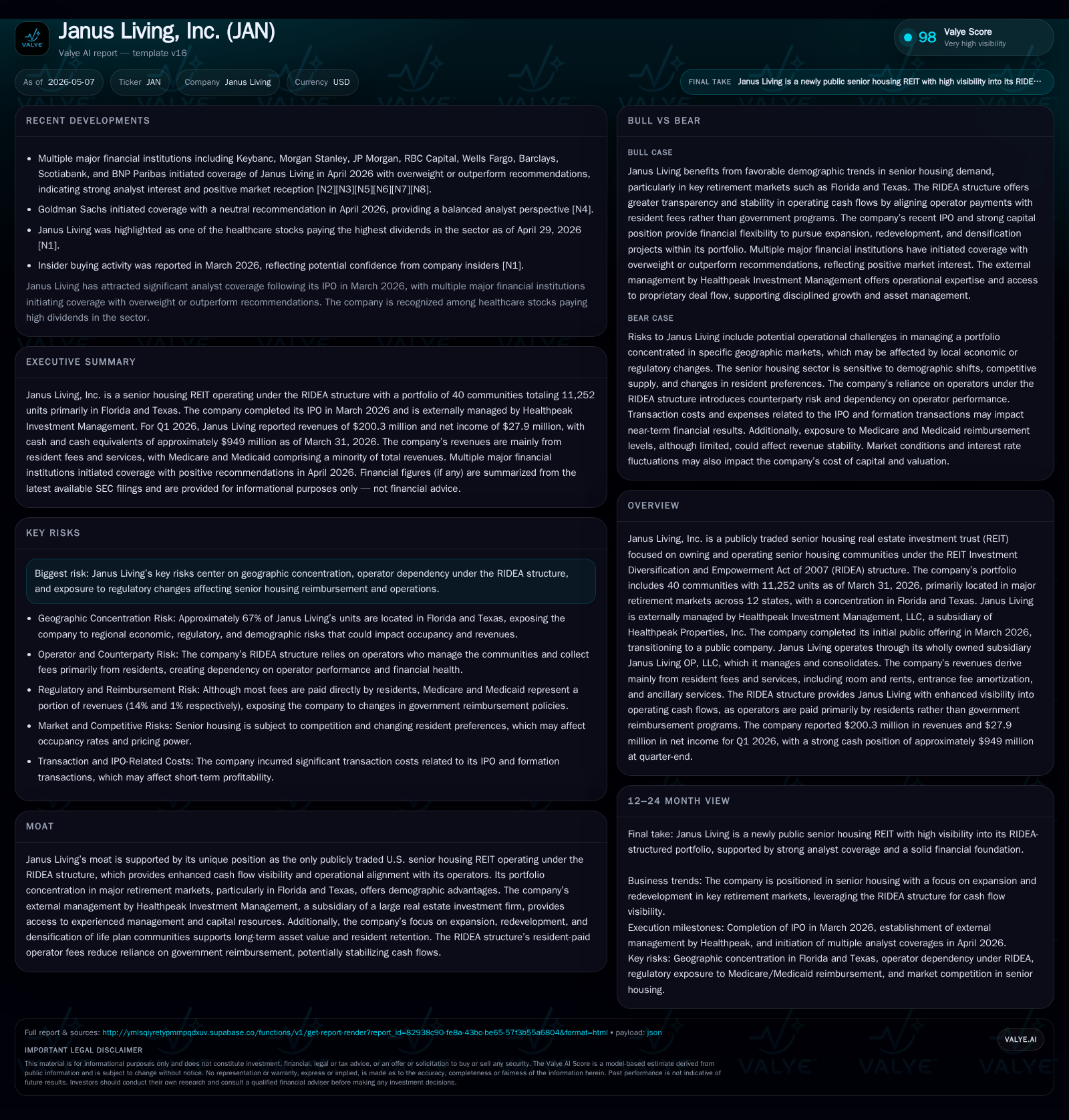
Janus Living completed its IPO in March 2026, becoming the only publicly traded U.S. senior housing REIT operating under the RIDEA framework, which enhances cash flow stability and operational alignment. Its portfolio of 40 communities with over 11,000 units is concentrated in major retirement markets such as Florida and Texas, offering demographic tailwinds. Externally managed by Healthpeak Investment Management, Janus Living focuses on disciplined acquisitions, redevelopment, and densification to drive growth while navigating risks related to management dependence and regulatory exposure.
Recent Quarterly Operating Update: Transitioning Post-IPO with Stability
Janus Living’s transition into a publicly traded entity was cemented with its initial public offering completed in March 2026 [S2][S5]. The company remains externally managed by Healthpeak Investment Management, LLC (a subsidiary of Healthpeak Properties), underscoring its operational continuity.
The latest quarterly filing as of March 31, 2026 reports net income of approximately $27.9 million and a robust cash balance nearing $949 million [F1][S2]. This financial footing is bolstered by a revolving credit facility with undrawn capacity totaling $500 million alongside a $100 million delayed-draw term loan facility—all with flexible maturity profiles extending to 2030 and beyond [S4].
Importantly, the filing highlights dependencies including the Manager’s personnel continuity and potential conflicts stemming from ownership structures linking Janus Living with Healthpeak. Despite these managerial considerations, cash available for distributions supports continued dividend payments at anticipated levels [S2]. The company shows conservative risk exposure through limited maximum loss on variable interest entities (VIEs), specifically an AgeTech investment capped at $185 thousand [S2][S23].
Business Model and Product Quality: Resident-Paid Services in a RIDEA Framework
Janus Living operates uniquely within the senior housing REIT sector by employing the REIT Investment Diversification and Empowerment Act (RIDEA) structure—a rarity among publicly traded peers [S2]. This arrangement separates property ownership from operations but aligns incentives by requiring operators' fees to be paid directly by residents rather than relying predominantly on government reimbursements such as Medicare or Medicaid.
Revenue derives mainly from resident fees encompassing room rentals, amortization of entrance fees, ancillary services, and other offerings typical within life plan communities. This model affords Janus Living enhanced cash flow visibility and reduces exposure to reimbursement volatility common in healthcare-related segments. The business relies heavily on resident retention drivers supported by quality community amenities, operator effectiveness, and location desirability.
External management via Healthpeak Investment Management injects real estate operational expertise while preserving strategic flexibility across markets. The presence of related-party transactions demands transparency but also facilitates aligned interests between health-focused property management and asset ownership [S18][S24].
Industry Structure and Competitive Position: Niche Leadership with Concentrated Geography
Janus Living occupies a singular niche as the only U.S. publicly listed senior housing REIT structured under RIDEA, giving it a defensible moat amid stiff competition from traditional triple-net lease REITs or private operators. The companies’ portfolio concentration—67% of units in Florida and Texas—targets major retirement hubs where demographic trends support sustained demand for senior housing options [S20].
This geographic focus dovetails with limited new supply dynamics in those regions, enhancing pricing power potential under favorable population aging trends. Portfolio scale is nontrivial: more than 40 communities encompassing over 11,000 units offers diversification benefits while still enabling operational synergies across proximate assets.
Competition includes national seniors housing operators and other REITs; however, Janus Living’s integrated approach under RIDEA allows active participation in operational outcomes rather than passive landlord returns alone. Such active involvement creates switching costs among operators keen to remain aligned in performance incentives.
Growth Drivers: Market Demographics, Portfolio Expansion, and Life Plan Densification
Growth prospects for Janus Living are primarily structural rather than cyclical due to ongoing increases in the U.S. senior population within target states such as Florida and Texas.[S20]
The company aggressively pursues disciplined acquisitions incorporating high-quality senior housing assets that either complement current holdings or present entry into promising new markets sharing key demographic attributes [S20]. Post-IPO capital resources enable meaningful expansion without immediate drawdowns against credit facilities.
Moreover, Janus Living emphasizes redevelopment projects focused on densifying existing life plan communities. These initiatives positively impact same-store net operating income by improving unit yields through modernized amenities or unit mix optimization that attract higher-paying residents while elevating overall occupancy rates.
Operationally aligned external management facilitates evaluations of acquisition candidates capable of benefiting from RIDEA economics while allowing flexible operator selection or transitions when warranted. This strategy positions Janus Living well to capture growth both organically via development/densification and externally through accretive transactions.
Risks and Constraints: Manager Dependence, Geographic Concentration, Regulatory Exposure
Dependency on Healthpeak Investment Management introduces key-person risk; should manager personnel depart or management agreements terminate unexpectedly without suitable replacement arrangements, operational execution could suffer materially [S2]. Conflicts stemming from overlapping ownership interests between Janus Living stakeholders and Healthpeak complicate governance dynamics.
Geographic concentration amplifies vulnerability to regional economic downturns or adverse events affecting popular retirement areas—natural disasters or policy shifts localized to Florida or Texas could disproportionately impact community performance.
Regulatory risk remains salient despite the resident-paid fee model reducing dependence on government reimbursement. Potential federal or state changes impacting licensure requirements, staffing mandates, or health regulation compliance may increase operating costs or constrain service delivery models within senior housing sectors broadly [S21].
Additionally, entrance fee refund obligations pose actuarial uncertainties affecting deferred revenues and liabilities if resident behavior deviates meaningfully from assumptions.
Key Monitors Ahead: Management Continuity, Dividend Distribution Capacity, Capital Access
Investor attention should focus keenly on developments related to the management agreement’s stability given its centrality to operations [S2]. Announcements regarding personnel changes or contract renewals will provide early signals about continuity risks.
Dividend policies convey underlying operational cash flow strength; maintaining distributions consistent with IPO expectations will reflect success integrating acquisitions while managing expenses prudently.
Capital markets access remains critical for funding future acquisitions targeted in growth plans. Monitoring utilization levels on revolver capacity alongside any changes in credit facility terms will inform financial flexibility outlooks [S4][S7].
Performance indicators including same-store net operating income growth rates post-redevelopment initiatives offer tangible metrics tracking effectiveness of organic growth efforts.
This analysis is based solely on information available from Janus Living’s latest quarterly SEC filings dated May 6, 2026 ([S2], [S3], etc.), associated public disclosures, companyfacts data[F1], and relevant industry context. No speculative forecasts are offered.
Disclaimer: This is research-only, informational analysis and not investment advice. It may include AI-generated interpretation and general industry context. Always verify important details using primary sources.

Comments