
Actinium Pharmaceuticals Advances Radiopharmaceutical Pipeline and Manufacturing Amid Clinical and Financing Challenges
Actinium’s latest quarterly report reveals continued R&D focus on novel radiotherapy programs, paired with strategic manufacturing expansion and ongoing dependency on clinical and regulatory milestones.
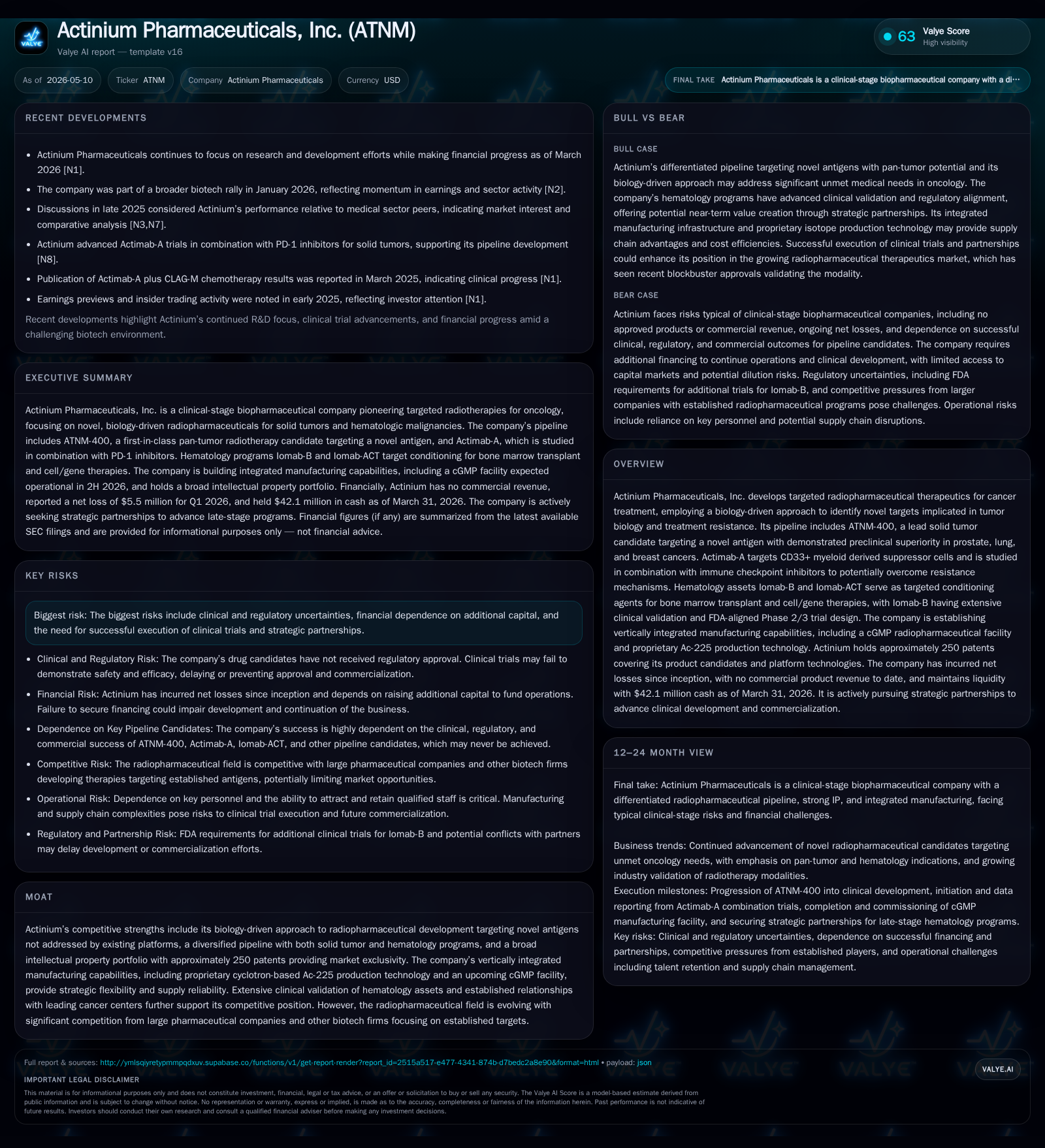
Actinium Pharmaceuticals remains a clinical-stage biopharma company pioneering targeted radiopharmaceuticals with unique biology-driven programs addressing solid tumors and hematologic malignancies. The recent quarter underscores steady progress toward operationalizing its proprietary Ac-225 production and radiopharmaceutical manufacturing facility, positioning the company to scale clinical supply. However, Actinium continues to operate at a net loss without commercial revenues, dependent on successful clinical trial outcomes, regulatory approvals, and additional financing. The broader radiopharmaceutical market has gained significant validation but remains highly competitive and technologically complex. Key growth drivers include first-in-class pipeline candidates targeting novel antigens, vertical integration in supply chain capabilities, and strategic collaborations. Risks hinge on clinical trial success, regulatory hurdles, capital sufficiency, and industry competitive pressures.
Recent Operating Update
Actinium Pharmaceuticals’ Q1 2026 10-Q filing presents an operating picture characterized by continued pre-commercial research and development activity across its lead programs [S2]. The company remains a clinical-stage entity without any revenue derived from product sales as of the reporting date [S2], underscoring its developmental status.
A pivotal near-term operational focus is the completion and activation of a new radiopharmaceutical manufacturing facility designed specifically for producing Ac-225 based drug products under cGMP conditions. This facility aims to address one of the critical bottlenecks in targeted alpha therapy—reliable production scale-up. Management anticipates this site will be operational within the second half of 2026 [S1],[S19].
Though routine filings confirm the absence of commercial launches or sales revenues to date, Actinium reports maintaining a robust cash position with approximately $42 million in cash and equivalents as of March 31, 2026 [F1]. Operating losses persist reflecting investment into R&D and infrastructure expansion.
Business Model
Actinium operates a dual-pronged development model focused squarely on targeted radiopharmaceutical therapeutics for oncology indications, divided mainly between two strategic areas: solid tumors and hematologic malignancies [S1].
The revenue mechanics anticipate future commercialization from proprietary radioconjugate drugs where hospital systems or specialty clinics would procure these therapies for administration to patients diagnosed with relevant cancers. Currently there are no commercial revenues as all efforts are directed toward advancing clinical trials towards regulatory approval.
Primary product candidates include:
ATNM-400: A first-in-class agent targeting a novel non-PSMA antigen implicated in prostate cancer as well as lung and breast cancers. This solid tumor candidate leverages biological insights aimed at tumor biology determinants distinct from competitors’ typical targets [S1].
Actimab-A: Uses CD33 targeting to bind myeloid-derived suppressor cells (MDSCs), notable for their role in immune evasion. It is studied alone or combined with immune checkpoint inhibitors to overcome clinical resistance mechanisms among solid tumors as well as blood cancers (AML/MDS) [S1],[N1].
Iomab-B & Iomab-ACT: Targeted conditioning agents facilitating bone marrow transplants and cell/gene therapies through selective ablation of CD45-expressing cells. These assets have extensive prior clinical validation supporting Phase 2/3 readiness [S1],[S19].
The end-to-end business model encompasses proprietary discovery guided by biology-driven target identification coupled with internal and external manufacturing partnerships. Vertical integration extends from cyclotron-based isotope production through final drug product formulation aimed at securing cost-effective supply chains capable of handling complex alpha emitters such as Ac-225 [S1],[S19].
Margins will ultimately depend on supply efficiencies especially around the costly isotope procurement and manufacturing process complexity intrinsic to radiopharmaceuticals.
Industry Structure & Competitive Position
The radiopharmaceutical therapeutics field has matured significantly but remains highly specialized and technically demanding with limited commercialized treatments approved globally [S1],[S18]. Major pharmaceutical companies have entered primarily by acquiring startups or radiotherapy platforms targeting well-characterized antigens such as PSMA (e.g., Novartis' Pluvicto®), somatostatin receptors (Lutathera®), or fibroblast activation proteins.
Despite this activity, much of the current industry pipeline clusters around these conventional targets leaving an opportunity gap for novel biology-first approaches like those pursued by Actinium [S18].
Competitors include established large-cap pharmas leveraging deep pockets for late-stage development, regulatory expertise, global distribution networks, and capabilities in manufacturing scale-up [S4]. Biotech peers focus largely on incremental advancements rather than first-in-class target innovation.
Actinium’s defensive moat rests on:
- Its unique focus on novel antigenic targets implicated directly in tumor biology pathways unaddressed by existing agents,
- Extensive IP protection with roughly 250 patents safeguarding technology platforms and product candidates,
- Vertical integration spanning isotope production to drug product enabling greater control over supply reliability,
- Established relationships with major cancer centers through prior clinical trials enhancing future commercialization opportunities [S18],[S4].
However, risks loom from rapid technological shifts within alpha emitter chemistry obligations as well as market entry challenges against better-capitalized competitors.
Growth Drivers
Novel First-in-Class Pipeline Programs
Actinium’s core growth proposition hinges on ATNM-400’s potential differentiation beyond PSMA-targeted therapies which dominate prostate cancer radiotherapy markets. By addressing patients whose tumors do not express PSMA or who have progressed post-Pluvicto®, ATNM-400 could expand patient populations benefiting from targeted radiation treatment [S1].
Similarly, Actimab-A opens combination treatment avenues intended to disrupt immunosuppressive MDSCs that blunt checkpoint inhibitor efficacy—a growing segment within immuno-oncology [S1],[N1].
The hematology franchise offers potentially more immediate paths through advanced clinical trial readiness stages given prior data packages supporting regulatory interactions for Iomab-B/Iomab-ACT conditioning agents [S19],[S1].
Manufacturing & Supply Chain Capabilities
Completion of the dedicated cGMP Ac-225 manufacturing plant is a critical scaling milestone expected later in 2026 [S19]. Coupled with proprietary cyclotron-based production technology which avoids problematic radioactive contaminants inherent in competing methods, this facility stands to materially improve cost base and supply chain robustness—a notorious bottleneck limiting widespread adoption of alpha emitters in medicine.
Such vertical integration may yield strategic flexibility not commonly available among small biotech peers reliant solely on external suppliers or partnerships.
Regulatory & Strategic Collaborations
Collaborations like the CRADA agreement with the National Cancer Institute provide validation channels accelerating clinical studies particularly for Actimab-A programs while potentially enabling shared costs or access to federal funding opportunities [S9],[N1].
Successful regulatory milestones including IND acceptances or fast track designations would materially de-risk pipeline assets driving valuation uplifts.
Risks & Watchpoints
Multiple risk vectors persist:
- Continued net losses without commercial product revenues underlines dependence on raising additional capital which can cause dilution or financial strain if not timely secured [S2],[F1].
- Clinical trial uncertainty remains high given early-stage status across multiple candidates; failure to demonstrate safety/efficacy or negative trial readouts could derail assets entirely [S20],[S12].
- Regulatory unpredictability includes possible delays from FDA or international authorities exacerbated by potential government shutdowns impacting agency operations documented late 2025 into early 2026 [S16],[S12].
- Dependence on single-source third-party manufacturers during early stages introduces supply risks; despite ongoing efforts to establish alternatives these remain vulnerabilities pending maturation of own manufacturing lines [S23],[S21].
- Competitive intensity from big pharma entrants armed with established pipelines might limit market penetration opportunities even if regulatory approval is achieved [S4],[S18].
- Healthcare legislative reforms aimed at drug pricing pressure could adversely affect future reimbursement landscapes diminishing commercial prospects [S12],[S6].
- Litigation risks exist related to securities class actions reflecting market volatility perceptions tied to developmental uncertainties reported since prior years [S17].
What To Watch Next
Key upcoming milestones include:
- Commissioning and regulatory qualification of the new cGMP Ac-225 production/manufacturing facility mid-to-late 2026.
- Initiation or progression through pivotal phase trials for ATNM-400 targeting metastatic castration-resistant prostate cancer cohorts.
- Expansion of Actimab-A combination trials exploring immune checkpoint inhibitor synergies recruited through ongoing collaboration with NCI.
- Regulatory feedback cycles on BLA submissions expected for hematology conditioning agents Iomab-B/Iomab-ACT.
- Capital raise execution or partnership announcements providing funding runway extension beyond current cash reserves.
- Updates regarding resolution or progress in ongoing litigation which may impact investor sentiment.
Additionally monitoring competitive landscape developments such as licensing deals or acquisitions involving similar asset classes provides insight into relative positioning dynamics.
Financial Profile Snapshot (Q1 2026)
Latest financial snapshot
| Metric | Value | Period |
|---|---|---|
| Cash & equivalents | $42mm | |
| 2026-03-31 | ||
| Current assets | $43mm | |
| 2026-03-31 | ||
| Current liabilities | $7mm | |
| 2026-03-31 | ||
| Current ratio | 5.89x | |
| 2026-03-31 |
Source: SEC companyfacts cache [F1].
As per the latest SEC data disclosed on May 8th, cash liquidity remains adequate with low debt levels last reported at $900K (2019 vintage) suggesting minimal leverage constraints allowing operational continuity in upcoming quarters absent unforeseen events [F1],[S2]. Its strategic investments into unique biological targets diversify beyond crowded known antigen spaces dominated by larger incumbents offering potential differentiation if technical hurdles can be overcome.
Execution competency over forthcoming quarters centered around manufacture scale-up milestones paired with disciplined advancement through complex regulatory pathways represent essential inflection points determining transformational commercial viability prospects. While substantial inherent risks tied to clinical failure probability, capital dependency, intense competition, and regulatory flux endure unabated — Actinium’s integrated vertical platform coupled with distinct scientific targets establishes credible long-term value creation avenues subject to navigating near-term execution challenges prudently.
This analysis is based exclusively on information available up to May 8th, 2026 filings without speculation beyond provided data. It is intended solely as an informed industry review rather than investment advice or recommendation.
Disclaimer: This is research-only, informational analysis and not investment advice. It may include AI-generated interpretation and general industry context. Always verify important details using primary sources.

Comments