
Pacific Biosciences Advances HiFi Sequencing Amid Profitability and Debt Challenges
Pacific Biosciences reported Q1 2026 results reflecting ongoing investments in HiFi sequencing technology while facing near-term profitability pressures and significant debt.
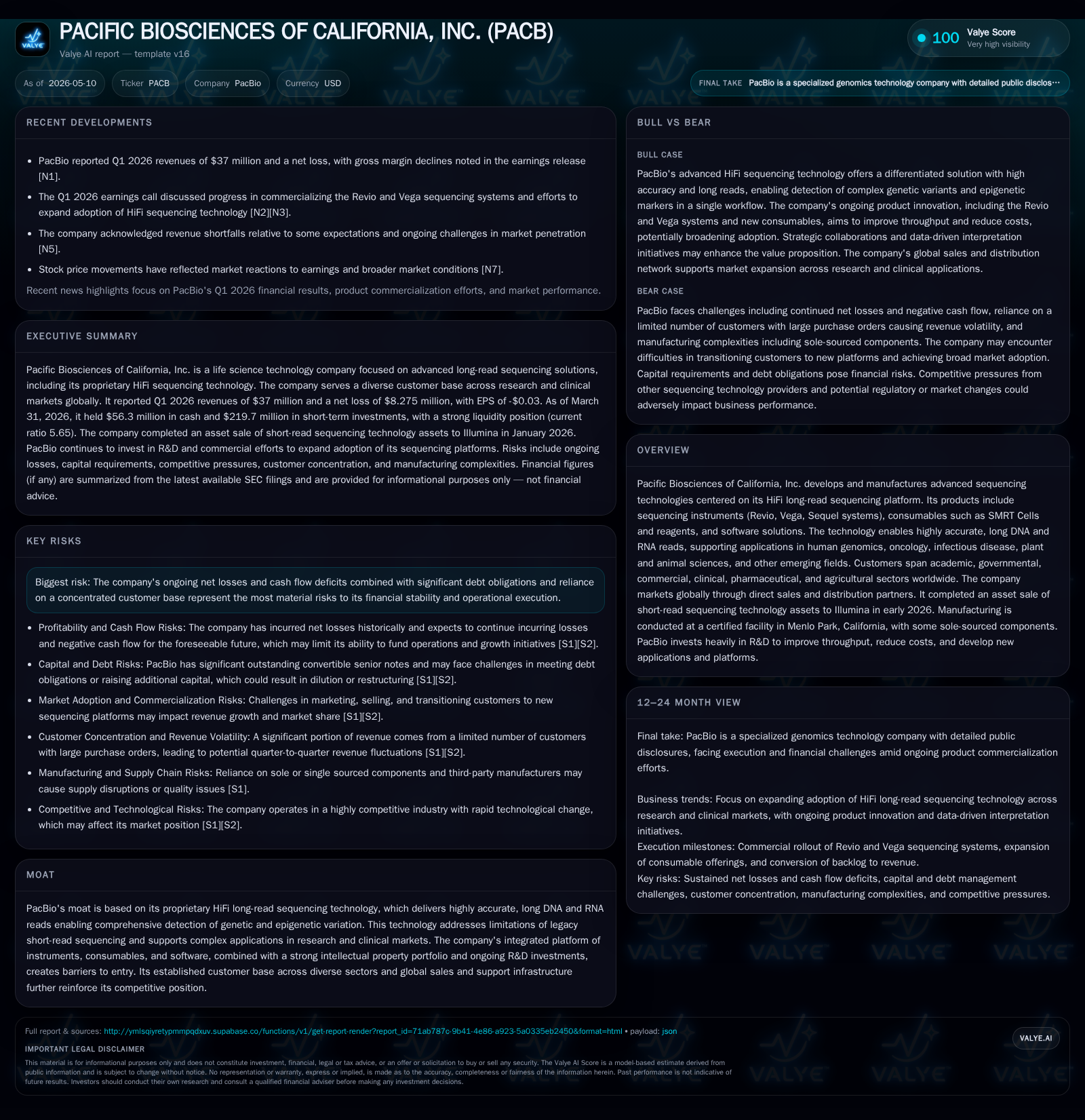
In its latest quarterly filing, Pacific Biosciences (PacBio) continues to focus on its HiFi long-read sequencing platform, supporting genomic research across diverse applications globally. The company’s asset sale of short-read technologies in early 2026 marks a strategic shift to concentrate on its high-precision offering. Despite solid technological differentiation and an expanding customer base, PacBio’s financial profile is constrained by persistent net losses, negative operating cash flow, and considerable convertible debt. Market adoption remains a multiyear process driven by the platform's accuracy advantages versus legacy short-read methods, with execution risks linked to manufacturing complexity and customer concentration.
Recent Operating Update
Pacific Biosciences reported its Q1 fiscal 2026 results in a filing dated May 8, 2026 [S2][S3]. The quarter's revenues reflected continued sales of HiFi long-read sequencing platforms and consumables but came in below certain market expectations [N1][N4]. The company confirmed the successful completion of the strategic divestiture of its short-read DNA sequencing technology assets to Illumina Cambridge Limited earlier in 2026 for $50 million cash consideration [S1][S5]. After transaction adjustments including milestone payments related to prior acquisitions, PacBio netted approximately $48.1 million from this sale.
Operating expenses remain elevated as PacBio invests in market expansion for its HiFi-based instruments—Revio system notably improves throughput with multiple SMRT Cells per run—and software solutions that complement the platform with advanced data analytics [S1][S10]. This investment posture contributed to persistent operating losses reported through year-end 2025 and continuing into Q1 2026. Manufacturing operations are centralized at a certified Menlo Park facility with some critical components sourced solely from specific suppliers, exposing the production chain to risk [S1][S4].
The company highlighted ongoing reprioritization efforts aimed at expense reduction targeting better alignment with strategic goals under uncertain academic funding conditions and evolving trade tariff environments [S14][S15]. PacBio's first quarter disclosures emphasize the challenge of balancing innovation-led growth with near-term profitability constraints.
Business Model
PacBio generates revenue primarily through sales of sequencing instruments equipped with Single Molecule Real-Time (SMRT) chemistry integrated onto proprietary SMRT Cells that deliver its hallmark highly accurate long DNA/RNA reads—HiFi sequencing [S1][S10]. The core product family includes:
- Revio System: High-throughput instrument capable of running up to four SMRT Cells simultaneously.
- Vega System: Mid-throughput sequencer optimized for single SMRT Cell runs.
- Sequel Systems: Earlier-generation platforms still in use.
Beyond instrument sales, recurring revenue derives from consumables such as SMRT Cells and reagents essential for each sequencing run alongside software offerings that provide computational translation of fluorescent signals into genomic data. Customers typically fund instrument purchases via large one-time orders but rely on ongoing consumable procurement tied closely to usage frequency [S10][S9]. This fosters a mixed revenue stream where volume growth of sequencing projects directly impacts consumable demand and margin profiles.
PacBio serves a diversified customer mix spanning academic institutions, government research labs, clinical centers incorporating genomics into diagnostics, pharmaceutical companies developing targeted therapies, agricultural biotechnology firms, and commercial contract research organizations (CROs) offering sequencing as a service [S10][S9]. However, topline results depend markedly on a concentrated group of larger customers whose purchasing patterns cause quarter-to-quarter revenue variability.
The company's value proposition hinges on delivering comprehensive genome sequence accuracy unattainable by traditional short-read technologies—addressing complex genetic variation including structural variants and epigenetic modifications important for advanced research and clinical decision-making [S1]. This vertical integration across instruments-consumables-software creates switching costs that reinforce customer retention once deployed.
Industry Structure and Competitive Position
PacBio operates within the highly competitive life sciences genomics sector dominated historically by short-read sequencing providers such as Illumina—also now a former business partner following PacBio's divestiture of certain short-read assets. The firm distinguishes itself through its proprietary HiFi long-read approach that overcomes many intrinsic limitations of legacy short reads in detecting structural variants, haplotype phasing, and full-length transcript analysis [S1].
The industry is characterized by rapid technological evolution combined with lengthy adoption cycles among cautious academic and clinical end-users. Complex capital equipment purchases require validation over multiple years before broad acceptance. PacBio faces competition not only from established players but also emerging startups seeking innovations combining read length with higher throughput or lower cost per genome sequenced.
PacBio’s moat derives from sustained R&D investment protecting its intellectual property portfolio around SMRT technology chemistry and instrument design alongside its software ecosystem enabling optimized data interpretation downstream. Nevertheless, pricing pressure exists due to competition and volume discounting negotiated by large centralized customers leading to margin compression risks. Supply chain specialization imposes additional operational challenges not easily replicated by competitors but constraining scaling pace.
Growth Drivers
Expanding Applications Scope: Increasing penetration of HiFi technology into oncology research, infectious disease monitoring, human germline studies as well as plant/animal sciences offers multi-sectoral demand expansion potential [S1].
Large-Scale Genomic Projects: Participation in consortiums like the HiFi Solves Global Consortium aggregates deep datasets accelerating adoption by providing reference benchmarks critical for academic validation [S10].
Product Innovations: Launching enhanced instruments like Revio which boosts throughput addresses key barriers—cost per genome and operational efficiency—that can unlock broader market segments beyond early adopters [S1].
Geographic Expansion: Broadening distribution networks especially outside North America through partnerships can tap emerging research hubs increasing user base diversity [S10].
Software Integration: Enhancing bioinformatics capabilities lowers barriers for complex variant interpretation facilitating clinical translational use cases where regulatory approval becomes relevant later.
Risks / Watchpoints / Growth Constraints
Profitability Execution: Despite revenue growth efforts underlying economics remain stressed by continued operating losses requiring further expense discipline without stifling growth investments [S2][S15].
Leverage Profile: Outstanding convertible notes totaling approximately $641 million principal plus associated obligations introduce refinancing/refund risk exacerbated by lack of positive operational cash flows [F1][S19][S20].
Customer Concentration & Purchase Variability: Dependence on large bulk buyers leads to episodic revenue swings complicating forecasting and resource planning; loss or delay from top customers could materially impact outcomes [S9][S17].
Manufacturing & Supply Chain Reliance: Sole sourcing for key components raises operational vulnerability to disruptions or cost inflation impacting production continuity [S4][S21].
Regulatory Uncertainty: Potential future FDA regulation if products are labeled for diagnostic uses could increase commercialization costs and timelines introducing new compliance burdens [S21][S22].
Competition & Technological Evolution: Rapid innovation cycles demand ongoing R&D investment; failure to keep pace could erode technological edge leading to market share erosion amidst intensifying competitive pressures [S11].
What to Watch Next
Key upcoming execution points include:
- Quarterly revenue trends reflecting larger customer purchasing patterns and success in expanding recurring consumable sales.
- Progress on product launches or upgrades particularly enhancing throughput or ease-of-use driving broader adoption curves.
- Updates on legal proceedings related to intellectual property disputes which may affect market positioning or licensing costs.
- Cost management outcomes relating to planned expense reductions implemented since late 2024 aiming at profit margin recovery.
- Refinancing activities addressing near-to-medium term convertible note maturities impacting liquidity trajectory.
- Expansion of collaborations or consortium membership that validate platform utility within key research sectors.
- Regulatory developments concerning diagnostic labeling or other medical device classifications impacting market access.
Financial Profile Snapshot (as of Q1 2026 End)
Latest financial snapshot
| Metric | Value | Period |
|---|---|---|
| Cash & equivalents | $56mm | |
| 2026-03-31 | ||
| Current assets | $370mm | |
| 2026-03-31 | ||
| Current liabilities | $65mm | |
| 2026-03-31 | ||
| Current ratio | 5.65x | |
| 2026-03-31 |
Source: SEC companyfacts cache [F1].
Total debt figure is last reported value; no more recent explicit update available.
Operating losses continue to weigh heavily on net income as PacBio invests heavily toward driving adoption of its differentiated genomic platform. Expense management initiatives initiated since late 2024 aim at aligning the cost structure closer with expected revenues; however balancing innovation investments with financial constraints remains challenging. The sizeable convertible notes outstanding pose refinancing risks requiring monitoring given current negative cash flows.[S15][F1]
This analysis is based exclusively on publicly filed documents up to May 10, 2026, including SEC filings and recent market commentary. It does not constitute investment advice or an endorsement of Pacific Biosciences' securities. Readers should review original documents for detailed disclosures underlying this summary.
Disclaimer: This is research-only, informational analysis and not investment advice. It may include AI-generated interpretation and general industry context. Always verify important details using primary sources.

Comments