
AMC Global Media Advances Streaming and Content Production Amid Financing Updates
AMC Global Media rebrands and refinances its capital structure while focusing on diversified media assets and streaming growth.
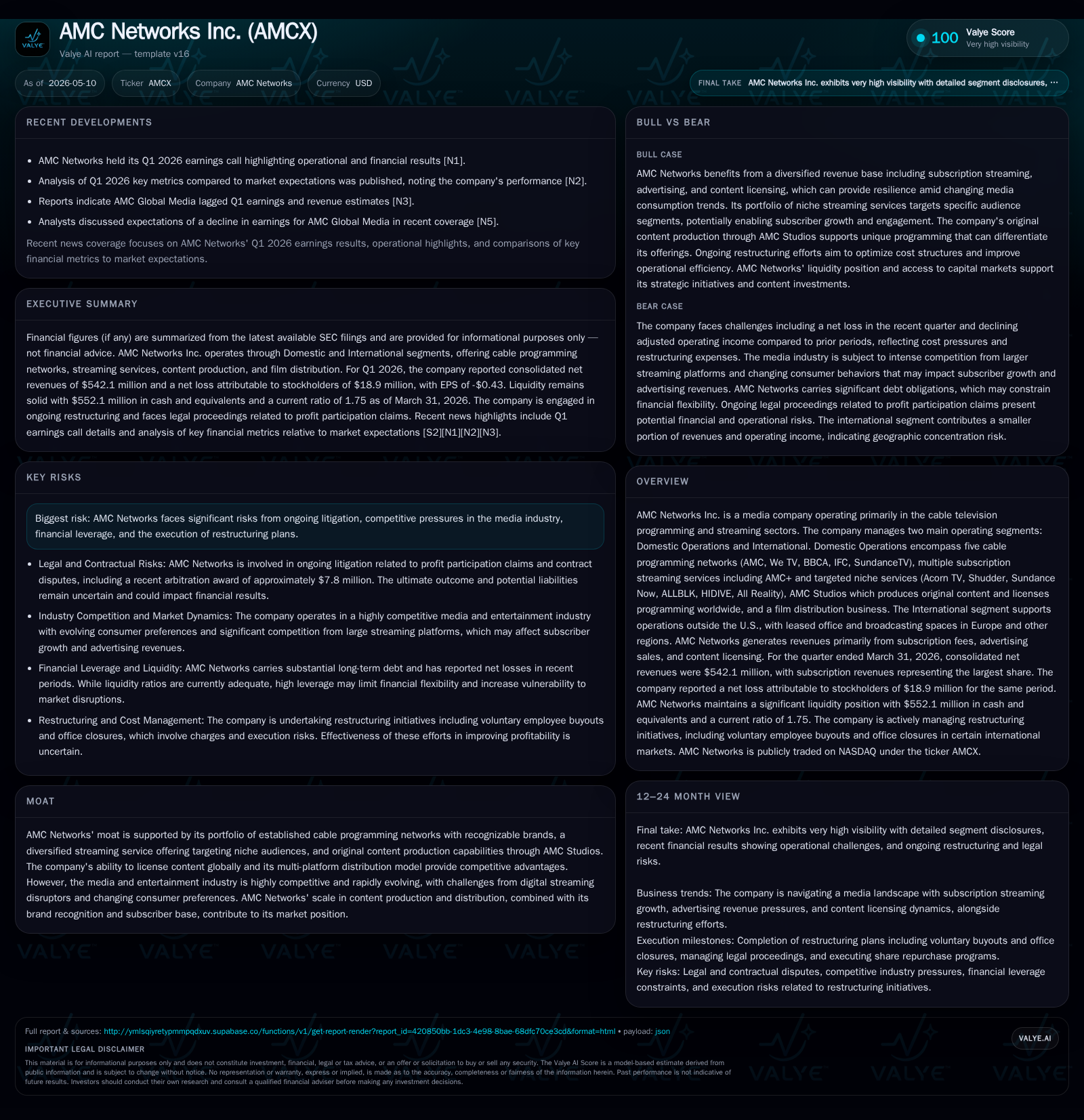
In Q1 2026, AMC Networks transitioned to AMC Global Media Inc., signaling a strategic evolution embracing a broader media portfolio beyond traditional cable. The company granted significant equity incentives to employees and repaid its Term Loan A Facility early, reflecting active capital management linked to amended debt covenants permitting equity buybacks. AMC’s business model blends cable programming, a growing collection of niche streaming services, original content production via AMC Studios, and global licensing, positioning it uniquely amid digital transformation pressures in media. Key risks remain litigation from profit participation claims, financial leverage levels, and competitive dynamics in both the subscription and advertising-driven segments.
Latest Quarterly Operating Update: Transition and Tactical Moves
In the first quarter of 2026, AMC Networks officially became AMC Global Media Inc., reflecting a deliberate shift toward an expanded media identity that encompasses both legacy cable programming assets and diversified streaming platforms [S2]. This rebranding came alongside issuance of nearly 3.4 million restricted stock units (RSUs) to executives and employees under the Amended and Restated 2016 Employee Stock Plan. These grants vest over three years, highlighting management's focus on employee retention in a dynamic industry environment [S2].
Notably, AMC Global Media announced repayment of the remaining $80 million principal balance on its Term Loan A Facility by May 12, 2026, effectively terminating this tranche of credit [S4]. Concurrently, the company amended covenants around its 10.50% Senior Secured Notes due 2032 to permit up to $50 million in restricted payments specifically earmarked for equity buybacks or related transactions. This maneuver signals an increased emphasis on capital allocation flexibility including share repurchases as part of broader strategic financial management [S4][S11].
This combination of equity compensation programs alongside proactive debt repayment and covenant amendments paints an operational picture of a company actively repositioning its capital structure to support streaming investment while balancing legacy cable exposure.
Evolution of Business Model and Product Offering Quality
AMC Global Media operates through two primary segments: Domestic Operations and International [S2]. The Domestic Operations unit houses five core cable programming networks — including AMC, We TV, BBCA (BBC America), IFC, SundanceTV — which provide steady advertising revenues backed by established brand identities [S1]. Complementing these is an increasingly critical cohort of subscription streaming services led by AMC+ plus niche channels such as Acorn TV (British content), Shudder (horror genre), Sundance Now (independent films/documentaries), ALLBLK (African American-focused content), HIDIVE (anime), and All Reality (unscripted).
Integral to this ecosystem is AMC Studios’ original content production capability. The studio produces proprietary scripted series that not only feed AMC+ but also generate licensing income internationally. This vertical integration enhances competitiveness by providing exclusive programming that differentiates the portfolio in a crowded marketplace [S1].
Internationally, AMC maintains leased offices and broadcast infrastructure across Europe (Spain, Hungary, UK) supporting global distribution efforts [S1]. Licensing revenues further diversify income streams beyond U.S.-centric subscription revenues.
Overall revenue is generated predominantly through three mechanisms: subscriber fees on streaming platforms where average revenue per user (ARPU) can be enhanced via bundling; advertising sales driven by linear cable network audiences; and licensing fees derived from original productions distributed globally. This multi-channel monetization allows adaptation to evolving consumer preferences favoring OTT consumption without abandoning legacy ad-supported broadcast revenue.
Competitive Industry Dynamics and Positioning
The media landscape has undergone rapid disruption with over-the-top (OTT) streaming challenging traditional cable models. While pure-play streamers typically compete on scale mandates and global reach (e.g., Netflix, Disney+), AMC leverages its hybrid cable-to-OTT portfolio allowing cross-platform market penetration [S1]. Its niche streaming brands cater to segmented audiences passionate about genre-specific content, which decreases direct head-to-head competition with mass-market streamers but also caps addressable scale.
Brand moat resides in curated channel lineups like AMC’s flagship drama-oriented channels combined with genre specialists such as Shudder’s horror niche. Coupled with owned original programming through AMC Studios—with licensing rights controlled—the company wields meaningful control over key intellectual property assets fostering switching costs for subscribers.
However, pricing power remains nuanced: ad revenues tied to linear networks face downward pressure from audience fragmentation; meanwhile subscription services require continual investment in fresh exclusive content to sustain growth against aggressive deep-pocket competitors investing billions annually in originals. Supply chain constraints include rising content acquisition costs replacing traditional syndication models plus lease costs for broadcasting infrastructure and international office footprints adding fixed overheads [S1][S24].
Key Growth Drivers: Streaming Services and Original Content Production
Driving growth are:
- Subscriber base expansion for flagship streaming service AMC+, projected to benefit from continuous launches of popular original scripted series produced in-house.
- Rollout momentum behind ancillary niche SVOD offerings like ALLBLK targeting African-American viewers or HIDIVE focusing on anime enthusiasts offers specialized engagement metrics supporting ARPU gains.
- International segment ramping distribution footprint using existing leased studios/offices in Europe supports new market penetration opportunities which could boost licensing income via localized content agreements.
- Enhanced licensing deals for original productions globally add high-margin revenue streams distinct from volatile domestic subscriber dynamics.
Measurable KPIs mentioned in associated earnings commentaries include net subscriber additions reported each quarter along with churn rates impacting overall platform scale [N1][N2]. Bundle packaging potential within domestic operations enhances ARPU while cross-marketing among niche streamers creates incremental subscriber value.
Challenges and Risks: Litigation, Leverage, and Market Competition
Legacy risk arises primarily from ongoing legal proceedings related to profit participations owed under contracts associated with "The Walking Dead" franchise; unsettled claims result in residuals accrual volatility impairing precise forecasting of operating expenses [S1][S29].
Financial leverage is notable: as of March 31, 2026 total debt approximated $1.83 billion versus cash reserves near $552 million yielding net debt about $1.28 billion — raising concerns about interest burden sustainability despite recent refinancing improvements like covenant easing allowing up to $50 million in buybacks [F1][S4]. This leverage constrains operational agility especially if macroeconomic factors tighten capital markets access.
Competition intensifies not only among premium scripted providers but also across free ad-supported streaming TV (FAST) platforms competing for attention away from traditional pay-TV environments where AMC’s networks historically held strength — a structural shift requiring ongoing investments in content quality plus marketing spend [S1].
Restructuring initiatives tied to international office downsizing illustrate attempts at cost base rationalization yet execution risk remains especially given employee-related severance charges recorded recently [$2.6 million severance plus additional expected] indicating transition costs impacting short-term profitability [S21][S22].
Upcoming Milestones and Operational Indicators to Watch
Investors should focus keenly on next quarterly earnings references for:
- Updates on subscriber metrics across flagship OTT platforms including net adds or churn trends signaling underlying demand shifts.
- Progress reports on share repurchase programs enabled by amended notes covenants revealing capital return priorities versus balance sheet repair needs [S21].
- Announcements regarding new original series premieres tied to subsequent quarters could influence licensing income visibility.
- Further deleveraging moves or refinancing deals potentially affecting interest coverage ratios falling under contractual requirements beyond current compliance demonstrated at Q1 close [S4][F1].
- Execution status updates on restructuring actions within international segments informing margin improvement trajectory.
Current Financial Profile and Capital Structure Overview
Latest financial snapshot
| Metric | Value | Period |
|---|---|---|
| Cash & equivalents | $552mm | |
| 2026-03-31 | ||
| Total debt | $1829mm | |
| 2026-03-31 | ||
| Net debt | $1277mm | |
| 2026-03-31 | ||
| Current assets | $1341mm | |
| 2026-03-31 | ||
| Current liabilities | $764mm | |
| 2026-03-31 | ||
| Current ratio | 1.75x | |
| 2026-03-31 |
Source: SEC companyfacts cache [F1].
As of March 31, 2026 balance sheet highlights include:
| Metric | Amount (USD millions) |
|---|---|
| Cash & Cash Equivalents | 552.1 |
| Total Debt Outstanding | 1829.3 |
| Net Debt | 1277.1 |
| Current Assets | 1340.6 |
| Current Liabilities | 764.0 |
| Current Ratio | 1.75 |
The company was compliant with all required financial covenants governing maximum net leverage ratio limits set at 5.75x through March 2026 before dropping to a stricter 5.50x threshold subsequently; Interest Coverage Ratios are maintained above minimum ratios currently set at 1.5x through September 2028 with planned step-up after that period [F1][S4]. The termination of Revolving Credit Facility scheduled shortly after quarter end further simplifies credit exposure potentially lowering ongoing commitment fees [S4].
Disclaimer: This report is an independent industry analysis based on recent publicly available SEC filings and news sources as cited; it does not constitute investment advice or recommendations.
Disclaimer: This is research-only, informational analysis and not investment advice. It may include AI-generated interpretation and general industry context. Always verify important details using primary sources.

Comments