
Whitestone REIT Advances Merger with Ares Amid Stable Portfolio Income
The company reports Q1 2026 results and merger progress, underscoring core business resilience and pending integration risks.
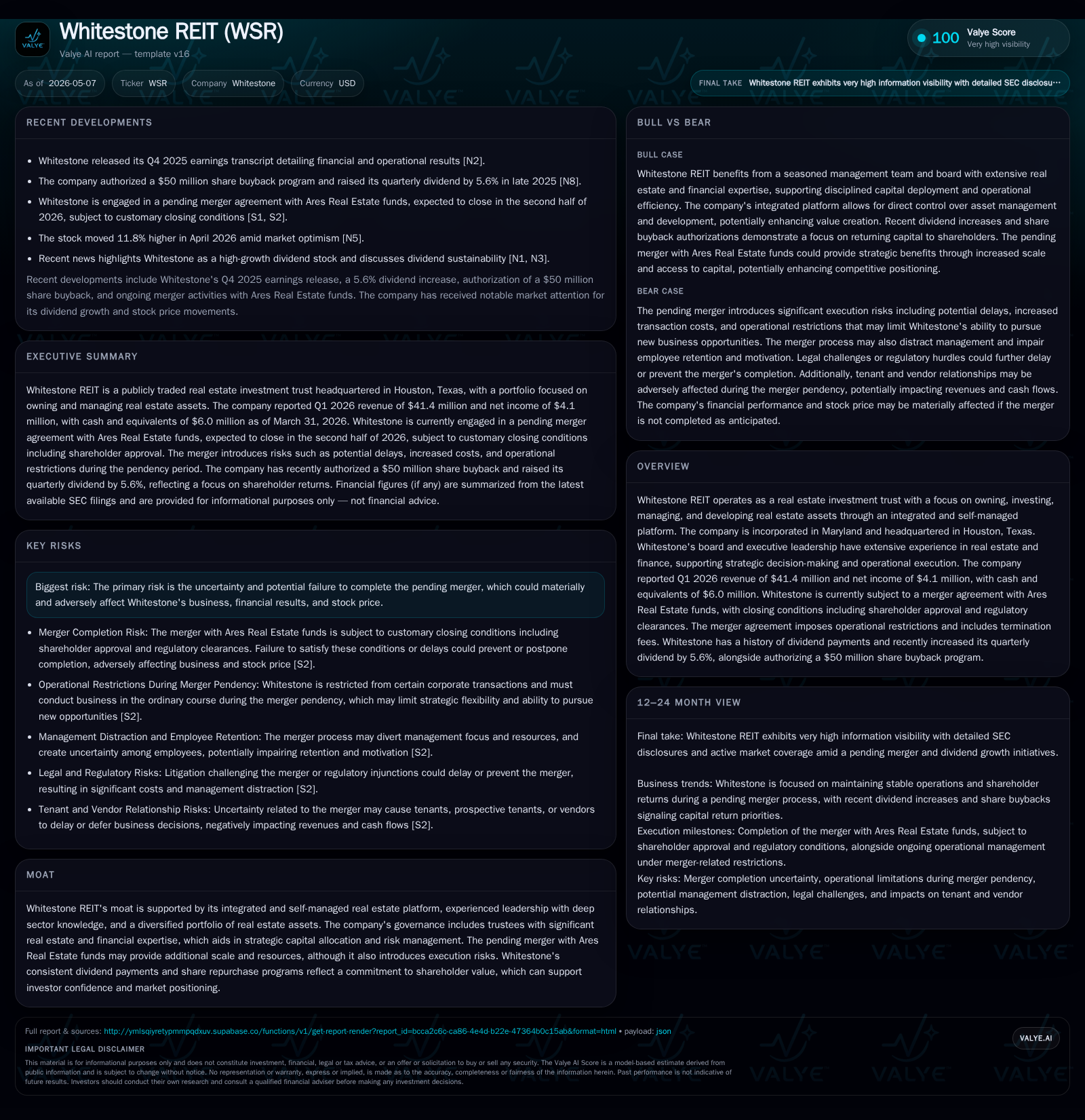
Whitestone REIT's latest quarterly filing reveals stable operating performance with $41.4 million revenue and $4.1 million net income, supported by its integrated self-managed real estate platform. The company is progressing toward a merger with Ares Real Estate funds, subject to shareholder approval and regulatory clearance, which introduces notable execution risks. Whitestone's diversified portfolio, experienced leadership, and consistent dividend policy position it well for ongoing operational stability, although merger completion uncertainties remain a key risk. Financial leverage stands at approximately $660 million in total debt balanced against $6 million cash as of March 31, 2026.
Recent Operating Update
Whitestone REIT filed its latest quarterly report (10-Q dated May 6, 2026) showing Q1 revenue of $41.4 million and net income of approximately $4.1 million [S2][F1]. These results affirm the core earnings power of its diversified property portfolio primarily concentrated in Texas markets. Operational cash flow generation remains consistent during prevailing macroeconomic conditions impacting the real estate sector.
A material development is the announcement on April 9, 2026, of a binding merger agreement with investment vehicles affiliated with Ares Real Estate Management ("Ares Funds") [S3]. The merger consideration is set at $19 per common share in cash. Completion is targeted for the second half of 2026 but depends on customary closing conditions including shareholder approval and regulatory clearances [S2][S3]. The deal imposes operational limitations such as no-shop provisions restricting Whitestone from soliciting alternative bids and includes termination fees payable to Ares if certain termination rights are exercised ($36 million fee) [S2].
Management confirms that despite these contractual constraints the company continues to execute its business plan while preparing for integration post-merger. There have been no material changes to other risk factors since the prior annual filing except those related to this transaction [S2][S29].
Business Model
Whitestone REIT operates as an internally managed real estate investment trust focused predominantly on the acquisition, ownership, management, development, and disposition of multifamily residential and select commercial properties. It emphasizes an integrated platform anchored in self-management rather than outsourcing property operations or asset administration [S1]. This model provides tighter alignment between asset performance incentives and operational execution.
Revenue principally derives from rental income paid by tenants under leases across its portfolio complemented occasionally by ancillary service revenues within managed communities. Rent pricing dynamics hinge on localized market fundamentals such as occupancy rates, supply-demand balances, lease renewal trends, rent escalations triggered by inflation or market strength, and tenant credit quality.
Margins benefit from scale in property management efficiencies achieved through this vertically integrated approach supported by technology-enabled leasing and maintenance operations. Cash flow conversion is stable given long-term lease structures underpinning minimum revenue thresholds with periodic rent resets.
Whitestone’s management team leverages seasoned experience to identify accretive acquisitions in growth markets like Houston while pursuing development projects that offer attractive risk-adjusted returns through modernized design appeal or infill locations advantageous for demographic demand drivers.
Industry Structure and Competitive Position
Operating mainly in Texas metro areas such as Houston situates Whitestone in competitive but growing multifamily real estate markets characterized by substantial demand tailwinds driven by population migration trends and economic diversification beyond energy into technology and healthcare sectors.
The REIT landscape spans diverse competitors ranging from large institutional landlords with sizeable portfolios offering economies of scale to smaller regional players focused on niche submarkets. Whitestone’s integrated self-management differentiates it by allowing more nimble responsiveness to tenant needs relative to externally managed peers who face split incentives.
Delay or termination triggers significant costs including potential payment of a hefty termination fee ($36M) [S2].
- Regulatory Approval: Required regulatory clearances pose obstacles particularly given antitrust considerations or jurisdictional stipulations.
- Leverage Exposure: As of March 31, 2026, Whitestone held cash and equivalents totaling approximately $6.0 million paired against total debt near $660 million resulting in a net debt figure close to $654 million [F1].
- Tenant Concentration & Leasing Volatility: Localized economic shifts can affect occupancy or enhance tenant default risks impacting collections.
- Operational Disruption: Integration-related uncertainties could temporarily impair property-level performance post-merger or distract management focus from core operations.
What To Watch Next
Key milestones ahead include:
- Obtaining requisite shareholder approvals at special meeting anticipated later in H2 2026.
- Receipt of required regulatory clearances which will dictate transaction timing.
- Subsequent quarterly reports that will disclose updated performance metrics inclusive/exclusive of merger impacts.
- Monitoring changes in dividend policy post-close given capital structure adjustments.
- Progress updates on lease renewals or new property acquisitions indicating organic growth momentum during transition.
- Market reaction reflected through share price volatility around deal-related announcements [S8][N5][N8].
Financial Profile (Latest)
Latest financial snapshot
| Metric | Value | Period |
|---|---|---|
| Cash & equivalents | $6mm | |
| 2026-03-31 | ||
| Total debt | $660mm | |
| 2026-03-31 | ||
| Net debt | $654mm | |
| 2026-03-31 |
Source: SEC companyfacts cache [F1].
As of March 31, 2026, Whitestone held cash and equivalents totaling approximately $6.0 million paired against total debt near $660 million resulting in a net debt figure close to $654 million [F1].
Q1 2026 showed revenue generation around $41.4 million derived primarily from property rentals consistent with prior periods reflecting ongoing portfolio occupancy strength [F1]. Net income reported was positive at about $4.1 million demonstrating profitability retention despite expense pressures typical during transitional phases ahead of merger completion [F1].
Dividend distributions were recently increased by roughly 5.6% effective Q1 2026 reflecting balance-sheet confidence but remain subject to board discretion conditional upon merger outcome and capital needs going forward [S21].
This analysis synthesizes publicly available information including SEC filings up to May 7, 2026. It aims to provide a detailed operating and strategic overview without expressing investment recommendations or price forecasts.
Disclaimer: This is research-only, informational analysis and not investment advice. It may include AI-generated interpretation and general industry context. Always verify important details using primary sources.

Comments